
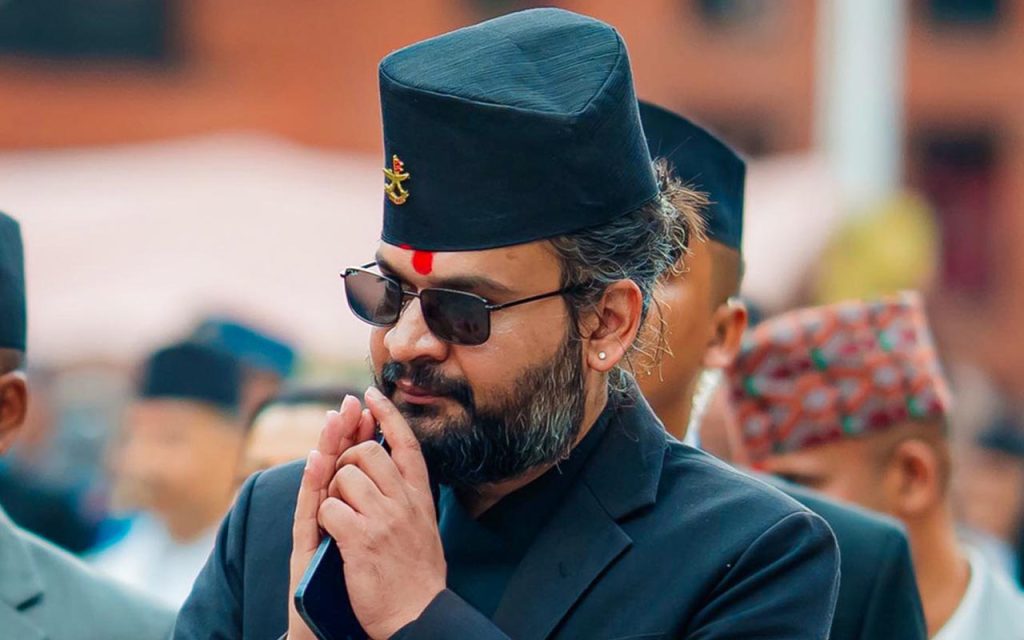

By P.K.Balachandran/Daily News
Colombo, April 28 – In one of the most striking reforms targeting his country’s education system, Nepal’s Prime Minister Balendra Shah has ordered the complete removal of party-affiliated student and professional unions from university campuses across the country. The directive, issued during a high-level meeting on April 20, is part of the government’s 100-point “Good Governance” agenda.
Universities and colleges were given 60 days to dismantle existing political structures and 90 days to establish non-partisan student councils. Education Minister Sasmit Pokharel has instructed vice-chancellors to remove students’ union offices, banners, flags and wall graffiti. The Ministry of Home Affairs has been tasked with providing security support if resistance emerges during implementation.
Balendra Shah (better known as Balen Shah) said that educational institutions are meant for learning, not political mobilisation. He told university students that those interested in politics must pursue it outside the academic space or outside the campuses.
Paradoxically, the 35-year-old Balen Shah had himself come to power on a Gen Z anti-establishment wave against the K.P. Oli government in September 2025. He became Prime Minister on March 27 after winning the parliamentary elections decisively in the same way.
Balen Shah should be aware of the fact that all political movements in Nepal since 1950 had been led by students. As expected, student organisations linked to major political parties termed Balen’s directive on campus politics as “undemocratic”. Protesters took to the streets in Kathmandu and other towns.
The people had already been incensed by the new Customs duty on Indian goods worth over Rs. 100. This hurt people living along the India-Nepal border who go across to India to buy many of their daily necessities in small quantities.
Balen Shah seems to have forgotten that he himself is the son of this region called Mades on the Indo-Nepal border. Therefore, within a month of taking over, Balen Shah has alienated two of his natural constituencies, the students and the people of Mades.
Public anger is rapidly intensifying in Nepal, posing an early challenge to the newly formed administration led by Balen Shah. Less than a month after assuming national leadership with a commanding mandate, Shah is facing widespread protests that have spread from local demonstrations to the heart of governance at Singha Durbar. What began as isolated gatherings has now transformed into a broader movement, drawing participation from students, political groups, and everyday citizens across Kathmandu and other major cities.
The protests have since gained significant traction, with thousands of students joining demonstrations nationwide. Visuals of school and college students in uniform, holding placards and raising slogans, have come to define the movement, highlighting its expansion beyond traditional political actors into wider society.
The unrest has been further amplified by allegations against Sudan Gurung, Nepal’s Home Minister. He is facing accusations of accumulating disproportionate assets and engaging in questionable financial activities. Opposition parties and protest groups have pointed to reports suggesting links to controversial investments and business dealings. These claims intensified calls for his resignation, with critics arguing that the government must uphold accountability at the highest levels. Gurung subsequently resigned.
With demonstrations growing in scale and frequency, the Shah administration is under increasing pressure to respond effectively. The convergence of economic concerns, student-led protests, and corruption allegations has created a complex crisis early in its tenure.
As protests continue to unfold, the government’s handling of the situation is likely to shape public perception and determine its ability to maintain trust and stability in the weeks ahead.
Historical Role of Students
All political movements in Nepal since 1950 had been led by students. As expected, student organisations linked to major political parties termed Balen’s directive on campus politics as “undemocratic”. Protesters took to the streets in Kathmandu and other towns.
Nepalese scholar Abhi Subedi observes in a piece in Kathmandu Post that Nepalese rulers have always looked upon the youth, especially the educated youth and college students, as a source of danger.
The autocratic Ranas, who were the Prime Ministers and de facto rulers of the Kingdom of Nepal from the 18 th.Century to 1950, tried to manage the youth by entering into tacit agreements with them. The powerful Chandra Shumsher Rana was forced to lay the foundation stone of Tri-Chandra College in 1918. And after he did that, he remarked – “I have laid the foundation stone of the Rana rulers’ grave!”
In 1934, another Rana, Juddha Shumsher, allowed some youths to publish a literary magazine named “Sharada” to accommodate voices of dissent, though within limits. In more recent times, the tale of student organisations in Nepal began with the “Jayatu Sanskritam” movement in 1947.
Students and youths played a key role in the overthrow of the Ranas and the restoration of Nepal to King Mahendra in 1950.
After 1950, political parties, most prominently the Nepali Congress and the Communist Party of Nepal, capitalised on student power. Students were divided on party and ideological lines. Students were the foot soldiers of the Nepalese political parties. They organized and took part in demonstrations, agitations and clashes with the police. Party leaders settled disputes among student organisations.
Students and young citizens come together by using social media to make their presence felt and mount protests in public spaces. The role of new media technologies as an organising tool has led besieged authorities to ban online platforms, though the imposed restrictions have, instead of containing protests, accelerated them.
Student Power in South Asia
South Asia has recently experienced massive protest movements involving crowds of young people. In July 2022, after an economic collapse in Sri Lanka, a rebellion forced its President Gotabaya Rajapaksa to flee the country. In July 2024, economic and students- led political upheavals ended the long rule of Sheikh Hasina in Bangladesh, and in September this year, violent protests against misrule in Nepal forced Prime Minister Khadga Prasad Oli’s government to resign.
Even though specific incidents triggered these upheavals, they were all due to long-term, shared grievances evolving from stark wealth gaps, rampant nepotism, and unlimited corruption. Above all, youngsters protested against members of powerful dynasties, favouring a wealthy and discredited political elite.
So far, successor governments have managed to keep their countries on an even keel. Sri Lankan President Anura Kumara Dissanayake has not introduced any radical political or economic changes. He has continued the previous government’s economic and foreign policies. The same could be said about Bangladesh, where too there has been no radical change even after elections brought a new regime into being.
But Nepal under Balen Shah seems to be a tad different. Balen Shah is making radical departures from the past. If he continues to do so, would there be an adverse popular reaction? That is yet to be seen.
Shah Has his Supporters
However, not all disapprove of Balen Shah’s steps vis-a-vis students unions. Many see the politicised unions as the primary vehicles for political interference in education, leading to a decline in academic standards. Politicised students had turned campuses into battlegrounds for the mother parties, in which the welfare of students was routinely sacrificed for partisan interests.
Some say that these politicised student unions are no longer needed for youngsters seeking a political career. One argument is that the traditional pipeline that once saw student leaders rise to national prominence has been broken by Balendra Shah’s ascent to the Office of Prime Minister through a diffuse and inchoate popular wave. This is a definitive signal that the youth are moving away from established party-led wings.
In the past, many top-rung student leaders were in their forties, sometimes with children who are themselves students. These ‘eternal students’ used their positions as a launchpad for national politics, remaining disconnected from the real needs of universities.
Campuses had become notorious for the presence of ‘goons’ rather than student leaders. Violence and vandalism were frequent. Union members were often involved in destroying university property and assaulting faculty. Academic calendars were neglected, and infrastructures were left to rot as resources were funnelled into political manoeuvring over student welfare. Strikes and school closures, called at the whim of party bosses, had severely impacted education.
Given the pulls and pressures, Balen Shah’s government is truly at the crossroads. Will it stick to stern action politicisation and face the consequences, or will it opt for a moderate stance?
END
Nepalese PM Balen Shah bans political parties from campuses
