

By P.K. Balachandran/Sunday Observer
Colombo, April 26 – The recently activated Indo-Russian Reciprocal Exchange of Logistics Agreement (RELOS) signals India’s shift away from the West to Russia to meet its defence needs and reassert its interest in exploring the Arctic Circle for significant economic gains in terms of minerals exploration and transportation.
RELOS was signed in Moscow on February 18, 2025, but it became operational only on January 12, 2026, and came to public notice early this week months after it was operationalized.
This was partly due to the unpredictable changes in the world order thanks to the constantly changing US policy under President Donald Trump. One day he would threaten India, and the next day he would be effusive towards India. He would his change his diktats on tariffs equally frequently.
Under these circumstances, it would have been difficult for Indian Prime Minister Narendra Modi (and the Russian President Vladimir Putin) to fashion policies Therefore, it took time for both India and Russia to move forward on RELOS.
Basic Provisions of RELOS
As per the path breaking RELOS, India and Russia will allow the stationing of up to five warships, ten aircraft and 3,000 soldiers on each other’s territory at any given time for an initial period of five years, with provision for extension.
This signals three changes:-
(a) India’s shift away from its traditional opposition to stationing foreign troops on its soil.
(b) A dilution of its dependence on the West and the US for its defence needs and the strengthening of defence ties with Russia.
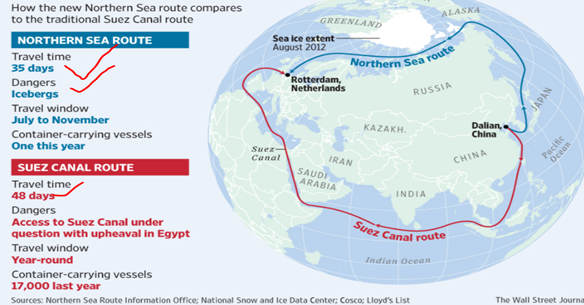
(c) A renewed interest in exploring the Arctic circle for economic gains such as minerals mining and maritime connectivity. The Arctic is rich in minerals and the Northern Sea Route (NSR) cuts the East-West voyage time by 50%.
Under RELOS, Russia will gain access to refuelling, repair, spare parts and supplies at Indian ports, while India will receive similar facilities at Russian airfields and ports, including Murmansk and Severomorsk in the Arctic. The provisions apply in both peacetime and wartime.
LEMOA vs RELOS
India has signed a comparable agreement with the United States — the Logistics Exchange Memorandum of Agreement (LEMOA). However, unlike LEMOA, RELOS explicitly permits the stationing of troops and allows payments through barter (exchange of goods).
RELOS strengthens India’s defence partnership with Russia, which remains substantial despite New Delhi’s growing engagement with the West. Between 2020 and 2024, Russia accounted for 36% of India’s arms imports, making it the country’s largest supplier during that period.
India’s tie-ups with the West for its armament needs have run into roadblocks. The US company General Electric was delaying the supply of engines for the Indian Tejas Mk-2 fighter aircraft. After tough negotiations GE agreed to transfer technology and intellectual property rights over its F414 engine.
Dassault Aviation has still not granted India full, independent control over the Rafale fighters sold to it, particularly in critical areas like core software, avionics, and major upgrades.
In contrast, Russia made an unusually comprehensive “full ToT plus local production” offer for the Su-57/FGFA—deeper than what most Western suppliers have provided on similar platforms. However, the Russian offer is still at the proposal stage rather than an agreed deal.
Pakistan Factor
A geopolitical factor which has made India tilt to Russia is Washington’s clear preference for rival Pakistan as its strategic partner in South Asia.
Pakistan has not only opened its doors to US investment in rare earths mining but is also building a bridge between the US and Iran to end the war. In the past also, the US had found Pakistan useful for building bridges with China.
Feeling left out, New Delhi made overtures to Beijing, offering economic concessions. And now, it is strengthening defence ties with Moscow.
India’s Interest in the Arctic
Although not explicitly stated in RELOS, it is expected to bolster Russo-Indian cooperation in areas such as mineral exploration, climate research in the Arctic region, and the development of the Northern Sea Route (NSR).
Far from being a routine logistics pact, RELOS could play a vital role in providing security cover for economic activities in the Russian Arctic — and by extension, across the wider Arctic region.
China Factor
Analysts, including Anand Patel of the Harvard Kennedy School (2025), have highlighted the China dimension in India’s Arctic policy. Beijing’s Polar Silk Road initiative has significantly expanded its footprint in Russia’s Arctic energy and shipping infrastructure. New Delhi is keen to avoid being marginalised while China secures preferential access to discounted hydrocarbons and a dominant position in the emerging Arctic trade and logistics networks.
At the same time, India is strengthening ties with Nordic democracies such as Norway, Sweden and Denmark through platforms like the India–Nordic Summit and bilateral initiatives, including the Green Strategic Partnership with Denmark, which focuses on sustainable development, climate innovation and maritime security.
History of India’s Arctic Engagement
India’s engagement with the Arctic dates back surprisingly far. As early as 1920, it became a signatory to the Svalbard Treaty. In 1998, it established the National Centre for Polar and Ocean Research (NCPOR). India launched its first Arctic scientific expedition in 2007, focusing on atmospheric sciences, microbiology and geology.
In 2008, it set up its first Arctic research station, “Himadri”, at Ny-Ålesund in Svalbard, Norway — making India the first developing country after China to establish a permanent presence in the region. India gained Observer status at the Arctic Council in 2013 and has since expanded its footprint with facilities such as the IndARC multi-sensor observatory (2014) and an atmospheric research station at Gruvebadet (2016).
In 2018, India received its first shipment of LNG from the Russian Arctic. It released its formal Arctic Policy in 2022. In 2023, Indian scientists conducted India’s first winter expedition and collaborated with Canadian researchers on permafrost studies. That same year, New Delhi deepened ties with Russia through joint feasibility studies on the Northern Sea Route, Arctic energy projects and alignment with the Chennai–Vladivostok Maritime Corridor. In 2025, India signed a deal with Norway to co-develop its first indigenous Polar Research Vessel.
The Arctic matters greatly to India from multiple points of view. Changes in sea ice alter atmospheric and oceanic circulation patterns that influence the Indian monsoon. Arctic warming also affects Himalayan glaciers, contributing to sea-level rise, glacial lake outburst floods, erratic snowmelt and threats to water security for millions.
Resource-Rich Region
Russia’s Arctic holds vast reserves of oil and natural gas. Estimates suggest the region may contain over 40% of the world’s undiscovered oil and gas resources, along with significant deposits of coal, zinc and silver.
India has sharply increased its imports of Russian fossil fuels following Western sanctions. As a major buyer of Russian hydrocarbons, New Delhi has a strong incentive to engage more deeply in Arctic energy corridors.
The Chennai–Vladivostok Maritime Corridor
The Northern (Arctic) Sea Route (NSR) cuts down the sailing time between East and West by 50%. A vessel sailing from St. Petersburg to Mumbai via the Suez Canal takes about 25 days, whereas the NSR via Vladivostok to Chennai can be completed in roughly 12 days.
The 10,500 km Chennai–Vladivostok Maritime Corridor (CVMC) passes through the Sea of Japan, South China Sea and Malacca Strait, offering a significantly shorter alternative to the traditional 16,000 km St. Petersburg–Mumbai route via Suez.
The 2021 Suez Canal blockage underscored the value of such alternative routes
India is already using the NSR. In the first seven months of 2023, India accounted for 35% of the Murmansk port’s eight million tonnes of cargo.
Harsh conditions once made the NSR risky, but Russia’s fleet of nuclear-powered icebreakers — currently seven, with three more expected by 2027 — is rapidly improving navigability.
A study by Chennai Port Trust identifies coking coal, crude oil, LNG and fertilisers as key cargoes that could be imported from Russia via the CVMC. Russia’s NSR development plan targets 80 million tonnes of cargo by 2024 and 150 million tonnes by 2030, even amid Western sanctions.
In March 2023, Russian delegations engaged with Indian businesses in New Delhi and Mumbai on NSR projects, with Rosatom seeking Indian participation.
END
