

By P.K.Balachandran/The Daily Times of Bangladesh
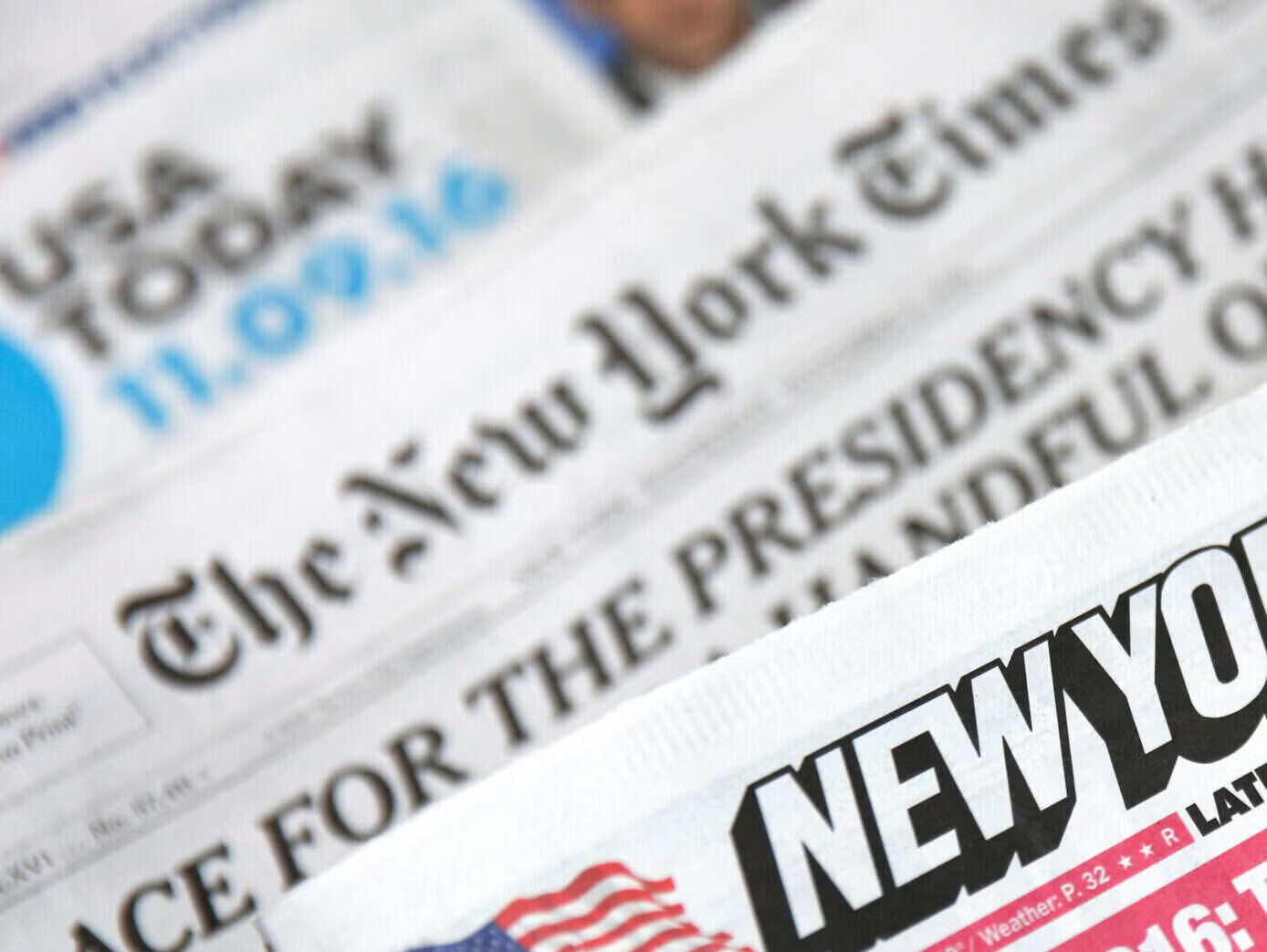
Colombo, March 12- The United States has recorded the sharpest drop in the Inter American Press Association’s Chapultepec press freedom Index, losing 22.65 points and falling from fourth to eleventh place.
The report released in Miami on Tuesday attributes this decline to an environment marked by hostile rhetoric toward the press during the administration of President Donald Trump, the removal of certain institutional safeguards, and episodes of aggression against journalists during news coverage.
The IAPA presents a new edition of the barometer covering 23 countries across the American continent. Throughout the Americas, regimes view the press as “public enemy number one” to evade accountability and weaken public scrutiny, says the Inter American Press Association.
The overall average reached its lowest level since the indicator was created, with a score of 47.13 out of a possible 100 points.
During the presentation of the study in Miami, IAPA Executive Director Carlos Lauría warned that the results confirm “a significant deterioration both in authoritarian regimes and in consolidated democracies,” reflecting a regional trend marked by political pressure, violence, judicial harassment, and growing risks for the practice of journalism.
Martha Ramos, president of the IAPA’s Committee on Freedom of the Press and Information and director of Organización Editorial Mexicana (OEM), highlighted the proliferation of authoritarian rhetoric and practices that seek to portray the.
León Hernández, the index’s academic coordinator and researcher at the Andrés Bello Catholic University (UCAB), presented the results based on the evaluation of 195 freedom of expression experts in 23 countries. Among the most relevant findings are:
Precarious leadership
The Dominican Republic remains in first place with 82.17 points, the only nation in the category “With Freedom of Expression.” However, Hernández warned of the presence of a “silent gag,” characterized by the discretionary use of official advertising and the economic vulnerability affecting many media outlets.
Alarming Declines
The United States recorded the sharpest drop in the index, losing 22.65 points and falling from fourth to eleventh place. The report attributes this decline to an environment marked by hostile rhetoric toward the press during the administration of President Donald Trump, the removal of certain institutional safeguards, and episodes of aggression against journalists during news coverage.
Red Zone
Venezuela (7.02 points) and Nicaragua (18.22 points) continue to rank in the category “Without Freedom of Expression.” In Venezuela’s case, the IAPA denounced the consolidation of a systematic structure of censorship that has resulted in the closure of more than 400 radio stations and the detention of 25 journalists following the electoral events of 2024.
El Salvador
Sergio Arauz, president of the Association of Journalists of El Salvador (APES), elaborated on the situation in his country, which ranks alongside Cuba, Venezuela, and Nicaragua among the most critical levels of the index.
Arauz denounced an “escalating repression” in the context of the state of exception promoted by the government of Nayib Bukele. According to his account, the use of the Foreign Agents Law, combined with judicial harassment against media outlets and journalists, has forced around fifty Salvadoran journalists into exile over the past year.
“There are no possibilities of practising journalism fully without facing consequences when there is an Executive branch with virtually unlimited powers and no effective legal oversight,” said Arauz, deputy editor of El Faro, whose newsroom currently operates from abroad. He also warned of growing self-censorship among the Salvadoran population due to fear of reprisals.
The period analysed stands as one of the most difficult for journalism in the region, marked by homicides, arbitrary detentions, judicial proceedings, and forced exile affecting journalists from Mexico and Central America to several countries in the Southern Cone.
Among the most common mechanisms of restriction are the criminalisation of independent journalism, the use of stigmatising rhetoric against the press, and various forms of deliberate financial suffocation targeting critical media outlets.
While the Dominican Republic remains the only country with a score above 80 points, followed by Chile, Canada, Brazil, Uruguay, and Jamaica, much of the hemisphere faces the challenge of strengthening protection mechanisms for journalists and revising legal frameworks that restrict or discourage free expression.
Looking toward 2026, the region is entering a period shaped by electoral processes and geopolitical shifts that could redefine the information environment, raising new dilemmas, challenges, and responsibilities for the defence of press freedom.
The IAPA is a non-profit organisation dedicated to defending and promoting freedom of the press and expression in the Americas. It comprises more than 1,300 publications from the western hemisphere and is based in Miami, Florida, United States.
END
Press freedom, US, The Americas. Steep decline in the US,
