

By Laxmi/Substack
Mar 11, 2026 – In Sri Lanka, the ocean is never merely scenery. It is infrastructure, livelihood, and vulnerability. This relentless force of nature brings trade, tourists, storms, and an unsettling routine of maritime emergencies. Along this busiest shipping lane in the world, “incidents” strike without warning: sudden engine failures near ports, collisions in congested channels, containers plunging into the sea, fires raging out of control.
In 2021, I covered the X-Press Pearl fire from its first day, writing, photographing, and filming through thick smoke and fog until the blaze was contained. The rolling black clouds that hung over Colombo’s waters for days remain vivid in my memory.
Thanks for reading Parts of the Gods! Subscribe for free to receive new posts and support my work.
In early March this year, when news broke of the Iranian warship IRIS Dena’s disaster off Galle, that familiar pattern of attention kicked in again—tracking official briefings, parliamentary clamor, media leaks, and the silent gaps in between. This time, I could only observe from afar, yet I patiently and persistently pored over Sri Lankan media reports, politicians’ statements, officials’ positions, and deliberately avoided topics—for truth often sprouts from such ground.
Yet this was no ordinary maritime incident. The IRIS Dena–Bushehr affair belonged to an entirely different crisis category: a great-power conflict spilling into the Indian Ocean, forcing Sri Lanka once again to defend its neutrality amid converging pressures from legal obligations, diplomatic entanglements, and domestic politics.
The Never-Sleeping Waterway
The Indian Ocean here is no metaphor—it is a veritable maritime artery. Sri Lanka straddles one of the world’s busiest shipping lanes, where grand narratives of “freedom of navigation,” “maritime transport routes,” and an “open and inclusive Indo-Pacific” intertwine with the harsh realities of fuel surcharges, shipping insurance, and daily fears of becoming collateral damage.
The presence of IRIS Dena in these waters was not coincidental. The frigate was on its way back from Visakhapatnam, India, where it had just participated in the biennial multilateral naval exercise, MILAN 2026, hosted by the Indian Navy from February 15 to 25. As a “guest of New Delhi,” the Dena had shared the harbor with vessels from over 70 nations—including those from the United States—under a banner of “Camaraderie, Cohesion, and Collaboration.” Its sinking just days after leaving Indian shores has transformed a routine return voyage into a geopolitical litmus test.
This is precisely why Sri Lankan media’s sharpest commentary on the IRIS Dena incident does not begin by focusing on Iran, Washington, or legal provisions, but instead points directly to the plight of a nation least able to withstand external shocks. An editorial in The Morning, one of leading English newspaper in Sri Lanka, on March 8 noted that the sinking of the IRIS Dena has thrust Sri Lanka into a “profound geopolitical predicament,” with this crisis striking at a “vulnerable moment” for the nation’s economic recovery. The editorial also drew a stark comparison that instantly jolted Sri Lankans awake: While India has repeatedly intervened against Chinese ships entering its ports, the region’s collective silence became newsworthy when a U.S. submarine operated in nearby waters, launched an attack, and turned the area into a conflict zone.
In Sri Lanka, silence has never been neutral. Silence itself is an interpretation.
Colombo’s Stance: Neutrality Is a Procedure, Not a Slogan
In such an atmosphere, official rhetoric matters profoundly—not because words can calm the storm, but because they shape the domestic political agenda.
Sri Lankan Foreign Minister Vijitha Herath spoke succinctly at the 2026 Raisina Dialogue in New Delhi: Sri Lanka would handle the matter strictly in accordance with the United Nations Convention on the Law of the Sea and “has no intention of supporting any party.” Such phrasing is typical of small nations navigating an overly polarized strategic environment, inevitably prompting domestic questions: So whose pressure are you actually under?
President Anura Kumara Dissanayake offered the most comprehensive official statement. At a special media briefing on March 5, he emphasized the “exceptional nature” of this incident, stressing that Sri Lanka must balance obligations under both UNCLOS and the 1907 Hague Convention—legal frameworks directly governing how neutral states respond when warships from conflicting parties seek entry or assistance. He further stated that Sri Lanka would not permit any party to exploit its territory, waters, or airspace in a biased manner.
The intent behind these remarks is clear: to etch neutrality into the public consciousness. Sri Lanka seeks to articulate neither a moral high ground nor an indifferent stance, but a procedural framework—one involving rescue operations, legal assessments, controlled access, and situation management.
Rescue First, Blockade Later
The Sunday Times provided a clear timeline of events. The Sri Lankan Navy received distress signals in the early hours of March 4 and launched a rescue operation from Galle Harbor before 6 a.m. The incident occurred approximately 19 nautical miles from Galle, beyond the 12-mile territorial sea but within Sri Lanka’s Exclusive Economic Zone (EEZ). The rescue operation saved 32 survivors and recovered 87 bodies.
This rescue mission was more than a procedural success; it was a testament to a hollowed-out state capacity. Launching a mission 19 nautical miles offshore from Galle while the nation still reels from a debt crisis is no small feat. It highlights a stark reality: even as Colombo maintains its “procedural neutrality” on paper, the physical act of policing these waters increasingly pushes Sri Lanka’s aging naval assets to their absolute breaking point.
“They Sank the Enemy, We Got the Dead”: The Grim Toll of High-Tech War
The recovery of these 87 bodies was not just a naval operation, but a harrowing collision between high-tech maritime warfare and the raw, unvarnished limits of a bankrupt state. While the world’s attention was fixed on the unseen submarines and the lethality of their torpedoes, the physical aftermath was left to the morgues of Galle.
Reports from the scene paint a picture of a nation utterly unprepared for the scale of this inherited tragedy. At the Karapitiya Hospital in Galle, the grim reality of the economic crisis met the grim reality of war: a sudden influx of nearly a hundred shattered bodies into a facility that, due to years of debt-induced shortages, lacked even the most basic requirements—proper refrigeration, dry ice, and enough body bags for a mass-fatality event.
As one local headline chillingly summarized the dynamic: “They Sank the Enemy, We Got the Dead.” For the doctors and naval officers working under the cover of night to avoid public panic, the “neutrality” of Colombo was no longer a diplomatic concept; it was a grueling, low-tech labor of handling the human wreckage of a conflict they did not start, using resources they no longer have.
While the world was still processing the Dena’s tragic fate, well-informed opposition parties disclosed through local media that a second Iranian vessel, the IRIS Bushehr, was also in waters near Sri Lanka. On the same day the Dena was sunk, this ship sent a distress signal to Sri Lanka requesting port entry due to engine failure.
This placed Sri Lanka in a genuine legal and diplomatic predicament. Following a special National Security Council meeting chaired by the President, Sri Lanka announced it would permit the second Iranian warship to enter its territory on humanitarian grounds. After consultations between the Foreign Minister and Iranian officials, it was agreed that Iranian crew members would disembark in Colombo, while the Bushehr would be escorted to the deep-water port of Trincomalee in the northeast.
Regarding this arrangement, the President explained: Allowing a foreign warship “designated as a target” to remain anchored near Colombo posed risks to urban security, commercial shipping, and maritime insurance costs. Therefore, it was decided to transfer it to Trincomalee under naval escort.
The Geography of Avoidance.
Precision coordinates showing the IRIS Dena strike zone (19nm off Galle) and the strategic redirection of the IRIS Bushehr to Trincomalee.
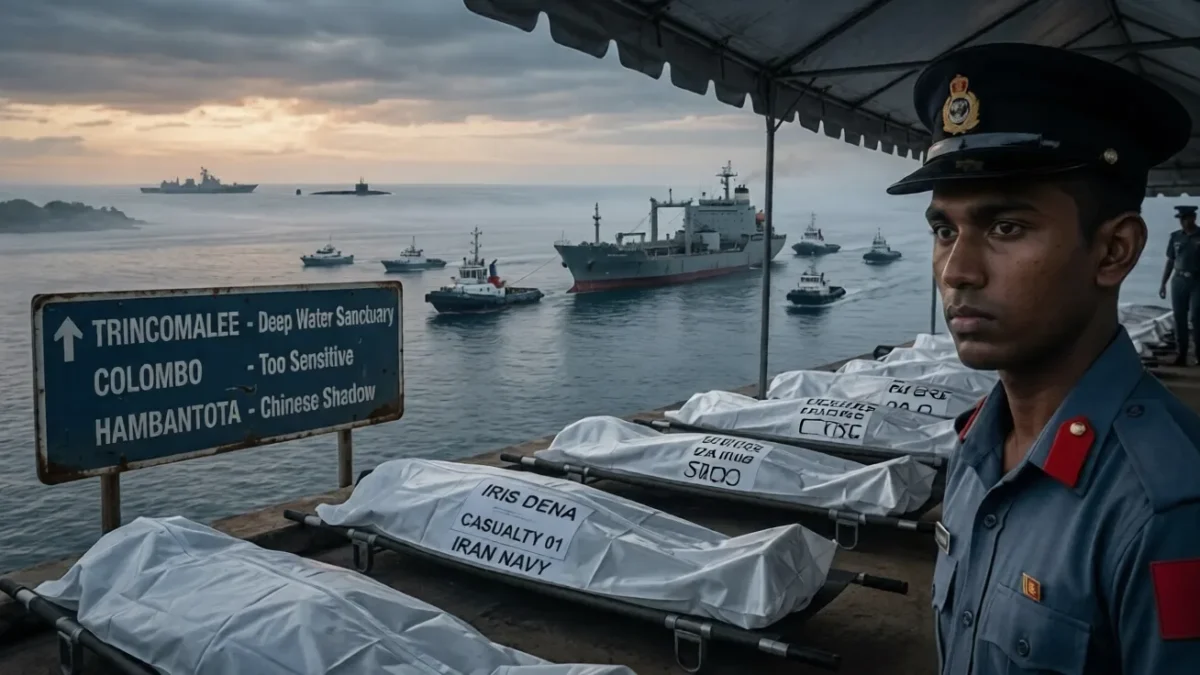
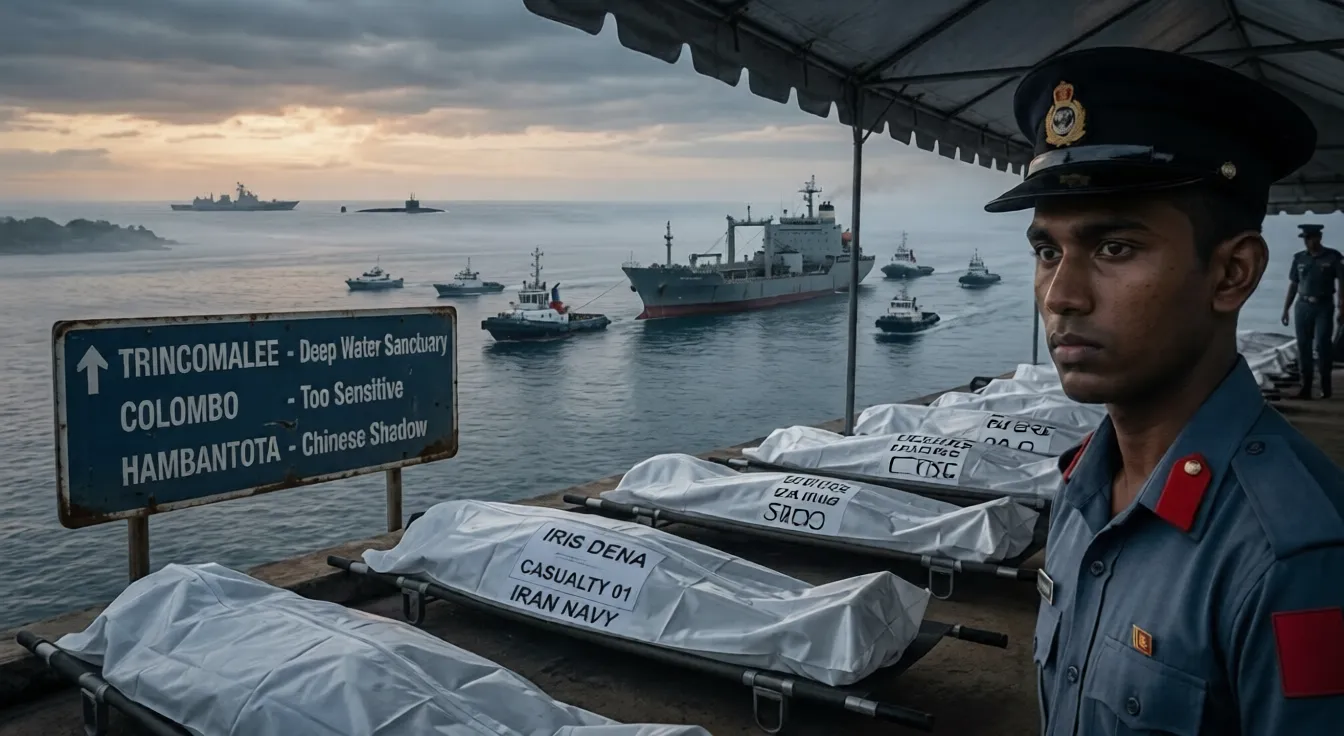
The logistical choice of Trincomalee was, in itself, a masterclass in the geography of avoidance. While Colombo was deemed too sensitive for urban safety, and Hambantota remains perpetually shrouded in the “Chinese shadow”—a political non-starter for such a crisis—Trincomalee emerged as the only viable sanctuary. Though it sits directly on New Delhi’s strategic nerves, it remains a terrain where the U.S.-India-Israel axis feels far more “at home” than in the Chinese-managed berths of the south.
Upon arriving at Colombo Port, the 204 personnel aboard the Bushehr were immediately transferred to the Welisara Naval Base. A navy spokesperson clarified that these crew members were considered “non-combatants,” with the move aimed at safeguarding Sri Lanka’s neutral stance.
However, as of March 9, the situation remained unresolved. Due to engine failure and unfinished legal procedures, the Bushehr remained anchored off Colombo, unable to proceed to Trincomalee as originally planned. This incident laid bare the realities of crisis management for a small nation: while the policy on paper might seem straightforward—“redirect the vessel to Trincomalee”—reality quickly imposed its own constraints: mechanical failures, missing port clearance documents, and limitations on tugboat availability. With each additional hour of delay, the risk of the situation escalating into a domestic political crisis grew.
Political Storm: “Neutrality” Under Scrutiny
If operational challenges were daunting, political imperatives loomed even larger. As this crisis unfolded, Sri Lanka’s domestic politics were already sharply polarized. Neutrality was no longer seen as a virtue but had to repeatedly prove its worth—to counter accusations of cowardice, complicity, or incompetence.
Sri Lanka’s media landscape is exceptionally dense, with the shadows of every political faction reflected across its multitude of outlets. This environment gave rise to a flood of narratives—some factual, some fabricated—surrounding the Iranian warship incident: Opposition lawmakers alleged the Sri Lankan Navy Commander had proactively invited the Iranian vessel to visit; some media reported the Dena had arrived at Sri Lanka’s invitation but was forced to wait 11 hours in international waters after the situation abruptly changed; while others claimed the Dena had sought permission before the incident but received no response.
This is not merely a factual dispute. In Sri Lanka, the controversy over the maritime timeline inevitably evolves into a contest over sovereignty and operational capability: Was Colombo “aware”? Did it ‘invite’? Did it “delay”? Was it powerless when foreign submarines turned Sri Lanka’s exclusive economic zone into a battlefield without notice? The weight of these questions lies in Sri Lankans’ haunting memories of similar patterns—where external pressures and internal vulnerabilities intertwine, creating situations where no one bears full responsibility yet everyone must explain. Under debt pressure, the capacity to explain is itself a scarce resource.
The Credibility Trap Facing the NPP Government
The current government, the National People’s Power (NPP), is dominated by the leftist People’s Liberation Front (JVP), which has a Marxist background. The reason the NPP government faces a more severe test of neutrality than any previous administration lies precisely in this history: for decades, the JVP has made fierce anti-Americanism a core component of its political identity—protesting U.S. overseas intervention and portraying Washington as the mastermind behind domestic turmoil. Even now in power, this history hasn’t vanished; it has merely shifted function: it has become the yardstick by which the opposition measures the government’s credibility.
In Sri Lanka’s political ecosystem, where conspiracy theories proliferate rapidly and are frequently weaponized across party lines, any perceived hesitation in pressuring the U.S. or gaps in public timelines can be packaged as “evidence” of “secret compromises.”
Following the Dena attack, Sri Lankan media abounded with speculation about the NPP government’s relationship with the U.S. When Trump announced that he would attack Iran, the commander of the US Pacific Fleet, Admiral Steve, visited Sri Lanka and met with the Deputy Foreign Minister, the Deputy Defence Minister, and senior defence officials.
Admiral Steve’s arrival was not a routine port call; it was a clear signal of “boundary-setting.” In the eyes of the Sri Lankan public, the visit transformed a maritime tragedy into a geopolitical alignment, leaving the NPP government to explain why American boots were on the ground just as Iranian hulls were hitting the seabed.
Some media outlets promptly questioned whether this visit was linked to the subsequent sinking of an Iranian vessel near Sri Lankan waters. Others stated more directly: “ Observing the JVP government’s response to the U.S. attack on Iran and the sinking of Iranian vessels near Sri Lanka’s maritime border, it appears the U.S. has placed the JVP government under its influence.“ The Sunday Times headline was even blunter: ”Iran War: Government Claims Neutrality, but Seen Moving Toward U.S.-Israel-India Axis.”
Editor’s Blade: Legal and Neutral Discourse in Sri Lankan Media
The March 8 editorial in The Morning, titled “A Profound Geopolitical Dilemma,” left a deep impression on me.
Citing an internal U.S. State Department cable seen by Reuters, it was revealed that Jayne Howell, the charge d’affaires at the U.S. embassy in Colombo, urged the Sri Lankan government not to repatriate the rescued Iranian sailors. The cable emphasized that Colombo should “minimize Iranian attempts to use the detainees for propaganda” and even noted inquiries about potential “defections” among the crew. This move placed Sri Lanka in a diplomatic quandary. The editorial thus issued two warnings:
First, insist that these sailors are rescued seafarers, not prisoners of war. Sri Lanka’s stance should be grounded in maritime law and neutrality, not political pressure, and must not appear to be acting under the direction of one side in the conflict.
Second, it questioned the legitimacy of the “propaganda risk” logic: if the crew members possess firsthand knowledge of the incident, they should have the right to speak. If Sri Lanka succumbs to external demands to suppress their voices, it risks becoming a tool for others’ narrative control, thereby jeopardizing its own neutral status.
A March 9 editorial in The Daily Mirror similarly emphasized that Sri Lanka’s decision on repatriating remains should be guided by national interests and humanitarian principles, not pressure stemming from great power conflicts. Notably, The Daily Mirror has historically been controlled by an opposition political family and has been skeptical of the NPP government. Yet this editorial praised the government’s handling of the Iranian vessel, stating it “balanced neutrality principles while upholding humanitarian standards, setting an example for small nations navigating great power rivalry.”
Chronology of a Stalemate.
From the MILAN 2026 naval exercise to the Reuters disclosure of the U.S. State Department cable.
Missing Link: The “Abandon Ship” Order and Crucial Negotiations Involving a Second Vessel
Among reports concerning the Dena, one unverified detail stands out. Multiple media outlets (citing Iranintl as the original source) reported that prior to the attack on the Dena, the U.S. issued two warnings urging the crew to abandon ship—an “abandon ship” order—which the captain refused. The 32 survivors later rescued by Sri Lanka were reportedly crew members who defied the captain’s orders and boarded lifeboats on their own.
The mystery of Iran’s maritime movements was further deepened by the fate of a third vessel, the IRIS Lavan. While the Dena was being tracked toward its demise and the Bushehr was pleading for refuge in Sri Lanka, the location of the Lavan remained a subject of intense speculation among regional intelligence watchers. Ultimately, it was confirmed that the Lavan, carrying 183 crew members, had been granted emergency docking at the Kochi port in India on March 1, effectively escaping the fate of its sister ship.
Mawbima, a media outlet close to the Samagi Jana Balawegaya (SJB), the opposition party, disclosed details of Sri Lanka’s handling of the second Iranian vessel (Bushehr). Reports indicate the Sri Lankan government initially planned only to receive the crew ashore—as a humanitarian evacuation operation—without assuming responsibility for the ship. This proposal was immediately rejected by Tehran, with Iran insisting that “Iranian sailors would not go to Colombo without their ship,” effectively refusing to “abandon ship.” Following prolonged consultations between Sri Lanka, Iran, and several Middle Eastern nations—covering international conventions, maritime law, and Sri Lanka’s legal obligations—a compromise was reached: Sri Lanka would accept both crew and vessel, but with the condition that crew disembark at Colombo Port while the vessel itself would not enter Colombo Port but be redirected to Trincomalee.
These details are not isolated; they collectively form a coherent political psychology. If “abandoning the vessel” had already been framed within Iran’s narrative as coercion and humiliation, then the subsequent refusal to separate crew from vessel transcended mere stubbornness—it rose to a principle: never abandon the vessel, never cede control of the narrative.
The refusal to “abandon ship”—even in the face of U.S. warnings—speaks to a rigid doctrine within the Iranian Navy: a warship is not merely a vessel, but a floating piece of sovereign territory. To cede the ship is to cede the narrative. By declaring that “Iranian sailors would not go to Colombo without their ship,” Tehran effectively weaponized its own distress, forcing Colombo to choose between a humanitarian crisis and a diplomatic stalemate that it was ill-equipped to resolve.
The Dilemma of Small Nations: Why “Putting Others First” Becomes National Policy
For years, Sri Lanka has navigated survival through essential diplomacy. Its geographic location renders its strategic position too significant to ignore, while its small landmass leaves it too weak to dictate terms. Recent debt crises have only intensified these dual constraints.
As a debt-ridden nation still recovering from severe crisis, Sri Lanka must prioritize creditors—often before its own voters—in foreign engagements. When China, the United States, India, and even Iran simultaneously exert influence through diverse means, “deferring to external powers’ core demands” ceases to be a personal preference and becomes the upper limit of state policy.
Consequently, Colombo now faces not a binary choice of “whether to remain neutral,” but a long-term challenge of “how to sustain proof of neutrality.” While rescue operations and humanitarian gestures may earn applause, gaps in the timeline, communication breakdowns, and ambiguous responses to external demands will subject neutrality to constant re-evaluation within domestic politics.
In the strategic Indian Ocean corridor, a debt-ridden small nation may have already done the “right thing” to the utmost of its ability. The greater challenge lies in transforming those “hard-to-explain” details into a coherent narrative that withstands both domestic scrutiny and external pressure.
A powerful close-up portrait of a Sri Lankan individual with a direct, intense gaze looking into the camera, symbolizing a counter-gaze against geopolitical pressure
The Silent Witness.
As great powers monitor Sri Lanka’s every move, the Sri Lankan people are watching back, demanding accountability and sovereign dignity.
As the wreckage of the IRIS Dena continues to settle in both the physical and political sense, the discourse within Sri Lanka has taken a sharper turn. An editorial in The Morning published today, titled “Neutrality must not mean silence,” marks a significant pivot in domestic sentiment. It argues that while avoiding entanglement in great-power conflicts is strategic, it should not lead to a “principled silence” when the nation’s Exclusive Economic Zone (EEZ) is transformed into a battlefield without warning.
Parallel to this, the Sri Lankan Ministry of Defence officially denied reports on March 9 regarding external pressure to halt the repatriation of the Iranian crew, reinforcing the government’s stance of acting strictly under international law.
These dual developments highlight the razor-thin line Colombo must walk. The call from the media is no longer just for “procedural neutrality,” but for a principled neutrality—one where a small nation dares to articulate its own security red lines even while navigating the crushing weight of its debts. In the Indian Ocean corridor, the silent witness is finally being urged to find its voice.
END
