

By P.K.Balachandran /The Citizen
Colombo, April 17 – The Chief Minister of Tamil Nadu, M.K.Stalin, has set off alarm bells over the likely consequences of the Delimitation Bill that was presented to the Indian parliament on Thursday.
“If passed, the bill would turn the people of Tamil Nadu into second-class citizens in their own country,” Stalin said on Wednesday, addressing a massive election rally in Dharmapuri.
Elections to the Tamil Nadu State Assembly are to be held on April 23, and the de-limitation of parliamentary constituencies which the bill envisages, is a major issue in the campaign.
“When our MPs have no voice, will we have a voice? And if we do not raise our voice now, there will be no voice left for us to raise,” Stalin asserted.
Slamming the Bharatiya Janata Party (BJP)-led National Democratic Alliance (NDA) government at the Centre, Stalin said that the Bill will ensure that “there can never be a Prime Minister from South India.”
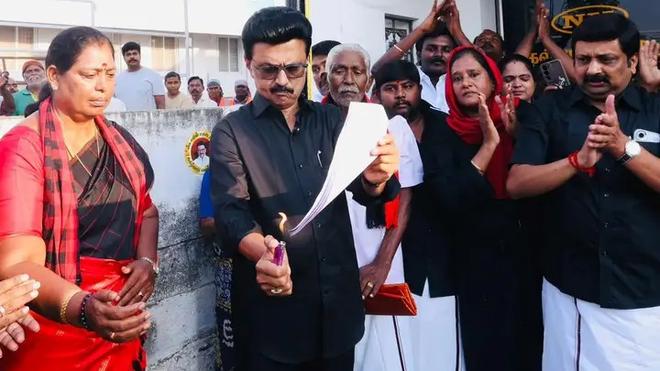
He called for a strong pushback from the people of Tamil Nadu that will “once and for all suppress the arrogance of the BJP”. He urged the people of Tamil Nadu to hoist black flags in their homes on April 16.
Controversial Provisions
The Bill proposes an increase in the number of seats in the Lok Sabha (the Lower House of the Indian Parliament) from 543 to 850. The number of seats for each State in the House will be based on the proportion of its population in the total population of India. The population of a State will be based on such Census (not necessarily the latest) that is specified by Parliament by enacting a law.
There will be a Delimitation Commission, and delimitation will be based on the 2011 Census.
M.R. Madhavan, President of PRS Legislative Research, explains the implication of the Bill in an article in “The Hindu.”
The immediate implication is that the relative share of seats in the Lok Sabha for each State will change based on the population ratio. The biggest losers will be Kerala and Tamil Nadu, because these have controlled their population, while the main gainers will be Rajasthan, Bihar and Uttar Pradesh, which have not controlled their population.
This will lead to MPs from Uttar Pradesh and Bihar (25% of total seats, up from 22%) having significant power to shape national policy.
The Bill gives Parliament the flexibility to determine the periodicity of delimitation and also the Census that will be used for the purpose. The Bill requires just a simple majority in parliament to determine whether to do a delimitation, and which Census to use.
This would enable the government of the day to fix everything as per its wish, Madhavan says.
House of States (Rajya Sabha)
While the size of the Lok Sabha is being increased, there is no proposal to change the size of the Upper House of States, the Rajya Sabha.
This affects the relative importance of the two Houses. If the two Houses disagree on a Bill, the President may summon a joint sitting. In such a scenario, the Lok Sabha with 543 seats will have 2.2 times the votes of the Rajya Sabha with 245 seats. This imbalance will also play out in elections to the offices of the President and the Vice-President, where each MP across both Houses has an equal vote.
A fourth implication is that the limit on the size of the Council of Ministers will increase. The Constitution was amended in 2003 to limit the Council’s size to 15% of the Lok Sabha. If the Lok Sabha is expanded to have 815 MPs, the limit on the size of the Central cabinet also increases from 81 to 122.
Fifth, the increased size of the Lok Sabha reduces the opportunity for an MP to participate in the deliberations of the House. Questions and zero-hour interventions are chosen by lottery, and an increased size of the Lok Sabha reduces the probability of getting balloted.
The issue is exacerbated by the fact that Parliament sits for less than 70 days a year.
In the UK
In the UK, the House of Commons has 650 members. It has evolved processes to provide opportunities to MPs to participate in discussions. It averages over 150 sittings a year, and has a robust committee system. Parliamentary committees can supplement deliberations.
The Indian Parliament is lacking in this respect. For example, every Bill in the U.K. Parliament is examined by Committees of both Houses. In India, less than a fifth of the Bills are referred to Committees.
The Bill in question will have a significant impact on the composition of Parliament and its functioning, but are being introduced with no public discussion.
“It is imperative that such Bills go through intensive deliberation, both outside and inside Parliament. At the very least, they should be referred to a parliamentary committee, which can engage with experts and the wider public before giving its recommendations,” Madhavan says.
Opposition and Support to the Bill
There is opposition to the bill from Tamil Nadu, Karnataka, Kerala and West Bengal but not Andhra Pradesh. Tamil Nadu is leading the charge against the bill because it has been in the forefront of the campaign for States’ rights in India since the 1960s.
Karnataka Deputy Chief Minister, D K Shivakumar, said the Centre’s proposal to increase the number of Lok Sabha seats from 545 to 850 and proceed with a delimitation exercise based on the pre-2026 Census would “systematically reduce” the representation of South Indian States.
In a post on X, Shivakumar alleged that the move could weaken the South’s voice in Parliament while disproportionately benefiting States with higher population growth. He called it “punishing progress and good governance” and said that the Southern States would be “politically marginalised.”
There is a serious suspicion in the Southern States that the bill is a move to subvert the federal system of the country, said the Chief Minister of Kerala, Pinarayi Vijayan.
“It is worrying that the Centre is moving forward on such a crucial issue without reaching a consensus with the States,” he said.
“There is widespread suspicion that the political dominance of the North Indian States due to their higher population is being converted into parliamentary seats and power is being consolidated for the long term,” Vijayan added.
The Trinamool Congress (TC) chairperson and Chief Minister of West Bengal, Mamata Banerjee said that delimitation will be followed by National Register of Citizens (NRC) which has been a means to delete names and said the deleted persons to detention camps.
“The people of Bengal will be driven out, and you will bring people from outside and make them vote for you. Is that the plan? They have selectively deleted voters. Over 60 lakh Hindus, and 30 lakh Muslim names have been deleted in West Bengal through the Special Intensive Revision of the electoral rolls, “ Banerjee said.
Andhra Pradesh, a South Indian State, is an outlier; the ruling party here is part of the BJP- led NDA government at the Centre and therefore supports the bill. Andhra Pradesh Chief Minister Chandrababu Naidu said he backs the bill “100%”.
END
