

By DBS Jeyaraj/Daily Mirror
Colombo, May 10 -The Indian Army launched “Operation Pawan” against the LTTE in Jaffna. Tiger cadres led by Paseelan with Balraj as his deputy were hastily deployed in Jaffna to combat the IPKF. It was then that Balraj – armed with an RPG launcher – demonstrated great courage by facing an advancing battle tank in Kopay and inflicting much damage
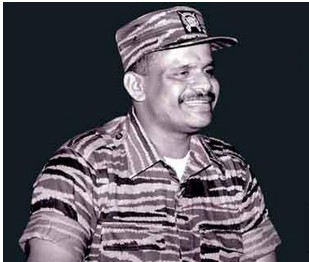
Former Liberation Tigers of Tamil Eelam (LTTE) deputy military chief Kandiah Balasegaran alias ‘Brigadier’ Balraj is regarded as the finest military commander the Tigers ever had. Balraj was a much admired military tactician, reputed for leading from the front. Born in 1965, Balraj died of a heart attack 17 years ago on 20 May 2008. Balraj’s 60th Birthday will be commemorated on November 27 this year. This article, based on previous writings, focuses on Balasegaran alias “Brigadier” Balraj and facets of his fighting history.
Balraj, regarded as second in command to LTTE leader Veluppillai Prabhakaran in the military sphere, excelled in both offensive and defensive positional warfare. The military capability of Balraj was appreciated even by his opponents in the Sri Lankan armed forces. It is said that the armed forces regarded Balraj as the finest tactician-fighter in the LTTE and ranked him above his leader Prabhakaran in that respect.
On one occasion, the LTTE intercepted an army message from the frontline to headquarters saying that Balraj was in the field. The response was “Be careful. Balraj is more dangerous than Prabhakaran”. Later, when Prabhakaran heard about this intercept, the LTTE chief was amused. He reportedly teased the shy Balraj about it saying, “The Army regards you as the No. 1 enemy now. So I am safe.”
Another little known incident regarding Balraj occurred in 2003. The peace process facilitated by Norway prevailed then between the government of Sri Lanka and the LTTE. The LTTE Deputy Military Chief Balraj was suffering then from a heart ailment and required urgent surgery in Singapore.
Katunayake
The President at that time was Chandrika Bandaranaike Kumaratunga. Ranil Wickremesinghe was the Prime Minister. Since the Oslo brokered ceasefire was then in progress, the government allowed Balraj to be flown to Singapore via Katunayake for surgery. The ailing Balraj accompanied by Norwegian officials flew with two bodyguards to Singapore. The surgery was successful and Balraj travelled back to Sri Lanka from Singapore after a few weeks.
Upon his return, Balraj found himself “surrounded” by about 15 military officers of captain, major and Lt. Colonel rank at the Katunayake international airport. The Norwegian officials accompanying Balraj were perturbed as they feared that the army officers intended causing harm to Balraj. That was not so.
The army officers with field experience in the north were aware of Balraj’s military prowess and exploits. Despite being enemies on the battle front, these officers had a healthy respect for Balraj whom they regarded as a first-class fighter. Knowing that Balraj was returning from Singapore, these officers had gathered merely to see their Tiger foe in the flesh. Some officers smiled and shook hands with Balraj. A few exchanged pleasant words. Afterwards Balraj flew safely to the Wanni by helicopter. The Norwegians were relieved that no ugly incident occurred.
The brief encounter at Katunayake demonstrated vividly the admiration with which Balraj was held by some military officers. These cheers from the “ranks of Tuscany” were due to the awesome military reputation of Balraj. The above mentioned incident illustrated the respect and regard with which Balraj was held by some officers in the Sri Lankan army then.
Kokkuthoduwaai
Kandiah Balasegaran alias Balraj was born on 27 November 1965 in the coastal area of Kokkuthoduwaai in Mullaitheevu district. Young Balasegaran was the fourth in a family of four boys and a girl. Balasegaran had his primary education at Kokkuthoduwaai in Mullaitheevu district and his secondary education at Pulmoddai in the Trincomalee district. He was supposedly the brightest child in the family, and his father Kandiah and mother Kannagi were very keen to send Balasegaran to university as he had passed his “O” Levels with flying colours. But this was not to be as the son opted to join the Tamil militant movement while doing his GCE Advanced Level.
Balasegaran was formally inducted into the LTTE in 1984 and given military training in Tamil Nadu as part of the ninth LTTE batch. His nom de guerre in the LTTE was Balraj.
Balraj returned to the island after receiving training in Tamil Nadu. Having been taken into the LTTE by the then Wanni commander Gopalaswamy Mahendrarajah alias Mahathaya, Balraj was first absorbed into Mahathaya’s bodyguard unit. Gradually he was utilised for regular combat also.
Balraj made his mark first in mid-1986 when he played an active role in taking over the Karadipokku junction in Kilinochchi in what was an abortive bid by Mahathaya to encircle the Kilinochchi military camp.
Mahathaya was made deputy-leader of the LTTE in 1987 and moved to Jaffna. However he continued to be in overall charge of the Wanni. Jeyam, Suseelan and Paseelan were appointed as military commanders for the districts of Vavuniya, Kilinochchi and Mullaitheevu respectively.
Balraj became Paseelan’s deputy and functioned in the Mullaitheevu district. In a well-planned ambush at Munthirikaikkulam, the tigers led by Paseelan and Balraj killed 14 soldiers. Balraj was stationed at the Manal Aaru-Weli-Oya region since he knew the terrain well.
Indian Army
The Indo-Lanka accord of July 1987 brought about a temporary lull when Indian troops known as the Indian Peace Keeping Force (IPKF) were deployed in the north and east. The fragile peace was shattered in October when fighting erupted between the IPKF and the LTTE.
The Indian Army launched “Operation Pawan” against the LTTE in Jaffna. Tiger cadres led by Paseelan with Balraj as his deputy were hastily deployed in Jaffna to combat the IPKF. It was then that Balraj – armed with an RPG launcher – demonstrated great courage by facing an advancing battle tank in Kopay and inflicting much damage.
The war with the Indian army began escalating. LTTE supremo Prabhakaran, Mahathaya and other senior tiger leaders relocated to the Wanni. Prabhakaran himself began camping out in the dense Nithihaikkulam jungles of Mullaitheevu district. Lt. Col. Navam was in overall charge of Prabhakaran’s security in particular and Mullaitheevu defences in general. Balraj functioned as Navam’s deputy.
It was then that Balraj began interacting closely with his leader Prabhakaran. The LTTE numero uno was greatly impressed by Balraj’s unassuming simplicity and quiet efficiency.
When the IPKF launched “Operation Checkmate” in 1988 to capture Prabhakaran, Balraj played a key role in thwarting the mission by taking on the Indian troops frontally. Several Gurkha soldiers were reportedly killed in the skirmish. It is said that Balraj was injured on three separate occasions in combat against the IPKF.
After the withdrawal of the Indian army, the Tiger leader moved back to Jaffna with his retinue. There had also been a policy change of sorts where the LTTE was now as far as possible encouraging cadres from a particular locality to take up leadership positions in those areas.
Wanni Military Commander
In keeping with this policy, Balraj the son of Wanni soil was made military commander for the Wanni in 1990. This was the opportunity Balraj had been waiting for to demonstrate his military acumen and skills.
The A-9 highway or Jaffna-Kandy road was then under the “nominal” control of the army from Vavuniya to Elephant Pass. The army had military camps at strategic points.
The LTTE led by Balraj launched two attacks on the Kokavil and Mankulam camps and overran them. Later another attack was conducted against the Kilinochchi camp. Though it was not overrun ,the soldiers later evacuated and strengthened the Paranthan camp.
These victories raised the LTTE’s stock. Balraj became known as a reputed military commander who inspired and galvanised tiger cadres by courageously leading them up front into the thick of battle.
“Tharai – Kadal – Aahayam”
Another operation where Balraj proved his military prowess was the Elephant Pass operation of 1991. This operation codenamed “Tharai – Kadal – Aahayam” (Land – Sea – Air) was led by Mahathaya to lay siege to the Elephant Pass base and overrun it.
Balraj and his fighters including Theepan were tasked with the goal of penetrating the complex from the Kurinchatheevu sector. Balraj and his men delivered results by infiltrating through the lagoon and overrunning the military installation set up in the former guest house premises and retaining it till the operation was called off. They destroyed it when withdrawing. The failure of other LTTE cadres to achieve their objectives led to overall failure of the operation. 673 LTTE cadre were killed. It was however a personal triumph for Balraj.
First Infantry Brigade Commander
The LTTE in 1991 formed its first infantry brigade. It was named after Charles Anthony, Prabhakaran’s trusted deputy and close companion who died in Meesalai on 15 July 1983. Balraj was Prabhakaran’s choice to be the first special commander of Charles Anthony brigade. He served so until 1993.
Apart from leading military assaults and offensives Balraj also excelled in strategic defence. He was mainly responsible for defeating, preventing, restricting or nullifying several military offensives by the armed forces.
Some of these were “Operation Wanniwickrema” in Vavuniya, “Operation Lightning” in Manal aaru/Weli Oya, “Operation Leap Forward” in Jaffna, “Operation Yarl Devi” in Kilaly/puloppalai and operation “Agni Kheela” in Elephant Pass.
Balraj and his deputy Theepan had to counter “Operation Yarl Devi” launched by the army in the south of Jaffna peninsula in 1993. Balraj was seriously injured in the fighting at Puloppalai. He sustained serious injuries on a leg when he was firing an RPG at a T-55 tank. The injury caused him to limp slightly when walking. Also the leg started hurting when he walked for a long distance.
The advent of Chandrika Kumaratunga as President in 1994 resulted in a ceasefire and peace talks. The truce broke in 1995 April and war broke out. Initially the Army launched operation “Leap Forward” in the peninsula and advanced in the Valigaamam region. The LTTE launched a counter offensive codenamed “Tiger Leap”. The army withdrew. Balraj played a pivotal role in this. However the Army soon launched “Operation Riviresa” resulting in the LTTE being compelled to withdraw from the Peninsula into the Wanni in 1996.
Deputy-military commander
It was in 1996 that Prabhakaran gave Balraj his greatest military honour. He appointed Balraj as deputy-military commander. Prabhakaran was the military commander of the LTTE. Thus Balraj became number two in the tiger military hierarchy. The LTTE’s new Deputy-Military Commander began demonstrating his mettle in battle.
On 18 July 1996 the LTTE overran the Mullaitheevu camp killing more than a 1,000 soldiers. Balraj co-ordinated the operation codenamed “Oyatha Alaigal – 1.”
But Balraj failed to obstruct a major army offensive — “Operation Jayasikurui” in 1997 where the armed forces took Omanthai and Nedunkerny. Balraj was in overall charge of LTTE defences during Jayasikurui till the fall of Puliyankulam. Thereafter erstwhile eastern LTTE regional commander “Col.” Karuna took over defence arrangements in tandem with “Col.” Theepan.
In February 1998 the LTTE attacked Kilinochchi in Oyatha Alaigal 2. The soldiers withdrew after incurring heavy losses. Balraj was in overall charge and reportedly adopted psychological warfare as a military tactic. The timing of the attack coincided with Sri Lanka’s 50th anniversary of Independence.
Then came “Oyatha – Alaigal – 3” in 1999 November when the LTTE in a series of co-ordinated offensives overran military camps in Oddusuddan, Karippattaimurippu, Mankulam, Kanagarayankulam, Puliyankulam, etc. Most military gains of “Jayasikurui” accumulated over a period of 18 months were reversed in nine days.
Elephant Pass Base
“Oyatha Alaigal” or unceasing waves was an ongoing operation with more battles to follow in the Jaffna peninsula. The greatest of these was the lengthy series of operations to take the strategic military base in the Elephant Pass isthmus.
The key element in the LTTE’s “encircle and enfeeble” strategy was the interdiction of supplies along the A-9 highway between Eluthumattuvaal and Iyakkachchi/Elephant Pass. The besieged Elephant Pass garrison had to be “cut off” and isolated through a “cut out”.
In a bid to prevent such an eventuality, the armed forces had fortified a rectangular area extending from Thaalaiyaddy-Maruthankerny along the Vadamaratchy east coast of the peninsula up to the Puthukkaadu junction on the Jaffna-Kandy road.
This area known as the “Vathiraayan box” included Vathirayan, Pullaa Veli, Soranpatru and Maasaar. Thus Elephant Pass was assured of continuous supply from Eluthumadduvaal in the hinterland as well as Thaalaiyaddi in the littoral.
Balraj’s crowning achievement
How the LTTE breached these impregnable defences amounted to a modern military miracle. It was Balraj’s crowning achievement.
In an ambhibious operation on 26 March 2000, the Sea Tigers led by “Col.” Soosai succeeded in transporting 1,200 cadres from the mainland coast to the peninsular coast.
These cadres led by Balraj landed at Kudaarappu – Maamunai and then moved clandestinely into the interior by walking through the inland lagoon and marshy lands known as “kandal”. Army posts in Soranpatru and Maasaar were overrun and the Tigers reached the A- 9 road near Puthukkaadu junction.
Thereafter the Tigers led by Balraj moved up and set up positions at a place called Ithaavil near Pallai thus blocking military supplies to Iyakkachchi – Elephant Pass. The next few weeks saw an intense battle where Balraj and his band of intrepid fighters hold on to Ithaavil against formidable odds. There were many twists and turns but Balraj fought on stubbornly beating back attempt after attempt to dislodge him.
After 24 days of fighting the army gave in. Elephant Pass was abandoned on 19 April. The LTTE hoisted its flag ceremoniously on 22 April. Balraj’s incredible military feat was analysed and dissected in military manuals. The LTTE under Balraj had demonstrated that it could engage in offensive and defensive positional warfare in deep enemy territory and triumph against superior armed forces without air support. It was hailed as a paradigm shift in the conduct of “limited wars”.
On a personal note I was very eager to see Ithaavil when I visited the land of my birth in 2013 after 25 years of absence. We got down from our van at Ithaavil on the A-9 highway. We could not leave the road and venture into the interior because the surrounding areas were inaccessible due to mines. The area was being de-mined then.
“Operation Agnikheela”
A year after the fall of Elephant Pass came Balraj’s finest accomplishment in defensive warfare. This was the military resistance to “Operation Agnikheela” launched by the Army on 24 April 2001. The armed forces had moved out from the Kilaly-Eluthumattuvaal-Nagar Kovul FDL’s in a bid to re-take Elephant Pass. The LTTE inflicted heavy losses on the army.
With the Elephant Pass victory and the magnificent resistance displayed during “Operation Agnkheela” in retaining Elephant Pass the LTTE deputy-military chief’s reputation was further enhanced. Balraj became a larger than life legend.
Deteriorating Health
However Balraj’s health began deteriorating. He had always been affected by a “heart condition” and this began to worsen. In addition, there were diabetes and kidney complications. When the ceasefire was in progress Balraj went to Singapore in 2003 with two bodyguards for advanced medical treatment. He obtained heart surgery there. It was on his return that some military officers met him at the Katunayake Airport. Details of this unusual friendly encounter were narrated earlier in this article.
Due to his worsening health Balraj began to pursue a comparatively sedate life. He was involved as a lecturer and instructor at the LTTE’s military academy for officers. Balraj taught military strategy, planning and tactics. He also provided specialised training for the LTTE commandoes and special forces. He had earlier been a visiting instructor and demonstrator at various LTTE training camps. The recruits and conscripts liked being taught by Balraj.
With increasing health issues, Balraj began to gradually spend most of his time in a hospital in Puthukkudiyiruppu. But there was no way in which his services on the military front could end. The raising of the 59 division and its deployment in Manal Aaru/Weli Oya created fresh difficulties for the LTTE. Containing the armed forces in this strategically important terrain was of crucial importance.
Once again Prabhakaran turned to Balraj. Despite his ill-health Balraj began staying at the frontlines for extended periods. This worsened his physical condition. Yet he would leave the hospital and undertake prolonged trips to the frontlines inspecting and supervising defences. Subsequently senior LTTE commanders Sornam and Bhanu were sent to Manal aaru to help ease Balraj’s burden.
In May 2006, a confident Balraj had stated publicly to the media that the LTTE would win the final war. Balraj said then: “The Fourth Eelam War will be the final war, and a terrible war that will bring the long awaited liberation to our people and our homeland. We are certainly positioned to be victorious. The people are with us and our leader will lead us to victory.”
Cardiac Seizure
Things did not turn out the way Balraj had predicted. Three years later in May 2009, the LTTE was militarily defeated. The final phase of the war was fought out in Balraj’s home turf of Mullaitheevu district. Balraj was not alive then. He had died a year earlier. Balraj was receiving medical attention at a hospital in Puthukkudiyiruppu when he died of a cardiac seizure at about 2 p.m. on 20 May 2008. Balraj did not suffer the ignominy of witnessing the LTTE’s military defeat. He was promoted posthumously as “Brigadier” by Prabhakaran.
D.B.S.Jeyaraj can be reached at dbsjeyaraj@yahoo.com
