

By Tang Lu/Substack
April 9, 2026 – As a journalist who has covered the Maldives for many years, I have grown used to the country’s creative efforts to project its image on the world stage. So when an opinion piece published on April 8 by The Maldives Times—one of the country’s few English-language outlets—touted the Maldives as an “ideal natural, luxurious, and neutral venue” for potential U.S.-Iran talks, it caught my attention. The timing felt almost too precise, coming as the United States and Iran announced a two-week temporary ceasefire and the diplomatic community began searching for a “cleaner” negotiating table than turbulent Islamabad.
The article argues that the Maldives’ geographic isolation, tight security, blend of Islamic principles and pro-Western ties, and secluded overwater villas make it an excellent location for discreet, high-level diplomacy. It even disparages Pakistan, citing territorial disputes and internal unrest as “diplomatic liabilities.” At first glance, this reads like a clever mix of tourism branding and soft-power ambition—the kind of outreach small states sometimes attempt.
Context matters, especially in the Maldivian media ecosystem. Although the country is small, it has a surprisingly large number of outlets. Many rely, to varying degrees, on government grants and sponsorships or benefit from indirect official support, and The Maldives Times appears to be no exception. Yet it is also one of the few consistently outward-facing English-language platforms. Opinion pieces and commentary columns are relatively rare in Maldivian media; most coverage focuses on straight news, tourism promotion, or narratives aligned with the government’s stance. That is why I read its commentary section carefully—not because it represents official policy, but because it often reflects how certain circles in Malé want the country to be seen by an international audience.
In diplomatic terms, pieces like this can function as trial balloons: a tacitly approved attempt to test whether the Maldives can use a window of renewed U.S.-Iran engagement to make a geopolitical leap.
Still, this particular proposal is unconvincing.
The most immediate practical problem is entry policy. Since April 2025, the Maldives has officially banned entry for Israeli passport holders, a move intended to signal solidarity with the Palestinian cause. Given the close U.S.-Israel alliance, any serious U.S.-Iran diplomacy will inevitably be shaped by Israel’s security concerns. That means not only officials but also Jewish security personnel, think-tank advisers, and key journalists could be barred by a strict legal constraint. A host country that cannot admit people associated with key stakeholders can hardly claim credible neutrality.
Beyond entry rules, the Maldives’ recent diplomatic signalling has further complicated the picture. In late February 2026, when U.S.-Israeli coalition airstrikes reportedly killed Iran’s Supreme Leader, Ayatollah Ali Khamenei, the Maldivian government issued no official statement of condolence—noticeably different from its reactions to the deaths of other senior figures in the Islamic world. More strikingly, after an Iranian girls’ school was attacked, killing more than 100 children, the Maldives reportedly waited nearly a month before condemning the attack at the United Nations, and even then avoided explicitly naming the perpetrators. This pattern of “selective delay” and “tactical silence” suggests that Malé’s moral positioning on core Middle East issues is highly selective rather than principled.
In March 2026, the visit to the Maldives by U.S. Special Envoy for South and Central Asian Affairs Sergio Gor further highlighted this balancing act. According to press reports, during a press conference in Malé, President Mohamed Muizzu publicly suggested that Iran should target U.S. military bases rather than Arab states. Local media speculated that these remarks led the U.S. envoy to abruptly cancel a scheduled meeting with the president. This diplomatic overreach not only crossed Washington’s security red lines but also undermined the Maldives’ long-standing image as a “non-conflict actor.”
Taken together, these episodes suggest that the government is trying to balance domestic Islamic sentiment, economic ties with Gulf partners such as the UAE and Qatar, and the urgent need to protect a tourism-dependent economy. The result, however, looks less like neutrality and more like hedging. For a neutral venue’s core asset—predictability—the Maldives does not currently look stable enough.
By contrast, the venues that have successfully hosted sensitive negotiations among major powers—Geneva, Vienna, Muscat, and Singapore—have built trust through consistent impartiality and a proven ability to host all parties without friction. They offer not only meeting rooms, but also procedural credibility and robust physical security. Despite its extraordinary beauty and hospitality, the Maldives’ image is now more complicated and more contested.
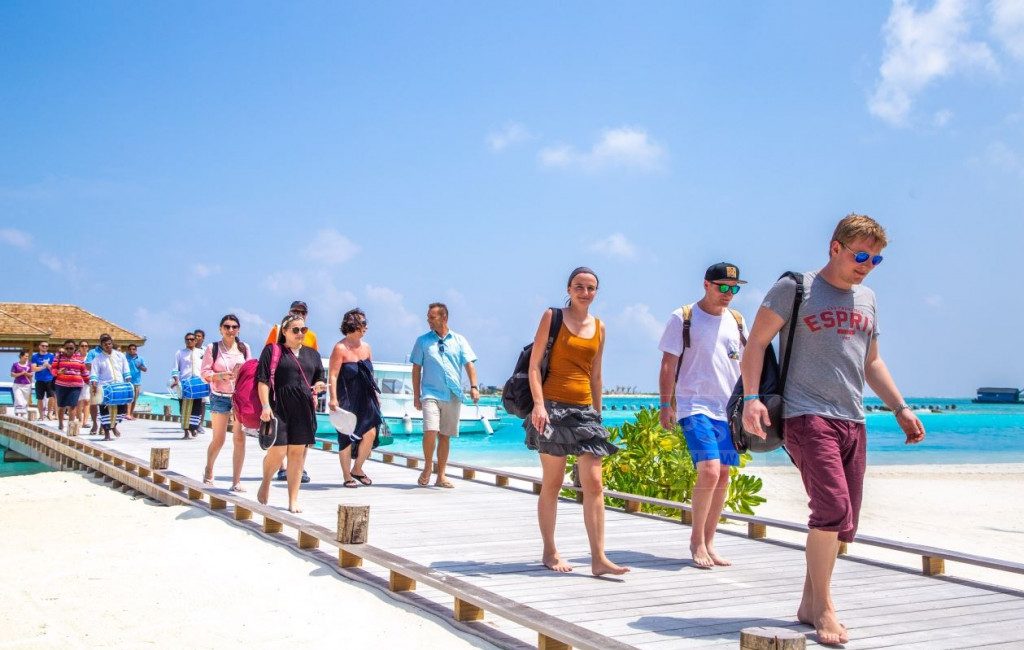
The tourism dimension is also hard to ignore. The Maldives’ brand rests on its reputation as a pristine, apolitical paradise—an escape from global headlines. In recent months, flight disruptions and security concerns linked to the wider Middle East conflict have reportedly contributed to a tourism decline of more than 20%. Hosting talks tied to one of the world’s most volatile rivalries risks associating this “secluded” destination with geopolitics, undermining the confidence of high-end visitors who prize the country’s distance from conflict.
Imagine heavily armed security vessels patrolling within sight of snorkelers, or the shadow of surveillance falling over overwater villas. The Maldives’ carefully curated sun-and-sand brand could quickly become securitized.
Small states have every right to look for innovative ways to amplify their voice. But framing a luxury atoll as the stage for U.S.-Iran diplomacy makes it seem as though branding ambition has temporarily outweighed practical constraints. The Maldives’ greatest comparative advantage remains its ability to offer genuine sanctuary from international tensions. The more sustainable course is to protect that “pristine” and low-key image, rather than testing how much geopolitical weight palm-fringed coral reefs can bear.
For a small island nation like the Maldives, the wisest diplomatic strategy may lie in knowing when to step back—and let the world discover it for the right reasons.
END
(Ms.Tang Lu is a senior journalist who has worked in the Maldives, Sri Lanka and India for many years)
