

Bt Veeragathy Thanabalasingham
Colombo, January 25: Despite the strength of the National People’s Power government with more than a two-thirds majority in Parliament, a healthy trend can be seen in the governance system without arrogance. The people of Sri Lanka have negative experiences of governance during the period of previous governments that had a two-thirds majority in Parliament.
Although President Anura Kumara Dissanayake and other leaders of the government are concerned that their governance should be different from the previous trends, it is obvious that the government is facing problems in functioning in a manner that meets the high expectations of the people.
As for the opposition parties, whether it was the old parties in the south or the Tamil nationalist parties in the north, they have been forced to find a place and voice for themselves in the new political situation after the two recent national elections. They have now initiated efforts to work together.
These efforts raise strong doubts about the possibility of bringing about any substantive change in the current political landscape. The reason for this is the relative lack of popular support for the opposition parties.
The United National Party( UNP) and the Sri Lanka Freedom Party (SLFP ) , which have long dominated politics, no longer have the popular support that even the Janatha Vimukthi Peramuna (JVP) had five years ago. This is mainly due to the policies and actions of their governments. In addition, the two parties have fractured into factions in recent years.
The Rajapaksas’ Sri Lanka Podujana Peramuna(SLPP ) has lost power and support as quickly as it gained immense popular support and came to power. Despite the Rajapaksas’ appeals to those who had defected to rejoin them, none have returned. In fact, hey have no reason to return.
The turmoil faced by United National Parties, Sri Lanka Freeedon Party and Sri LankaPodujana Peramuna has enabled the Samagi Jana Balawegaya (SJB) under the leadership of Opposition Leader Sajith Premadasa to emerge as a significant political force.
Earlier attempts by the UNP before last year’s elections to reach an understanding with the SJB had not yielded results. Realizing the dire situation after their disastrous defeats in the two national elections, politicians from both parties seem to believe that if they work together again, they can pose a challenge to the government in future elections.
The immediate reason for Wickremesinghe and Premadasa’s positive signal about exploring ways to work together is the local government elections that are expected to be held soon. Apart from leadership rivalry and egotism there is no political basis for the two parties to operate separately.
Former President Wickremesinghe has been the leader of the UNP for more than three decades. No previous leader of the party has held the leadership for as long as Wickremesinghe. Even after successive defeats in elections and the collapse of the party’s structures, Wickremesinghe is not ready to relinquish the party leadership. At the same time, the party is in a sorry state where it is impossible to find another viable leader other than him.
Sajith Premadasa formed the new party ahead of the 2020 parliamentary elections only after growing tired of the rebellion within the party against Wickremesinghe’s leadership, which led the UNP to successive electoral defeats. Most UNP politicians joined Premadasa for the sole reason that they could not win the elections with Wickremesinghe.
Premadasa, who had asked Wickremesinghe to hand over the leadership of the UNP to him citing the electoral defeats, has now lost two presidential elections himself. Wickremesinghe holds the dubious distinction of having served as the opposition leader for the longest period in the history of Sri Lankan parliament. Now Premadasa is also the opposition leader for the second time. Given his leadership style and political approaches, it is possible that he too will remain the opposition leader for a long time like his former leader.
The same flaws identified in Wickremesinghe’s leadership style have now led to opposition within the SJB against Premadasa. If the UNP had been even remotely strong, most politicians would have abandoned Premadasa and joined Wickremesinghe. They remain in SJB because they have no other choice.
Even if politicians from the UNP and SJB want to work together, there is no doubt that the egocentric rivalry between Wickremesinghe and Premadasa will be a major obstacle to those efforts. If the two had come to an agreement and one of them had contested last year’s presidential election, Anura Kumara Dissanayake would certainly not have won. Wickremesinghe and Premadasa are ‘shining examples’ of the fact that egocentricity is the key to losing public support. Ego has all the ingredients of unpopularity..
At the same time, any coalition formed under the leadership of either of them is unlikely to gain the trust of the people in the current political environment. It is true that the people, who had high expectations from the National Peoples Power (NPP) government, are somewhat dissatisfied with it as they cannot see any relief from the economic hardships. However, it cannot be said that the people will support the old parties, which are responsible for misrule that is the cause of today’s problems, including the economic crisis, no matter what new form they take.
Unlike in the past, people cannot be said to be loyal to a particular party for long.It seems that people today do not have permanent political loyalties. That is why the leader of the NPP, which received three percent of the votes five years ago, was able to receive 43 percent of the votes in the last presidential election. The alliances led by Wickremesinghe and Premadasa were not able to obtain the votes that both of them received in the presidential elections in the parliamentary elections.
The NPP has received a large number of votes from other parties in the last two elections. Therefore, it is important for President Dissanayake and the government leaders to realize that people who have given them a majority that Sri Lankan parliamentary politics has never seen, will continue to support them. It depends on the honesty and concern shown by the government in fulfilling its promises.
Meanwhile, the Tamil nationalist parties, which suffered a major setback in the parliamentary elections, are also showing interest in working together. These efforts are being spearheaded by the leader of the Tamil National People’s Front (TNPF) Gajendrakumar Ponnambalam. He initially held talks with Ilankai Thamizharasu Kadchi (ITAK) MP Sivagnanam Sritharan and Democratic Tamil National Alliance (DTNA) MP Selvam Adikkalanathan.
They say that the they have embarked on these efforts with the aim of presenting solutions to the national ethnic problem together when the NPP government begins the process of drafting a new constitution. In addition, their efforts to unite are based on the proposals put forward by the now defunct Tamil People’s Council (TPC), which was formed about ten years ago by some Tamil parties and civil society organizations when C.V. Wigneswaran was the Chief Minister of the Northern Province.He was prominent leader of the TPC.
Although Sridharan is cooperating with these efforts, the ITAK is not officially involved. It seems that it is because of opposition to Sridharan’s engaging in these unifying efforts alone as the leader of the ITAK parliamentary group. The party’s central working committee last week appointed a seven-member committee to participate in the negotiations that may be held with other Tamil parties regarding a political solution for the ethnic problem. It is not known whether the ITAK will participate in the negotiations with Gajendrakumar. But the decision of the central working committee actually prevents Sridharan from participating in the talks all alone. Having acted outside the party’s official decisions on some previous occasions, it is also not known whether he will comply.
The position of the ITAK central working committee is that talks with other Tamil parties should be held based on the party’s resolutions regarding the political solution. So it is not possible for the ITAK to cooperate with the efforts to unite the Tamil parties based on the proposals of the Tamil People’s Council.
It seems that the leaders of the Tamil nationalist parties believe that if they work together again, the Tamil people will once again support them overwhelmingly. However, it is unfortunate that Tamil leaders refuse to realize that the Northern Tamils were forced to support the NPP because of their failure to follow a pragmatic political approach and act in accord with the demands of the situation in the past fifteen years.
President’s China visit
President Dissanayake’s first two official international bilateral engagements were visits to India and China, the two Asian giants, engaged in a geopolitical tug-of-war. The President visited China last week, exactly a month after returning from India. He declared that both visits were tremendously successful. Sri Lankan presidents’ visits to India and China are usually watched more closely by international diplomatic and political circles than any their visits to any other country. President Dissanayake’s visits to these two countries were also watched closely. The main reason for this is the rivalry between India and China in maintaining their economic and strategic interests in Sri Lanka.
The help and support of these two countries is crucial for Sri Lanka to recover from the economic crisis. China has already increased its influence in Sri Lanka through large loans and investments in infrastructure projects. China is Sri Lanka’s largest bilateral creditor.
However, India, which cannot compete with China in providing financial and economic assistance, seized the opportunity opened by the unprecedented economic crisis that hit Sri Lanka three years ago and provided financial and material assistance. During his visit to both countries, President Dissanayake has signed numerous agreements to enhance cooperation in various sectors. It is said that Sri Lanka has got an opportunity to attract investments of about 10 billion US dollars from Chinese companies as a result of the President’s visit to China.
The concern shown by Sri Lankan polity during Dissanayake’s visit to New Delhi to be careful about what promises he should make to the Indian government was not seen during his visit to China. This is the big difference that can be seen in Sri Lanka’s relations with the two countries. India’s economic assistance, investments and strategic interests have always been viewed with suspicion by the South Sri Lankan polity. But that suspicion is not seen in the case of China. Although Sri Lankan leaders talk a lot about their historical and civilizational ties with India, they have fundamentally viewed India’s intentions with suspicion. They do not display such an attitude in their relations with China. It is an open secret that Sri Lankan leaders have a different mindset when they go to India than when they go to China.
Indian leaders are well aware of the difficulties in dealing with Sri Lanka. Sri Lankan Tamils are the ones who suffer the most as a result. This is because New Delhi has recently been adopting an approach that does not make Sri Lankan governments uncomfortable regarding the Tamil problem.
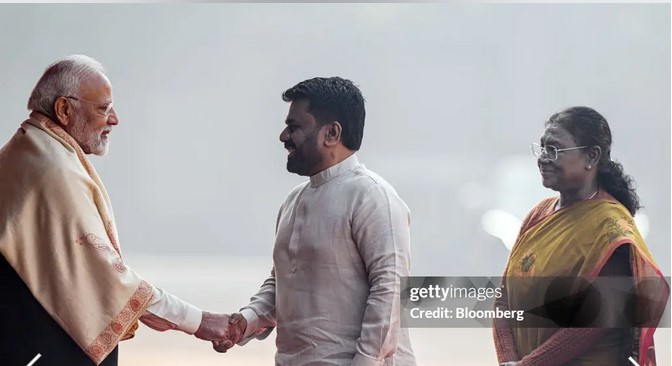
Sri Lankan Tamils and the political parties are very much worried about Indian Prime Minister Narendra Modi’s avoidance of speaking publicly about the controversial 13th Amendment during President Dissanayake’s visit to New Delhi last month.
Although the Indian government has sought to develop relations with Dissanayake and his government, forgetting that he is the leader of a political party that has traditionally had an anti-India political stance, there have been no clear signs that his party is ready to completely abandon its old attitude.
It has been customary for Sri Lankan leaders to renege on some of the agreements made in India upon return to Sri Lanka in order to overcome domestic opposition. Sri Lanka’s new government leaders are no exception to that trend. But when it comes to China, it seems that there is no chance of domestic opposition to any agreement or understanding with Beijing.
Balancing relations with China and India is a real tightrope walk for President Dissanayake. In Beijing, he promised that he would not allow any action on Sri Lankan soil that could pose a threat to China’s interests. At the same time he promised in New Delhi that he will not allow Sri Lankan soil to be used to any action that would be a threat to India’s security and regional stability.
Historically, Sri Lankan governments have been more comfortable in their relations with China than with India. The basic reason for this is that unlike the Sri Lanka-India relations, there are no sensitive issues such as the Tamil issue in the relations with China.
Be that as it may, the reality behind today’s geopolitical situation is that President Dissanayake’s government’s stability also lies in his deft handling the relations with India and China.He cannot afford to antagonize either.
( The writer is a senior journalist based in Colombo)
END
