
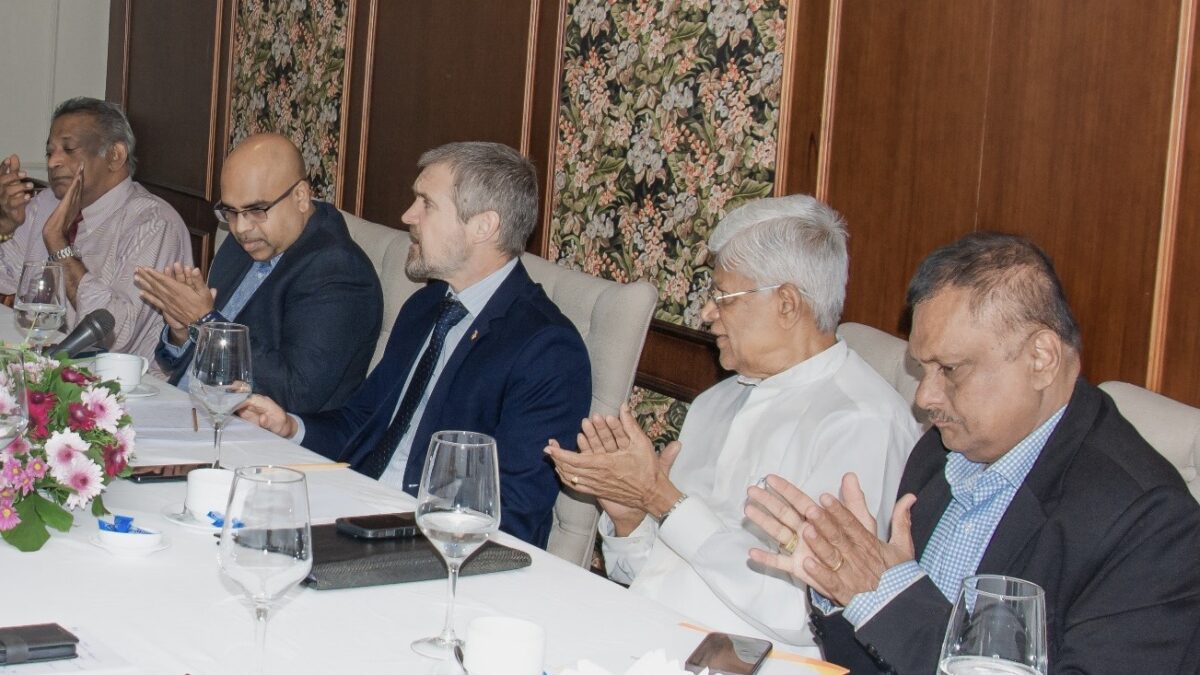

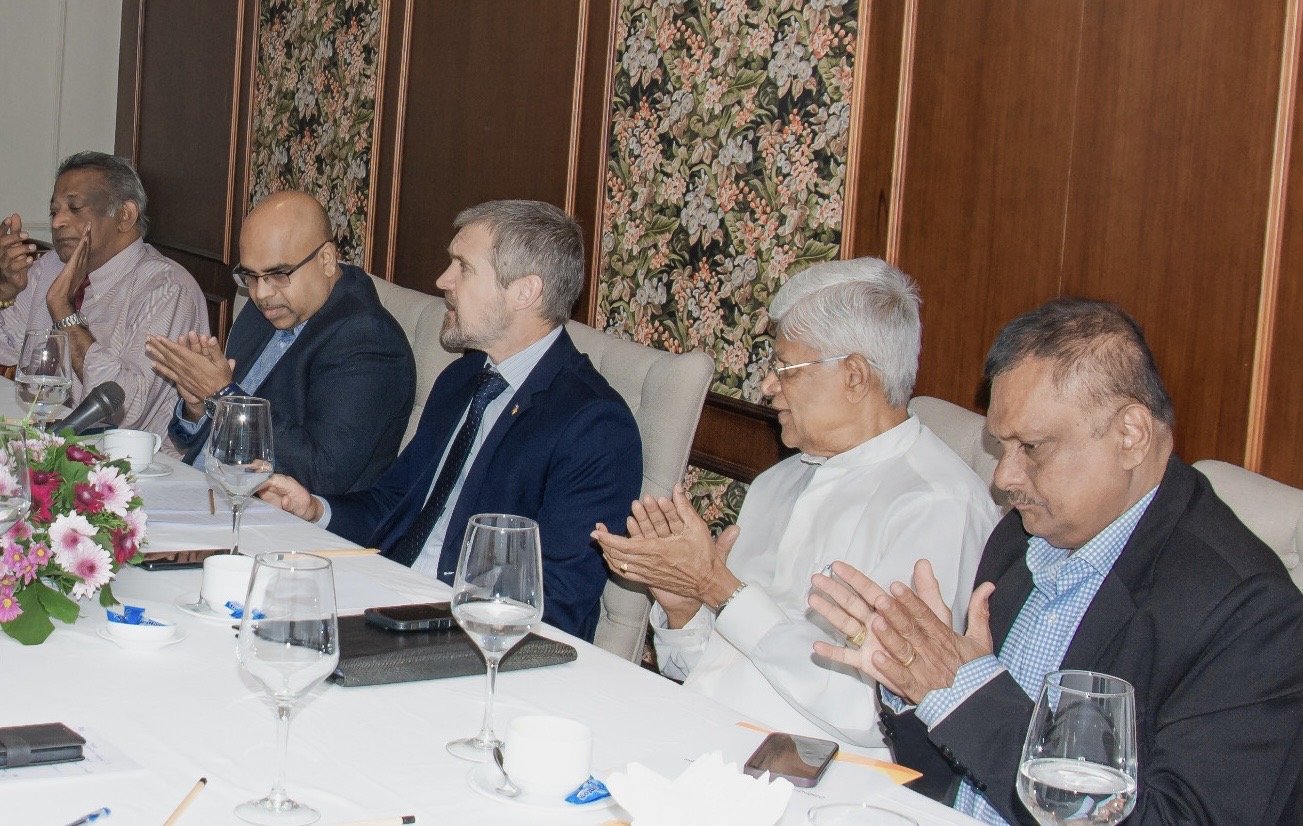
Colombo, February 15 – Speaking at the Pathfinder Foundation’s Ambassador’s Roundtable the High Commissioner of Australia to Sri Lanka, His Excellency Matthew Duckworth, outlined Australia’s vision for an era of “amplified middle power diplomacy,” emphasising resilience, principled engagement, and practical cooperation to safeguard peace and stability in the Indian Ocean region.
Welcoming the High Commissioner, Chairman of the Pathfinder Foundation, Bernard Goonetilleke, highlighted the timeliness of the discussion, noting that the rules-based international order is under unprecedented strain amid shifting power balances and intensifying geopolitical competition. He underscored the importance of dialogue on the role of middle powers, particularly in the Indian Ocean, where Sri Lanka and Australia share significant maritime interests.
In his address, the High Commissioner observed that the global environment is increasingly characterised by strategic contestation, economic coercion, supply-chain vulnerabilities, and mounting pressure on multilateral institutions such as the United Nations and the World Trade Organization. Citing remarks by Australian leaders and other international counterparts, he argued that middle powers can no longer assume that major powers alone will uphold the global rules and norms that have underpinned decades of relative stability and prosperity. Defining middle powers as states neither dominant nor insignificant, but sufficiently capable and credible to shape outcomes through coalition-building, he stressed that such countries must exercise agency.
Drawing on Australia’s experience, the High Commissioner referred to a period when approximately AUD 20 billion of Australian exports were subject to trade restrictions. He stated that although the measures imposed economic costs, Australia did not compromise sovereignty and ultimately stabilised relations and restored trade through dialogue and adherence to international trade mechanisms. The episode, he suggested, demonstrated that middle powers are not without leverage and can withstand pressure while remaining open to constructive engagement.
Turning specifically to the Indian Ocean, he described Australia as an Indian Ocean nation with an extensive coastline, island territories, and an Exclusive Economic Zone largely within the region. He noted that two-thirds of Australia’s trade passes through Indian Ocean sea lanes and emphasised the region’s importance to global energy flows and maritime security. He reiterated Australia’s commitment to freedom of navigation, respect for sovereignty, and the peaceful resolution of disputes.
The High Commissioner also highlighted Australia’s efforts to strengthen regional resilience through maritime security cooperation, disaster preparedness, climate adaptation, and support for renewable energy transitions. He pointed to Australia’s engagement with institutions such as the Indian Ocean Rim Association (IORA) and “minilateral” platforms, including the Quad and the Combined Maritime Forces, as practical examples of middle powers working together to address shared challenges ranging from piracy to humanitarian assistance. He underscored that such cooperation is not directed against any particular country but aims to preserve an open, inclusive, and rules-based regional order. While acknowledging the reality of major power competition, he stressed that Australia seeks stable and respectful relations with all countries, cooperating where possible and disagreeing where necessary, without compromising core national interests.
During the interactive question-and-answer session, participants raised issues such as India’s evolving role in the Indian Ocean, the trajectory of China’s rise, the durability of the current global order, alliance dynamics, and Sri Lanka’s positioning in the Indian Ocean.
Responding to a question about India, the High Commissioner affirmed that Australia expects all major powers—India, China, and the United States—to act transparently and to respect the sovereignty of smaller states. On whether the current emphasis on middle-power diplomacy is a temporary shift or a long-term trend, the High Commissioner stated that middle powers must now play a more visible and proactive role in sustaining international norms and institutions.
The discussion also covered trade diversification, Sri Lanka’s interest in acceding to the Regional Comprehensive Economic Partnership (RCEP), and opportunities for expanded Australian investment in sectors such as minerals, renewable energy, textiles, and education services. The High Commissioner reiterated Australia’s support for open trade and deeper regional economic integration, emphasising the importance of economic resilience in a contested global environment.
The session concluded with informal exchanges over tea and coffee, offering further opportunities for engagement among diplomats, academics, policymakers, and media representatives.
The Pathfinder Foundation is a Colombo-based think tank dedicated to fostering informed dialogue on foreign policy, economic development, and strategic affairs. Through the Ambassador’s Roundtable, held monthly, it provides a platform for candid discussion among foreign envoys and Sri Lankan stakeholders on issues of regional and global significance.
END
Australia, Sri Lanka. Middle Powers, Indian Ocean, Pathfinder Foundation,
