

By P.K.Balachandran/Daily News
Colombo, September 9 – In early medieval Sri Lanka (from the 13 th. to the 16 th.Century), the exercise of coercive power alone did not entitle a King to claim sovereignty. The touchstone of sovereignty was the King’s adherence to Buddhism, its principles and its institutions, besides abiding by time-honoured Sri Lankan Kingly traditions. The King not only had to abide by the prescriptions of the Buddha Sasana, but also control the Sangha.
The hallmarks of a true Sinhala-Buddhist sovereign are described by cultural historian Anne M. Blackburn of the University of Hawaii in her book “Buddhist-Inflected Sovereignties across the Indian Ocean – The Pali Arena, 1200–1550.” Blackburn takes the case of the early rulers of Dambadeṇiya, a Kingdom in South West Sri Lanka to illustrate her thesis.
The Kingdom of Dambadeniya was established in the 13 th. Century by a mix of coercive force and commercial successes. Vijayabahu III (1232-1236), the founder of the Dambadeniya Kingdom, had first established himself first in Ratnapura. But he and his son, Parakramabahu II (1236-1270), subsequently expanded their domain by defeating the local rulers and foreign invaders like Kalinga Magha from India and Chandrabhanu from Malaya.
Vijayabahu III secured control of South Western Sri Lanka called “Maya Raṭa”. His capital was at Dambadeṇiya in the present North Western Province.
Burgeoning Indian Ocean Trade
Vijayabahu III and Parakramabahu II were successful in their military campaigns because of the strategic location of Maya Raṭa. The mountainous area around present-day Kurunegala and Dambadeṇiya, provided natural protection. In addition, Dambadeṇiya offered easier access to the island’s Southern and South Western seaports which were active at that time due to the booming trade across the Indian Ocean.
In the Indian Ocean ecosystem, Sri Lanka offered valuable commodities such as spices, gems, pearls, and areca nut. And the island’s Southern and Western ports provided the most effective access to most of these items found in the hinterland. Therefore, ports like Mantai in the North and Trincomalee in the East declined, adversely affecting the ancient Kingdoms of Anuradhapura and Polonnaruwa.
Quest for Sovereignty
Having acquired political power and a domain of their own, Vijayabahu III and Parakranabahu II set about acquiring legitimacy or “sovereignty” and for that they needed to acquire certain hallmarks.
They imitated the earlier articulations of sovereignty found in the Kingdoms of Anuradhapura and Poḷonnaruwa. Simultaneously Dambadeniya’s intellectuals (Pandithas) and Parakramabahu II (who was himself a Panditha) delved deep into Pali, Sinhala and Sanskrit texts on the Buddha Sasana dating back to the middle of the first millennium AD to find attributes of true Kingship. They even established a lineage, albeit mythical, with Emperor Asoka of India whose son and daughter had brought Buddhism to Sri Lanka.
Both Vijayabahu III and Parakramabahu II took to restoring palaces, monastic dwellings, and ritual sites in Poḷonnaruwa to position themselves as successors to the glorious Poḷonnaruwa civilization. Even the regnal name adopted at Dambadeniya “Siri Sanga Bo Parakramabahu” indicated the aspiration to recapture greatness of the Anuradhapura period.
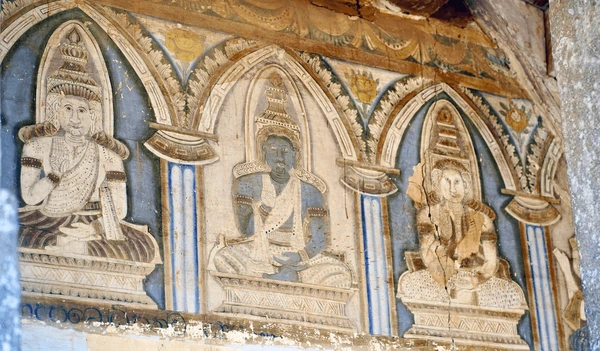
The name “Parakramabahu” evoked memories of the first King of Poḷonnaruwa, Parakramabahu I (1153-1186). Parakramabahu I had unified the three sub kingdoms of Sri Lanka, overseen the expansion and beautification of his capital, Polonnaruwa, constructed extensive irrigation systems, reorganized the country’s army, reformed Buddhist practices, encouraged the arts and undertook military campaigns in South India and Myanmar. The adage “not even a little water that comes from the rain must flow into the ocean without being made useful to man” is attributed to Parakramabahu I.
To cement his links to Polonnaruwa, King Parakramabahu II of Dambadeniya, undertook renovation of the buildings in Polonnaruwa such as the Hatthavanagalla Vihara near Gampaha. He interred the remains of his father Vijayabahu III there.
The Mahavaṃsa, composed in the middle of the first millennium AD, had delineated the attributes of royal conduct and sovereignty. And since the Mahawamsa was updated in the first half of the second millennium it covered generations of rulers, scholars, and officials, enhancing its influence.
Buddha’s Relics
The Mahavaṃsa’s chapters on Anuradhapura stressed the centrality of the Buddha’s relics in claiming sovereignty. A monarch’s right to rule, including the celebration of coronations and major military victories, was to be demonstrated by highly public, large-scale, royal patronage of the Buddha relic sites. To stress their importance, the Mahawamsa devoted six chapters to King Duttagamini’s offerings to Buddhist relics after his military victories.
Kelaniya and Sri Pada
Given the long distance between Dambadeniya and Anuradhapura, Dambadeniyas rulers had to find easily accessible alternatives to the holy sites in Anuradhapura like Thuparama and Ruvanvalisaya. There were two locations of particular interest in the South Western region, namely, Kelaniya and Sri Pada.
Both the Dipavaṃsa, a fourth-century Pali work, and the first instalment of Mahavaṃsa, had narrated a visit by the Buddha to Kalaniya, near Colombo. In addition to Kelaniya, the auspicious footprint of the Buddha on Samantakuṭa (Peak of Peaks) was recognized as a relic since at least the time of the first instalment of the Mahavaṃsa.
At King Parakramabahu II’s request, a leading official of his realm entitled the Devappatiraja, and referred to in the Pujavaliya as his confidant and minister (Amatya), undertook a massive set of renovations and infrastructural improvements at Sri Pada.
An image of Saman, a protective deity, was installed on the Peak of Peaks. Bridges were built to improve access to the Peak from various directions, as were pilgrims’ rest houses. The Amatya himself performed exacting rituals on behalf of his sovereign to underscore his chief’s status.
Sangha Katikavata
The determination of Parakramabahu II to portray himself as inheriting the mandate of earlier rulers in Sri Lanka manifested also in the promulgation of a Sangha Katikavata, a regulatory prescription for all monks within his realm.
The Sangha Katikavata he promulgated appears to have originated in Polonnaruwa under Parakramabahu I. The latter had issued this document as a stone inscription to reorganize the monastic community in areas under his control. Subsequent Sangha Katikavatas followed the language of the original. A version of Parakramabahu I’s Sangha Katikavata was available to the royal house of Dambadeṇiya, which incorporated parts of it into its own new regulatory text.
Control Over the Sangha
The Dambadeṇi Katikavata shows the King’s efforts to control the Sangha. Control of the Sangha was considered to be central to Statecraft. Historian R. A. L. H. Gunawardana’s work on the Anuradhapura inscriptions showed (and later inscriptional references continued to attest) that Buddhist monks and their institutions often played a central role in Sri Lanka’s economy and politics. Lankan monasteries and monastic lineages owned land from the Anuradhapura period onwards as a result of donations, especially from ruling families. They also owned or controlled agricultural workers and artisans. This gave them great clout.
The monasteries were involved in cash or credit transactions. In addition, there are indications that high-ranking monks tended to be persons from high class families, which suggested they would have had relatives or other close associates in powerful institutions such as the King’s court and the military.
This explains why sovereigns attempted to centralize control over the Sangha and why control tended to become more elaborate as Kingdoms expanded geographically.
Like his predecessors in Anuradhapura and Polonnaruwa, King Prakramabahu II of Dambadeniya controlled the Sangha in his domain through the Katikavata proclaimed by him, thus underscoring his sovereignty over the most important institution in his realm.
