
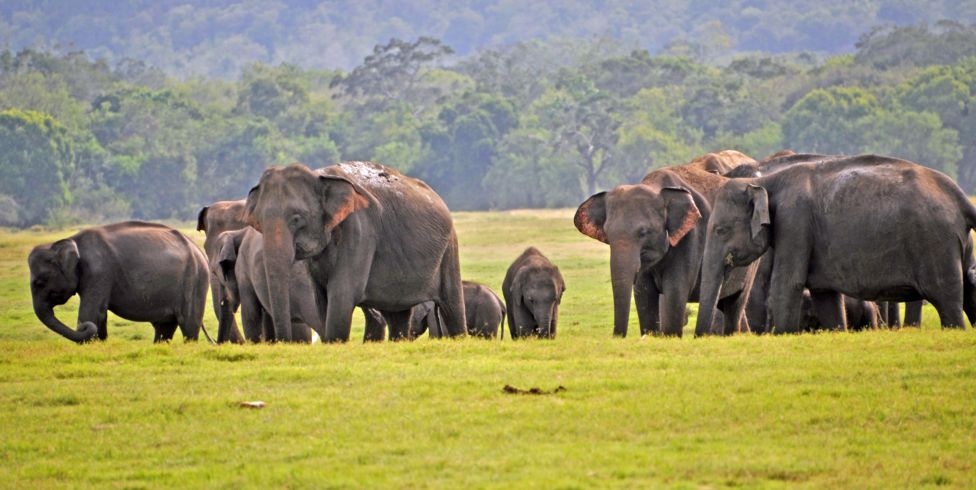

Colombo, March 11-The human-elephant conflict in Sri Lanka continues unabated. Although efforts by successive governments since the 1970s have reduced the rate of attrition and there are about 7,000 elephants still in existence, the issue remains a pressing concern. It is internationally listed as an endangered species.
Historically, human societies in South and South East Asia have had a close association with elephants. In the past, elephants were revered rather than seen as adversaries. Even today, they hold a sacred place in religions such as Hinduism and Buddhism, despite being viewed as a menace by modern villagers due to their frequent raids for food.
According to Hindu mythology, the gods (Devas) and demons (Asuras or Yakshas) churned the ocean in search of the elixir of life, during which nine sacred jewels emerged—one of them being the elephant. This divine origin made the elephant a symbol of good fortune in Hinduism. The elephant-headed deity Ganesha is venerated as the remover of obstacles. In South India, before entering temples dedicated to Lord Shiva, devotees first pay homage to Ganesha. Similarly, in North Central Sri Lanka, villagers install Ganesha statues to ward off wild elephants.
In both South India and Sri Lanka, elaborately decorated elephants are central to religious processions. Records of the use of elephants in Sri Lankan Buddhist rituals date back to the 3rd century BCE. Historical sources even mention the donation of elephants to temples, with the earliest recorded instance occurring in the 1st century CE. Prior to the advent of cavalry warfare, elephants were a vital asset in battles, and Sri Lanka engaged in a thriving trade of elephants with India.
Rising Conflict and Slaughter
Despite this historical reverence, human-elephant relations have deteriorated over time. The exponential growth of the human population and encroachment on elephant habitats have intensified conflicts. The British, who ruled Sri Lanka from about the beginning of the 19th.cetury to 1948, did a lot of damage, indulging in indiscriminate slaughter to develop their plantations as well as for sporting pleasure.
Until 1830, elephants were so plentiful that their destruction was encouraged by the government, and rewards were paid for any that was killed. A British army major was credited with having shot over 1,500 elephants.Between 1829 and 1855 more than 6,000 elephants were captured and shot under order of the government. The number declined to less than 2000 in the 1970s. But government’s conservation efforts led to the number to about 7000 to 7500 now.
But the killings or deaths of elephants go on with villagers killing to protect thneselves, their crops and homesteads as forest areas are now being encroached for human activities and settlements.
Sri Lanka’s Minister of Environment, Dammika Patabendi, recently reported alarming statistics in Parliament. Between 2015 and 2019, 1,466 wild elephants were killed. This number increased to 2,011 between 2020 and 2024.
Human casualties also rose sharply. Between 2015 and 2019, 456 people were killed due to elephant encounters. The figure surged to 734 between 2020 and 2024. In total, Sri Lanka lost 3,477 wild elephants and 1,190 human lives from 2015 to 2024.
To combat this crisis, the Sri Lankan government has implemented several measures, including: Constructing electric fences; Reopening blocked elephant corridors; Increasing food availability in elephant habitats; Establishing wildlife reserves; Deploying security task forces to deter elephant incursions into human settlements; and Developing regulated tourism.
Oswin Perera’s Contention
However, according to B. M. A. Oswin Perera of the Faculty of Veterinary Medicine & Animal Science, University of Peradeniya, in spite of the severe hardships and economic losses suffered by rural folk, many still have a positive attitude towards elephant conservation. The main activities of the Department of Wildlife Conservation are establishment of new National Parks, elephant corridors and conservation areas; habitat enrichment; capture and translocation of problem animals; collective drives of herds to Protected Areas; electrical and biological fencing; and provision of assistance and thunder flashes to villagers to drive away invading elephants.
Two further initiatives for elephant conservation are ex-situ conservation at the Pinnawela Elephant Orphanage and re-introduction of orphans in to the wild from the Elephant Transit Home at Uda Walawe. Many NGOs are engaged in community level activities and educational programmes for conservation of elephants and mitigation of the conflict.
In the past and even now, the main mitigation measures used by villagers have been, making sounds using voice, fire-crackers and thunder flashes; lighting lamps or fires around homesteads and fields; keeping watch at night in huts built on trees; hanging metal or glass objects on perimeter fences; planting live fences of thorny scrub; and use of shot-guns to scare or injure elephants.
However, elephants often get habituated to these measures and even became more aggressive with time, Oswin Perera says in his paper on the subject. He has stressed the need to (a) organize proper awareness programmes and establish good communication channels with villagers; (b) recruit and train villagers to handle village level management activities for preventing elephant intrusion; (c) introduce crop diversification using species that are not favoured by elephants; (d) promote alternative economic activities (e.g. inland fishery, livestock industries); and (e) consider relocation of elephants or humans in areas where no other alternative exists.
Thai Three-Zone Strategy
Thailand, often called the “Land of the White Elephant,” has a long-standing cultural reverence for elephants. However, the country has faced a severe human-elephant conflict due to habitat destruction and rapid urban expansion. The issue escalated to hundreds of deaths annually among both humans and elephants. Recognizing the urgency, the Thai Royal family initiated a government scheme called Bajrasudha Gajamurak Project in 2019.
This project, implemented in five eastern provinces—Chachoengsao, Chonburi, Rayong, Chanthaburi, and Sa Kaeo—focuses on creating a sustainable balance where both humans and elephants can coexist.
The project strategically divides areas bordering forests into three distinct zones: Forest Conservation Zones- designated areas where elephants can thrive naturally with sufficient food and water; Buffer Zones- transition areas with food sources and artificial water bodies that prevent elephants from venturing into human settlements and Community Zones – exclusively for human habitation, with strategies to deter elephant encroachment and promote coexistence.
Forest Conservation Zone
In the Forest Zones, 60 water sources with a combined capacity of 1.8 million cubic meters were established; reforestation to restore natural food sources was undertaken. Bamboo, mango, and banana trees were planted to ensure a sustainable food supply for elephants.
Buffer Zone
Buffer zones were create to act as temporary dwellings for elephants before they were guided back to conservation areas. Key measures in the buffer zones were as follows; creation of grassy meadows with check dams to ensure consistent water availability; introduction of strongly scented plants such as climbing wattle and cassia, which elephants avoid; establishment of community forests with medicinal plants to benefit both villagers and wildlife.
Use of Artificial Intelligence
A Comprehensive Elephant Surveillance System equipped with AI-powered automated cameras was implemented. These cameras, installed in buffer zones, detect elephant movements and send real-time alerts via the LINE chat app to villagers and trained volunteer teams, who then guide the elephants back to their habitats.
Community Zones
In the community zones, local populations received; awareness training on elephant behaviour and conflict mitigation; skill development programs to diversify livelihoods, and financial support for alternative income sources such as medicinal herb cultivation, basket weaving, and food processing.
As a result, communities transitioned from single-crop farming to multiple cropping systems, reducing dependence on land encroachment. The project fostered solidarity among villagers, strengthening communal efforts toward sustainable coexistence.
Model for Sri Lanka
The Bajrasudha Gajamurak model provides an effective, structured, and sustainable solution to human-elephant conflict. Sri Lanka, facing a worsening crisis, could benefit immensely from trying out a similar approach, particularly in conflict-prone areas. Implementing Thailand’s zoning strategy, AI-based surveillance, and community-driven conservation could pave the way for a more harmonious coexistence between humans and elephants.
END
