
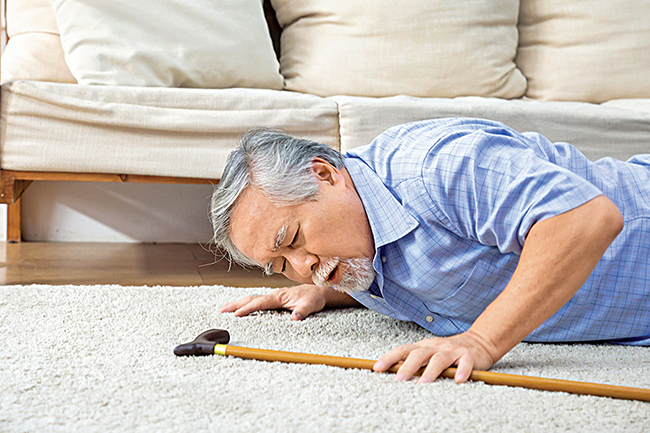

By Nadira Gunatilleke/Daily News
Colombo, October 7 – These are the excerpts from an exclusive interview conducted with Dr. Lasantha Ganewatta Consultant Physician (MBBS (SL), MD (Colombo), FRCP (London), FRCP (Edin.), MRCP (UK) Diploma in Geriatric Medicine- DGM (UK), MRCP-SCE (Geriatrics) (UK) , MRCP (Endocrinology & Diabetes) (UK) (Member of British Geriatric Society) on various types of falls often experienced by elders during their day to day life.
Why it is important to know about falls among older adults?
Falls occur at all ages and are an inevitable part of a bipedal gait and physical activities. However, It becomes very common among older adults. It is found that falls occur in one third of older adults aged over 65 years (considered as Geriatric age group) annually. Furthermore, two third of older people will have recurrent falls if they had a fall over the previous year. Consequences of these falls are more serious leading to personal distress, associated subsequent morbidity, disability, hospitalisation and mortality. It also leads to the placement of older adult to a residential home or nursing home as it is difficult to manage at usual residence. Falls related societal and economic consequences are substantial. You will understand the gravity of the problem considering that, no much change global burden of falls among elders over the period of time even with the advancement of very solid researches regarding falls and improvement of delivering the care by clinicians.
It is found that 10 to 15 percent of falls results in serious injuries and these injuries are the fifth common cause of death among older adults. 75 percent of people who ended up with hip fractures following a fall will not regain the prior level of functional capacity.
What are the common causes of falls?
We all could understand by observing the gait or walking carefully, the successful ambulation of a human being depends on the complex integration of cognitive, neuromuscular, sensory, and skeletal components. Impairment of any of these key components will lead to impaired mobility and falls. Mobility assessment is a major part in Geriatric assessment with the assessment of interrelated components like their cognition, vision, hearing, nutrition and psychological assessment. Following are the major risk factors leading to falls,
* Gait and balance impairment
* Problems in hearing and vision
* Muscle weakness and problems in nerves in legs and feet
* Nutritional deficiencies mainly protein and vitamin D
* Dementia and related other cognitive impairments
* Loss of inbuilt physiological reserve or Frailty
* Side effects and interactions of medications
* Improper use of walking aids and foot wear
* Environmental hazards are the other major contributor for falls among elderly. Some of common hazards are as follows.
Poor lighting
Cluttered furniture and house hold goods
Slippery floor
Pets
* Fall in an elderly person could be the presenting symptom of and acute illness of which does not have a direct relationship to the mobility. Common acute illnesses leading to falls are infections, heart attacks, heart rhythm abnormalities, brain strokes, pain and convulsions.
How we could find older people who are at risk of falls?
This is the most important part of this discussion. We need to find older adults who need comprehensive assessment of their mobility and falls. There are two categories. First category is the adults who presents to medical care following a fall or related injury. Obviously, they will have serious consequences including recurrent falls if not evaluated properly. Other category is opportunistic case finding among older adults come for medical care due to some other reason They are asked three key question for screening purposes to find the risk population. Following are those three questions.
01. Has fallen in the last year?
02. Feels unsteady when walking or standing?
03. Worries about falling?
If our older adult says at least ‘yes’ to one question, he needs further evaluation of risk, severity and assessment.
What are the basic evaluation methods for falls?
It is most of the time multi disciplinary assessment involved by the physician and the team, nurses, physiotherapist, occupational therapist and other disciplines accordingly. It is important to take thorough history of the fall and medication assessment and physical examination specially gait and balance assessment. Then patient tailored assessment of nutrition including testing vitamin D levels, memory assessment, basic evaluation of hearing and vision. If we suspect problems of walking and balance, patient is referred to the physiotherapist for further testing and to explore safe mobility. Occupational therapist will assess the older person if we suspect environmental hazards and unsafe house hold clutters and will make sure safe environment.
In addition to that some blood tests and brain scans are done for selected patients following the basic evaluation as described above.
Commonly, elders will be unsteady on their feet when they stand up due to sudden drop of blood pressure on standing. This mostly found in people who take one or more blood pressure pills. Therefore, measuring blood pressure both in lying down position and standing position is important and need to attend if there is a sizable discrepancy.
What do you mean by a high risk fall?
We identify high risk falls by assessing following areas among older adults.
* If there is an injury following the fall
* Two or more falls last year
* If there is associated frailty or lack of inbuilt physiological and biological reserve
* Patient was unable to get up from following the fall
* IF there is associated loss of consciousness
If a fall associated with at least one of these criteria, that person is categorise as high risk and multifactorial risk factor evaluation is done. That particular category needs frequent follow-up.
How can elders prevent falls?
Falls prevention among older adults is a vast topic. It needs involvement of multidisciplinary falls prevention team and care givers of the older person. Prevention methods should be patient tailored and closely discussed with the patient before implementing. I will briefly discuss multidomain falls risk interventions.
01. Educate them about falls stating the common risk factors as discussed in previous sections.
02. Exercise and physical activity
Balance challenging and functional exercises with three or more times of sessions per week. This includes, when feasible, of Tai Chi and/or additional individualised progressive resistance strength training. Exercise programmes that need to be of sufficient intensity and duration should be delivered in a way that ensures safety and considers functional abilities of older adults.
03. Medication review
Our frequent observation is that many of older adults are looked after by more than one doctor and have two or three prescriptions leading the many adverse out come. We advise you to show your all medications to the regular doctor and have an appropriate prescription.
04. Interventions to prevent blood pressure drop on standing
Adequate hydration and compression garments to restore blood supply from legs to heart are some of these. If there is a culprit medication, your doctor will change it accordingly.
05. If you live alone, tele health and smart home systems are important interventions used in many developed countries.
06. Make your home safer
Remove clutter and put often-used items in easy reach so you don’t need to step on a chair or even a stepladder to reach something. Improve lighting and do not try to navigate your home in the dark. Remove throw rugs and mats; they are a common tripping hazard. Put nonskid mats on the floor. Look at the arrangement of your furniture. Make sure there is plenty of space to walk. Remove glass table tops and heavy cupboards to make the space safer in case of a fall. Add grab bars in the bathroom, and make sure all staircases have handrails and are well-lit. Avoid climbing ladders for any reason. (Ask a family member or neighbor to change those ceiling lightbulbs for you.)
Avoiding pets inside the house is advisable to prevent falls.
Wear sturdy and nonslip shoes:
Make sure they fit well and have a sole with a strong grip. Heels, slick soles and shoes with “nubs” on the sole can increase fall risk. If you wear slippers at home, make sure they have a rubber sole that does not slip.
If you use walking aids get proper advice from a physiotherapist.
07. Alleviation of pain
Adequate pain relief in your leg joints and back spine is important.
08. Restoration of vision and hearing is paramount important. If you feel dizzy and suffering from vertigo you need to assess your ears for balance.
09. Adequate nutrition with proteins, calcium and vitamin D is important to prevent loss of muscle mass and function (sarcopenia) as well as loss of bone mass (osteoporosis).
10. Finally, meet your doctor regularly and control long standing medical problems like diabetes and high blood pressure.
END
