

By P. K. Balachandran/Sunday Observer
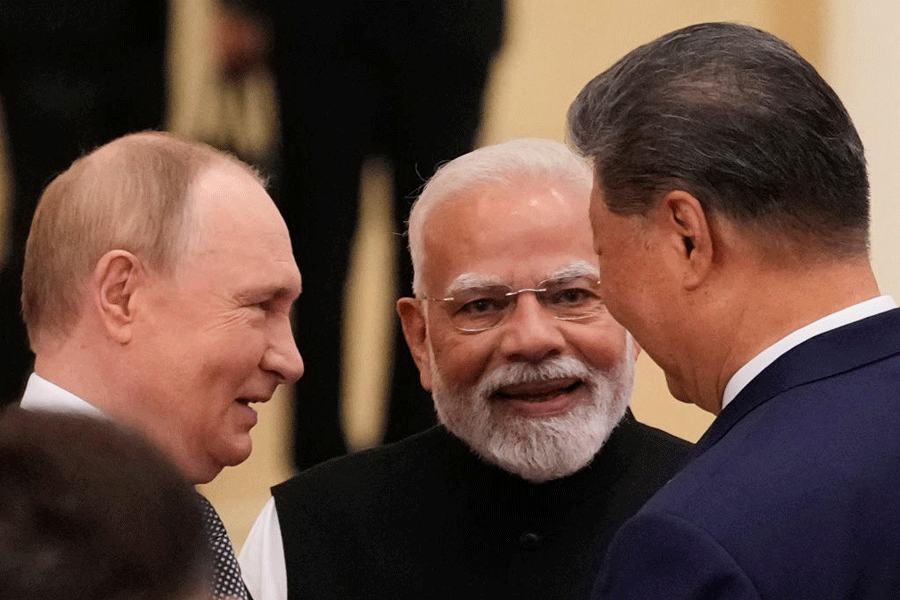
Colombo, September 14 – Indian Prime Minister Narendra Modi and Chinese President Xi Jinping who met on the sidelines of the Shanghai Cooperation Organisation (SCO) summit in Tianjin on August 31, agreed to respect each other’s core interests, exercise strategic autonomy, and view each other’s policies independently without looking through the lens of third parties.
The SCO summit raised hopes about the dawn of a new era in Asia based on peace, cooperation and constructive engagement in place of conflict, hegemonism and protectionism.
Modi and Xi agreed that India and China were “partners, not rivals” and that “differences between them should not be turned into disputes”.
In other words, China would recognise India’s right to build relations with the US and Japan. Presumably China would not cast aspersions on India for being in QAUD, a US-led association allegedly aimed against China in the Indo-Pacific region. The QUAD, which New Delhi has described as an “important developmental platform”, is to have a summit in India later this year.
India also expects that China would not make an issue of its objections to the Belt and Road Initiative (BRI). On its part, India overlooked China’s conspicuous support for Pakistan in the May India-Pakistan air war. If it did, Modi would have boycotted the SCO summit or addressed it virtually.
Controversy over China trip
When Prime Minister Modi decided to attend the summit in Tianjin, after US President Trump’s 50 percent tariff on Indian goods, many interpreted his holding the olive branch to China as a way of getting even with Trump.
Trump had not only supported Pakistan in the May war over Kashmir, but had called India the “King of Tariffs” and declared its economy “dead”. His officials accused India of “profiteering” on imported Russian oil and filling the coffers of a privileged few, who an US official described as “Brahmins”.
Western, and many Indian commentators too, described India’s sudden and sharp tilt towards China as a knee jerk reaction that would only harm India in the long run. It was pointed out that Indo-US relations had been built up over 20 years and were multi-faceted. Trade with the US had also been consistently in India’s favour.
Critics also said that Sino-Indian relations were fraught since 1949. The two countries had fought a full-scale war in 1962 and in the last few years, India had to face large scale Chinese incursions on the Sino-Indian border. Cassandras also said that China will not agree to narrow its gargantuan trade surplus with India.
Therefore, abandoning the US and joining the Chinese camp was ill advised, they said. The prediction was that India would eventually see reason and disentangle itself from the dragon’s embrace.
Modi’s political opponents, on the other hand, saw in his dalliance with Xi Jinping a good stick to beat him with. They said that going to China on the rebound, would be like jumping from the frying pan to the fire. His detractors said that “Narender” Modi had become “Surrender” Modi!
No surrender
But the fact is that Modi did not surrender to China at all. Modi had neither abandoned the US nor had he become a camp follower of China. On its part, China did not demand its pound of flesh, exploiting India’s current predicaments vis-à-vis the US.
Modi explained to the Chinese, India’s stand on the Belt and Road Initiative (BRI) saying that connectivity projects must respect sovereignty and territorial integrity, referencing core principles of the SCO Charter and directly alluding to India’s concerns over the BRI’s China-Pakistan Economic Corridor (CPEC), which runs through a part of Kashmir that Pakistan had seized from India.
India warned that “connectivity that bypasses sovereignty loses trust and meaning” and highlighted India’s own alternative approaches in the case of the Chabahar Port in Iran and North-South Transport Corridor in Central Asia.
In a give and take spirit, India overlooked China’s military aid to Pakistan in the May war against it.
Modi journeying to China had little to do with its fight with the US over tariffs. India and China had reached out to each in October 2024 itself, at the BRICS summit in Kazan in October 2024, well before difficulties with the US surfaced.
Over the past year, Indian industrialists had wanted their Government to lift curbs on Chinese investments and the employment of Chinese experts in India so that Indian industries and industrial goods exports grow. New Delhi had been lifting China-related curbs, imposed in 2020, in stages. Now, direct flights and relaxation of the visa regime are being implemented.
Indian and Chinese readouts issued after the bilateral in Tianjin echoed each other’s language. Both described themselves as “partners and not rivals”. The Indian statement said differences should not become disputes. The Chinese account said that the direction of “partners rather than opponents” should keep mutual relations “broad-minded, stable and long-term.”
Slight divergence on border issue
However, on the critical and sensitive Sino-Indian border issue, there was a difference, but not a substantial one. The Indian readout spoke of “successful disengagement” in 2024 and noted that “peace and tranquillity” had prevailed on the border since then. It also said the two leaders committed themselves to a “fair, reasonable and mutually acceptable resolution of the boundary question proceeding from the political perspective of their overall bilateral relations and the long-term interests of the two peoples”.
The Chinese statement avoided a reference to “disengagement” but said that the two sides should “work together to maintain peace and tranquillity in the border areas” and cautioned against letting the boundary issue “define overall China–India relations.”
Modi raised the issue of cross-border terrorism emanating from Pakistan, a fellow member of the SCO. He described terrorism as a scourge that had victimised both India and China and sought “understanding and support” from China in combatting it. India did receive understanding and cooperation from China on this, Indian Foreign Secretary Vikram Misri told the media.
In the Joint Statement issued upon conclusion of the summit, all forms of terrorism were strongly condemned. At the insistence of India and Pakistan, it mentioned the terror attack in Pahalgam in Kashmir in April and on the Jaffar Express train in Pakistan, but neither Pakistan nor India was identified as the perpetrator.
The Joint Communiqué sammed Trump’s tariffs, condemned terrorism and urged reformation of the UN, rejected unilateralism, hegemonism and protectionism.
The Chinese President urged leaders to reject the “Cold War mentality,” in an apparent reference to the US policies. Xi said the present international situation is “becoming chaotic and intertwined and the security and development tasks for the member states of the SCO have become even more challenging”.
Russian President Vladimir Putin used the forum to defend his war in Ukraine.
Economic and trade cooperation
The summit endorsed the SCO Economic Development Strategy to 2030, aiming for a “green” agenda, regional trade expansion, and favourable business/investment climate.
It called for improved global economic governance and upheld a multilateral, open, non-discriminatory trade system. It opposed unilateral sanctions, not backed by the UN Security Council, and denounced protectionism.
The summit promoted connectivity, including support for initiatives like the Chabahar port and North-South Transport Corridor. It approved the SCO Development Strategy until 2035, focusing on trade, investment, infrastructure, and energy cooperation.
The summit endorsed implementation of the SCO Energy Cooperation Strategy to 2030, including a roadmap for coordinated energy policy and developing renewable/low-emission technologies.
It highlighted environmental protection, climate change response, and the SCO Year of Ecology in 2024, supporting initiatives for mountain and glacier conservation.
END
