

By P.K.Balachandran
Colombo, July 25 – The Sri Lankan Supreme Court’s judgement in the MV X-Press Pearl case that was delivered on Thursday, has exposed severe deficiencies in the country’s marine environment management system.
It castigated the ship’s crew for not informing Colombo port of the severity of the toxic leak from the container vessel thus preventing timely and appropriate action to mitigate the crisis.
The court also rapped the Sri Lankan marine environment control authorities and the government Minster in charge for inaction and the Attorney General for not approaching the right court to secure justice.
A five-member bench of the court headed by Chief Justice Murdu Fernando, fined the Singapore-based owners of the ill-fated vessel to pay USD 1 billion as compensation to the Sri Lankan government within a year for causing severe pollution of the seas off Colombo in June 2021.
The first instalment of the compensation should be paid on or before 23rd September 2025, the court said.
Toxic Leak
Upon detection of a nitric acid leak from one of the containers the vessel had on board, the Master requested the Ports of Hamad and Hazira (in India) for permission to discharge the nitric acid. But when the request was turned down by the two ports, the vessel continued its voyage to Colombo. Upon reaching Colombo it requested permission to discharge the contents of the container.
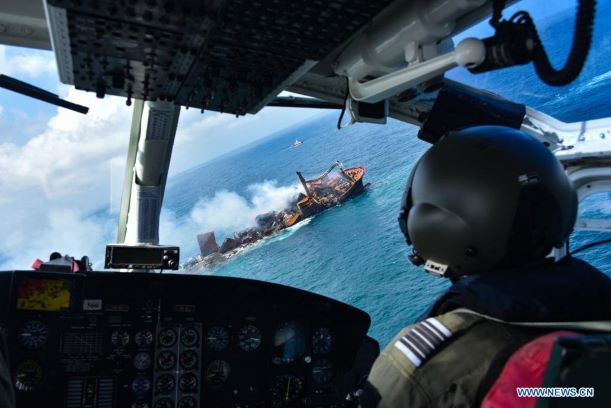
On May 20, 2021, a fire was reported on-board the vessel and was initially brought under control . But it re-ignited and continued for several days, until the vessel sank off Pamunugama village on June 2, 2021.
The sinking vessel caused the worst disaster to the marine environment of Sri Lanka. Massive quantities of toxic chemicals, including 46,960 bags of Low-Density and High-Density Poly Ethylene in 20 containers, were spilled into the sea. At least 70-75 billion plastic nurdles were released into Sri Lanka’s Western coastal belt.
The pollution resulted in the death of 417 turtles, 48 dolphins, eight 8 whales and a large number of marine species which were washed ashore. Analysis of the carcasses established the nexus of the causes of death to marine pollution.
Due to the heavy marine pollution, a fishing ban was imposed by the Sri Lankan government for well over a year in the Western coastal area. The ban deprived fisher folk of their livelihood.
Court’s Findings
This Court held that for the purpose of gaining entry to the Colombo Port, obtaining anchorage and thereafter using the berthing facility , the Master, Operator and the local Agent of MV X-Press Pearl had intentionally suppressed and withheld from the Harbour Master of Colombo Port, truthful, timely, comprehensive and accurate information regarding the situation that evolved over a period of time.
The afore-stated suppression and withholding of information resulted in the Harbour Master of the Colombo Port and other related parties not taking necessary measures to properly redress the situation that had arisen on board the vessel.
Therefore, they were jointly and severally responsible for the marine and coastal environmental pollution that was caused, the court said.
By deliberately concealing the true situation on board and inside MV X-Press Pearl, the Master, Operators, and the local Agent of MV X-Press Pearl had undermined applicable international reporting norms, and thereby deprived Sri Lanka’s competent authorities of the critical response time that was necessary, and exposed the marine and coastal environment, coastal and fisheries communities and marine eco-systems to a marine and coastal environmental disaster that was preventable.
The Agent of MV X-Press Pearl was responsible both as a corporate entity and its Directors and principal executive officers were responsible on an individual basis for the suppression of relevant information to the Harbour Master of the Colombo Port, and such suppression ex-facie constituted the offence of Cheating.
The then State Minister for Urban Development, Coast Conservation, Waste Disposal and Community Cleanliness Dr. Nalaka Godahewa, had failed to constitute the Marine Environment Council of the Marine Environment Protection Authority (MEPA) and thereby did not comply with his statutory obligation under Section 14 of the Marine Pollution Prevention Act.
Such non-compliance resulted in the MEPA not having the benefit of an instrument designed to enhance both readiness and response capacity in the face of a marine environmental emergency. The absence of the said Council to respond to the incident contributed towards the malfunctioning of the MEPA.
Dr. Nalaka Godahewa had failed to exercise the supervisory duties conferred on him by Section 52(3) of the Marine Pollution Prevention Act in respect of the MEPA, and thereby permitted MEPA and its Chairperson to respond to the situation relating to the MV X-Press Pearl incident, without necessary ministerial supervision.
The Marine Environment Protection Authority (MEPA) and its chairperson, Mrs. Dharshani Lahandapura, had failed to efficaciously respond to the situation pertaining to the MV X-Press Pearl incident in the manner described in this Judgment, and thereby were non-compliant vis-a-vis their statutory duties and obligations under and in terms of the provisions of the Marine Pollution and Protection Act.
This Court found that Mrs. Dharshani Lahandapura, had failed to convene the Board of Directors of MEPA when she was required to, and thereby failed to obtain the views of the members of such Board specifically appointed to guide decision-making in the MEPA, and failed to assess the effectiveness of the measures already taken in light of the worsening emergency.
The Attorney General had failed to perform his statutory function of indicting the Owner and the Operator(s) of MV X-Press Pearl, with regard to their criminal responsibility arising out of Section 26 paragraph (a) of the Marine Pollution Prevention Act. The decision taken by the Attorney General to institute civil legal action against the X-Press Pearl group of companies in a Singapore court, as opposed to instituting action in the High Court of the Republic of Sri Lanka exercising Admiralty jurisdiction, was an unreasonable, irrational and arbitrary decision, and was not in the best interests of Sri Lanka, the court said.
The Non-State Respondents (X-Press Pearl group) shall be jointly and severally accountable and liable under the Polluter Pays Principal for the marine and coastal pollution caused by MV X-Press Pearl.
Court Assigns Tasks
The court ordered the establishment of the MV X-Press Pearl Compensation Commission and appointed a retired Justice of the Supreme Court, E.A.G.R. Amarasekera, as its Chairman. It also established and constituted the MV X-Press Pearl Marine and Coastal Environment Restoration and Protection Committee.
The Chairpersons and members of the MV X-Press Pearl Compensation Commission and the MV X-Press Pearl Marine and Coastal Environment Restoration and Protection Committee and independent experts should be jointly responsible for the execution of the respective mandates entrusted to such Commission and Committee, and shall be answerable to the Supreme Court.
This Court directed the Attorney General to give necessary advice to the Criminal Investigation Department (CID) to conduct further investigations and conclude such investigations within a period not exceeding three months from the date of this Judgment into all offences disclosed, including offences already identified and in respect of which investigations are ongoing, offences under the Penal Code, the laws relating to the marine and coastal environment, and thereafter consider the institution of criminal proceedings against all offenders.
The Director of the CID was directed to conduct investigations relating to matters in respect of which the Attorney General gives advice, and ensure the completion of such investigations within a period of not exceeding three months.
The Attorney General was directed to report to the Supreme Court once in every three months about investigational and prosecutorial action taken by the Attorney General to give effect to the orders of the court.
The Attorney General was directed to undertake an analysis of international law, norms and standards relating to shipping and related maritime affairs and the applicable domestic laws and regulations, and advise the Government of the need to enact or amend existing legislation, regulations and rules, should there be a need to ensure compliance with international law, norms and standards.
The Attorney General was directed, to undertake a study and advise the Government on the need to amend legislation including the Marine Pollution Prevention Act and the Coast Conservation Act should there be a need to do so, for the purpose of bringing such legislation in line with contemporary international norms and standards.
The Attorney General was directed to advice the Director of the CID to take necessary steps in terms of the law, to ensure that (a) individuals whom this Judgment has referred to, to be deemed to be responsible to give effect to the directions for the payment of compensation, are available in Sri Lanka, should the need arise to take action against them for non-compliance with any direction made against Sea Consortium Lanka (Pvt.) Ltd., the ship’s agents in Colombo, or any other party of the MV X-Press Pearl group.
Probe into Corruption
The Director General of the Commission to Investigate Allegations of Bribery or Corruption (CIABOC) is directed to conduct a fresh investigation into the allegations of bribery and corruption referred to in this judgment..
In that regard, the DG CIABOC is directed to pay attention inter alia to (a) the contents of this Judgment, (b) the speeches made in Parliament by several Members of Parliament during the debate into the matter relating to MV X-Press Pearl environmental pollution disaster (c) other allegations that exist in the public domain, and (d) intelligence and information that may be available at the CIABOC.
To facilitate the conduct of such investigations, the DG CIABOC should initially call for and consider investigations already conducted into such allegations by the CID. The DG CIABOC should obtain the assistance of the Financial Intelligence Unit of the Central Bank of Sri Lanka and the State Intelligence Service and process intelligence that may be received.
Interim Reports relating to the progress and outcomes of investigations conducted by CIABOC should be submitted under confidential and sealed cover to the Registrar of the Supreme Court, once in every three months, the court said.
END
