
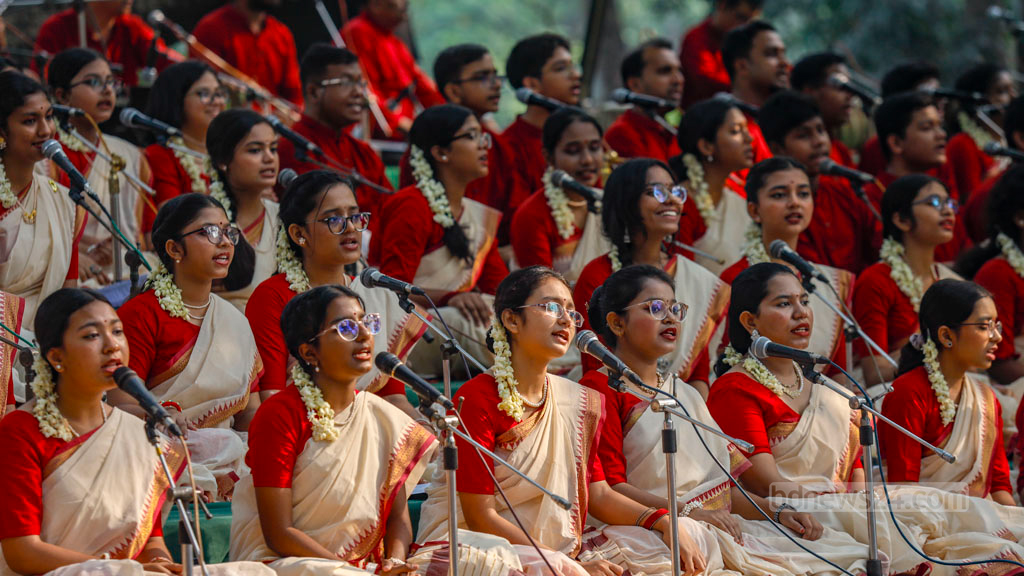

Dhaka, April 14 (The Daily Star)- As the first light of dawn touched Dhanmondi’s Rabindra Sarobar, the soft strains of the Sarod filled the air, mingling with birdsong and the soulful echoes of “Alo Amar Alo.”
With that began the Ispahani Channel i ‘Shurer Dhara’ celebration of Pahela Baishakh 1432—a vibrant homage to the spirit of Swadesh, the soul of the homeland.
The programme commenced at 6:00am with a performance by artists from Bengal Parampara Sangeetalay. Soon after, the stage was taken over by the soulful renditions of the ‘Panchakabi’—Rabindranath Tagore, Kazi Nazrul Islam, Dwijendralal Roy, Rajanikanta Sen, and Atul Prasad Sen—performed by singers of Shurer Dhara. The event opened with Tagore’s “Alo Amar Alo,” followed by Nazrul’s “Probhat Bina Tobo Baaje Hey,” which seemed to call in the morning with poetic grace.
One of the most captivating segments of the celebration was the participation of indigenous artists from different ethnic communities. Dressed in traditional attire, performers from the Chittagong Hill Tracts, Mymensingh, and northern regions of Bangladesh presented their folk songs and dances, adding rich cultural diversity to the theme of national unity.
Later, artists from indigenous communities of the Chittagong Hill Tracts performed the song “Amader Desh Heera-Manik, Shona, Rupay Bhora” in their regional languages.
Crowds poured in from various corners of the city—Mirpur, Uttara, and Old Dhaka among them. Families, artists, and culture enthusiasts thronged the venue from early morning, many of them regular attendees who consider this celebration an annual ritual.
The festival grounds also featured a traditional fair, complete with rural games and stalls showcasing clay dolls, jute crafts, handmade items, and indigenous cottage industry products. It was a celebration of local craftsmanship as much as music and art.
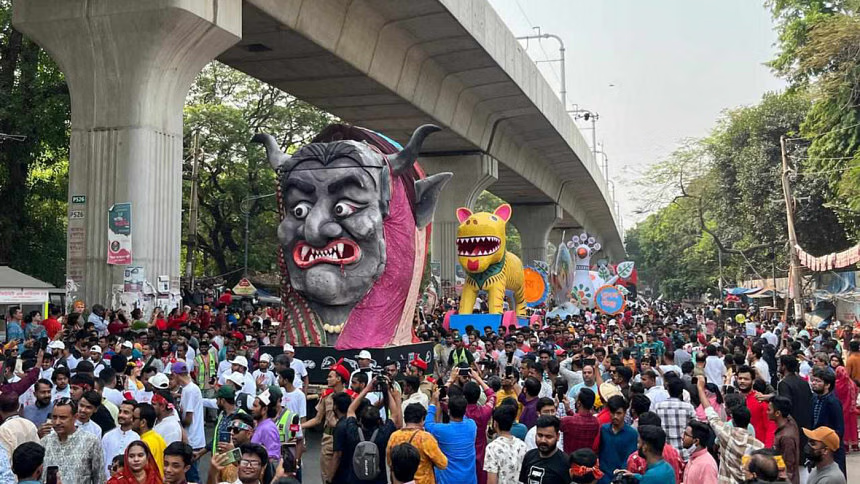
Adding further colour to the event was a special art camp where renowned musicians, dancers, and painters came together to create artwork inspired by themes of the New Year and Swadesh. Children and teenagers also joined in, turning the Sarobar into a vibrant intergenerational space of creativity.
With over 300 performers contributing to the festivities, the Rabindra Sarobar transformed into a grand cultural celebration—a harmonious blend of music, art, and community to usher in the Bengali New Year with heart and soul.
The Pahela Baishakh celebration, jointly organised by Channel i and Shurer Dhara, was supported by the Ministry of Cultural Affairs and Dhaka South City Corporation.
Chhayanaut’s Pahela Baishakh
As the sun rose over Dhaka, celebration for the Bengali year 1432 began at Ramna Batamul. The theme of Chhayanaut’s Pahela Baishakh celebration this year is “Amar Mukti Aloy Aloy” (my freedom lies in light). Through this theme, Chhayanaut aims to convey a message of hope, resilience, and renewal.
The event is taking place on a semi-circular stage measuring 72 feet in length and 30 feet in width, stretching from east to west under the banyan tree. According to a previous press briefing by Chhayanaut, this year’s celebration features a total of 24 performances: 9 choral songs, 12 solo renditions, and 3 recitations. The opening statement on the Bengali New Year will be delivered by Chhayanaut’s Executive President Sarwar Ali, and the event will conclude with the national anthem.
The performers’ dress code this year includes maroon panjabis with white pyjamas for the men, and off-white sarees with maroon borders for the women. The stage design complements these outfits, as the maroon color theme is reflected in the stage decor. While the stage structure remains the same every year, its colors change to match the performers’ attire. Last year’s stage was adorned in light green.
This cultural celebration of the Bengali New Year is being broadcast live on Chhayanaut’s official YouTube channel and Facebook page, along with various television channels.
Chhayanaut, a renowned cultural organisation in Bangladesh, has been organising this iconic celebration at Ramna Batamul since 1967. For this year’s programme, rehearsals have been ongoing for the past three months at the Chhayanaut Cultural Centre in Dhanmondi. Preparations for the stage at Ramna Batamul began on April 8.
Let us not squander this opportunity, Yunus
Chief Adviser Muhammad Yunus called upon everyone to not squander this opportunity of building a country free of discrimination. He began his speech wishing everyone ‘Shubha Nababarsha’, as ‘happy new year’ is said in Bangla.
He said in his three-minute speech that this was the first Pahela Baishakh (first day of the Bangla calendar) of the new Bangladesh. “Come, let us forget the shame, the pain, the ugly and the evil of the past, and march forward with renewed resolve and enthusiasm. Let us build a new Bangladesh.”
He said the upsurge of 2024 has brought forth an opportunity to rid the new Bangladesh of discrimination. “Let us not squander this opportunity. Let it be this new year’s resolution that we build a new Bangladesh free of discrimination.”
He began the speech noting that the Bangla calendar had begun in alignment with the crop cycle and farmers of Bangladesh still followed the Bangla calendar for farming purposes.
The Nobel peace laureate noted said that Pahela Baishakh remained an integral part of Bangali heritage and culture, and further noted that it afforded everyone another opportunity to showcase Bangalee tradition and culture amid festivities.
Professor Yunus said the ethnic communities of the hills and the plains are celebrating this year’s Chaitra Shankranti and Pahela Baishakh together.
Pahela Baishakh is a day of friendship and amity. “Today is a day to embrace everyone as our own.”
He wished success to all initiatives for celebrating Pahela Baishakh and wished everyone Shubha Nababarsha and hoped that it would bring peace and prosperity for everyone in the brief three-minute speech broadcast earlier today.
END
