

By P.K. Balachandran/Counterpoint
Colombo, December 18 – On Tuesday, Bangladesh celebrated its 54 th. “Victory Day”, the day on which the Pakistan army surrendered to the joint command of the Indian army and Bangladeshi freedom fighters called “Muktijoddhas”.
However, the war for Bangladesh’s liberation was fought not on one front, but three. The blood-stained battlegrounds in East Pakistan was only one of these fronts. The other two were diplomacy and the United Nations Security Council (UNSC). All three arenas proved to be extremely demanding and all three played a critical role in the birth of Bangladesh in December 1971.
In the ground battles, the loss of human life was humongous. By the conservative estimate of the US Congress, more than 300,000 lives were lost. About 3800 Indian soldiers and an unknown number of Bangladeshi guerillas called “Muktijuddhas” or “Mukti Bahini” lost their lives between March 26 and December 16, 1971. It was on December 16 an independent Bangladesh emerged after 93,000 Pakistani soldiers surrendered to the joint command of the Indian army and Bangladeshi fighters.
Diplomatic War
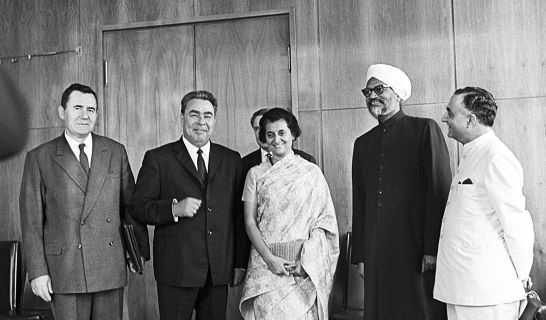
From March 26, 1971, neighbouring India had been putting up 10 million refugees from East Pakistan who had fled from the violence unleashed by the Pakistani army against Bangladeshi freedom fighters. Unable to cope with the high influx, the then Indian Prime Minister Indira Gandhi travelled to several major world capitals seeking their intervention to stop the violence in East Pakistan. The carefully drafted Indo-Soviet Treaty of Friendship which she authored with Soviet Premier Alexie Kosygin and President Leonid Brezhnev, brought the Soviet Union into the war without India breaking its resolve not to strike any military alliance. Thanks to the treaty, Soviet equipment poured in, enabling India to end the fighting quickly.
At UNSC
In early December, when clashes began between the Indian and Pakistani troops, the UNSC stepped in and began a series of debates, which resulted in many draft resolutions.
But these resolutions were opposed by India and its ally, USSR, because they sought a ceasefire and withdrawal of the Indian army without giving primacy to a political settlement of the issues dividing the people of East Pakistan and their rulers in West Pakistan. India and the USSR argued that half-baked resolutions for a ceasefire would only result in a political stalemate leaving the persecuted 75 million Bengalis of East Pakistan high and dry.
Long winding debates on technicalities and inappropriate principles of international law held over several days ended only when the Soviets used the Veto. The Veto coincided with the collapse of Pakistani resistance to the Indian forces and their Bangladeshi allies in East Pakistan. A few days after the veto, an independent Bangladesh emerged.
A critical part was played by the US and China, both inside and outside the UN. While supporting Pakistan to the hilt in the UNSC, both the US and China decided not to intervene militarily on the side of Pakistan though they were firm allies. Thereby, the US and China helped the cause of India and Bangladesh, albeit indirectly.
At the UNSC, China went hammer and tongs at India and the USSR. The US was not as aggressive but it firmly pressed for an immediate ceasefire to be followed by negotiations over the underlying political issues. In fact, the entire world rallied behind Pakistan, with the Muslim countries being in the vanguard.
The Security Council held extensive debates on 4, 5, 6, 12, 13, 14, 15, 16, and 21 December 1971. Nearly 20 draft resolutions were proposed by various UNSC members.
On 4 December, China vehemently opposed inviting representatives of the “so-called Bangladesh,” calling them “rebellious elements” and viewing their participation as “interference in Pakistan’s internal affairs, violating the UN Charter.” China accused India of “armed aggression against Pakistan,” dismissing India’s self-defence claims as “the law of the jungle”. Beijing demanded an immediate and unconditional withdrawal of the Indian armed forces from Pakistan.
Italy and Japan urged an immediate ceasefire as a prelude to political talks. Poland, however, argued that the UNSC should hear the representatives of Bangladesh “to gain a complete understanding of the complex and serious problem.” Poland, then a Soviet ally, stressed that the root of the crisis was the situation in East Pakistan following the Pakistan authorities’ bid to stifle the resistance movement by military means.
The USSR strongly advocated inviting representatives of Bangladesh for reasons stated by Poland. Moscow rejected any attempt to equate India and Pakistan, viewing Pakistan’s military repression and violence against its own population as the cause of the situation in Bangladesh. Moscow introduced a draft resolution calling for a political settlement in East Pakistan leading to a cessation of hostilities.
The UK stressed the need to pursue a unanimous decision on a ceasefire and withdrawal. The US called for an immediate cease-fire and withdrawal of forces, a proposal Pakistan accepted but India rejected. India stated that the roots of the crisis lay in the West Pakistan military regime’s actions against the people of East Pakistan (Bangladesh). New Delhi asserted that discussing the matter without hearing “the elected representatives of 75 million people of Bangladesh”, was unrealistic.
Pakistan accused India of initiating large-scale military aggression and attempting to cause the dismemberment of Pakistan. If the Council set a “dangerous precedent” by seating the “so-called representatives” of Bangladesh, Pakistan would “reappraise seriously its co-operation with the Security Council and the United Nations”, its delegate threatened.
On December 5, the USSR voted for its own draft resolution (S/10418), which insisted on organically linking the cessation of hostilities with the need for a political settlement in East Pakistan. China voted against the Soviet draft because it would constitute direct interference in the internal affairs of a UN Member State. China accused the Soviet Union of engaging in “social imperialism” and supporting India’s “aggression and expansionist policies.”
The US argued that tackling the complex political solution with fighting going on was unrealistic. The UK abstained on both the Soviet and the eight-Power draft resolutions. London maintained the view that only a unanimous resolution, or one that avoids a Veto, could send a clear message and be effective.
India said that any ceasefire agreement must be acceptable to the “Bangladesh government” (in exile in India at that time) while denying that listening to the representatives of Bangladesh implied international recognition of the Bangladeshi regime in exile.
Pakistan accused India of arming and training guerrillas from the refugee population and stressed that any invitation to the representative of Bangladesh would be a “sinister design to disintegrate Pakistan”.
On December 6, India recognised the government of Bangladesh. China labelled the newly created “Bangladesh” a “neo-quisling government” and a “neo-‘Manchukuo’ government,” comparing the situation to the Japanese occupation of Northeast China in the 1930s. China accused the Soviet Union and India of deliberately creating this entity to dismember Pakistan and perpetually occupy East Pakistan. China maintained that the Soviet Union was engaged in “social treachery” seeking to control the Indian subcontinent and the Indian Ocean.
The USSR introduced a draft resolution (S/10428), incorporating the ceasefire call but crucially linking it “inseparably and organically” to the need for a political settlement in East Pakistan recognizing the will of the population from the December 1970 elections.
The USSR insisted that failure to include the root cause (Pakistan’s actions against East Pakistan’s population) made other resolutions “one-sided.” The USSR also declared it would not support the UNGA referral resolution (S/10429) arguing that sending the issue to the General Assembly (whose resolutions are merely recommendations) was an attempt to avoid a mandatory solution and deflect attention from the core issue.
The US strongly supported the referral resolution (S/10429) to the General Assembly under the “Uniting for peace” resolution, arguing this was the necessary course given that the Security Council’s power to Veto any resolution.
India Recognizes Bangladesh on December 6
On December 6, India announced that it had granted official recognition to the “People’s Republic of Bangladesh”. India explained that this decision was based on the “unanimous revolt of the entire people of Bangladesh” and the assessment that “Pakistan was totally incapable of regaining control.”
India argued that the recognition placed the relationship of India to Bangladesh in a “completely different legal, political and constitutional context”. It rejected the idea that India and Pakistan can be equated as India was acting in self-defence against Pakistani aggression, which stemmed from the oppression and “genocide” carried out by Pakistan’s military regime.
Delhi insisted that the conflict’s underlying realities-refugees, genocide, and the will of the people-must be addressed.
Pakistan strongly condemned India’s recognition of Bangladesh, stating that India had followed a plan of “meticulous exactitude” designed to bring about the dismemberment of Pakistan and use the UNSC to legitimize the secessionist state. It categorized the Mukti Bahini as an “auxiliary of the 120,000 Indian armed forces”. It argued that a political solutions could not be imposed while a country was under invasion.
On December 12, the US said that while Pakistan accepted the UNGA resolution calling for a ceasefire, India did not, demonstrating “a defiance of world opinion”. While acknowledging Pakistan’s “tragic mistake” in using force in East Pakistan in March, the US stated this did not “justify the actions of India in intervening militarily and placing in jeopardy the territorial integrity and political independence of its neighbour Pakistan”.
The US expressed concern that Indian military actions were moving beyond occupying East Pakistan and constituted “an attack on the very existence of a Member State”. It urged India to disavow any intention to annex West Pakistan territory or change the status quo in Kashmir. It introduced a new draft resolution (S/10446) which was substantially the same as the General Assembly’s resolution.
China characterized the Bangladesh movement as a “toy in the pocket of the Indian expansionists and the Soviet social-imperialists,” and called Bangladeshi representatives “rebels and national traitors.” A sovereign State “cannot be dismembered by the use of force”.
Indian Foreign Minister Swaran Singh insisted that India was driven to war by Pakistan’s oppressive actions. He argued that the core of the problem lay in the denial of the demands and repression of the overwhelming majority of East Bengal’s population. He recounted Pakistan’s military actions, including a “premeditated and massive aggression against India” on December 3, “which led to India being forced to defend itself.”
Singh reasserted that India has “no territorial ambitions in Bangladesh or in West Pakistan”. India’s recognition of the People’s Republic of Bangladesh on 6 December was necessary because it provided a “proper juridical and political basis” for India’s military presence, ensuring Indian forces would remain “only as long as the people and Government of Bangladesh require and welcome their presence”.
Singh also insisted that any resolution must recognize the Bangladesh as a necessary party to any cease-fire or withdrawal negotiations.
Bhutto Admits Mistake
Pakistan’s Foreign Minister Z.A. Bhutto argued that the main issue was the violation of the international principle that a sovereign State cannot be dismembered by force. He admitted Pakistan had “made mistakes,” but asserted it was ready to rectify them in a “civilized spirit”. But he warned that dismembering Pakistan would set a “tragic precedent for the world at large” affecting smaller countries in Asia, Africa, and Latin America.
He rejected the idea that the crisis was about self-determination in East Pakistan, noting that India constantly blocked self-determination in Kashmir.
USSR Vetoes US Resolution
On December 13, the USSR vetoed a US resolution calling for a ceasefire and withdrawal. The USSR’s core position was that the military conflict stemmed from the anti-democratic, violent actions against the people of East Pakistan. It insisted on a solution that “simultaneously and indissolubly” linked the cease-fire and cessation of hostilities with a political settlement in East Pakistan based on the will of the 75 million people, as expressed in the 1970 elections.
China voted in favour of the US resolution, but declared it “highly unsatisfactory” because it failed to condemn India’s aggression and failed to distinguish between the aggressor and the victim.
India’s Swaran Singh firmly demanded that a cease-fire and withdrawal must include the people and Government of Bangladesh as a necessary party. India characterized the US draft resolution as defective because it totally ignored the massive human rights violations in Bangladesh.
Pakistan’s Bhutto argued that Indian aggression was turning a severe political crisis into a catastrophe. He stressed that the solution to Pakistan’s internal problems must be consistent with its sovereignty and territorial integrity and free from external interference. Bhutto said that Pakistan was ready to implement a ceasefire and withdrawal if Indian forces (including the Mukti Bahini) also did the same.
On December 14, Bhutto condemned India’s use of the refugee crisis as an “ugly, crude pretext” for “naked, brutal aggression” against East Pakistan. He stated that the Security Council had “failed miserably, shamefully,” denying Pakistan justice by using “dilatory tactics” (procedural delays) intended specifically for Dacca to fall. He refused to be a party to an endorsement of aggression.
Bhutto dramatically declared he was leaving the Security Council, finding it disgraceful to remain a moment longer. “I am not ratting, but I am leaving your Security Council.”
Ceylon’s Shirley Amerasinghe stressed a policy of strict and scrupulous neutrality as a sincere friend and conciliator to all parties. He stated that if withdrawal of forces is dictated by the will of the people, Pakistan must be given the opportunity to do so with honour and dignity.
India’s Unilateral Ceasefire
On December 16, the Pakistani forces surrendered to the Indian army and the Bangladesh forces. India’s representative at UNSC Swaran Singh declared that India had no territorial ambitions and, since the Pakistani armed forces had surrendered in Bangladesh and Bangladesh was now free, continuing the conflict was pointless.
India had therefore ordered a unilateral ceasefire everywhere on the Western front effective from 2000 hours Indian Standard Time on Friday, 17 December 1971.
END
