
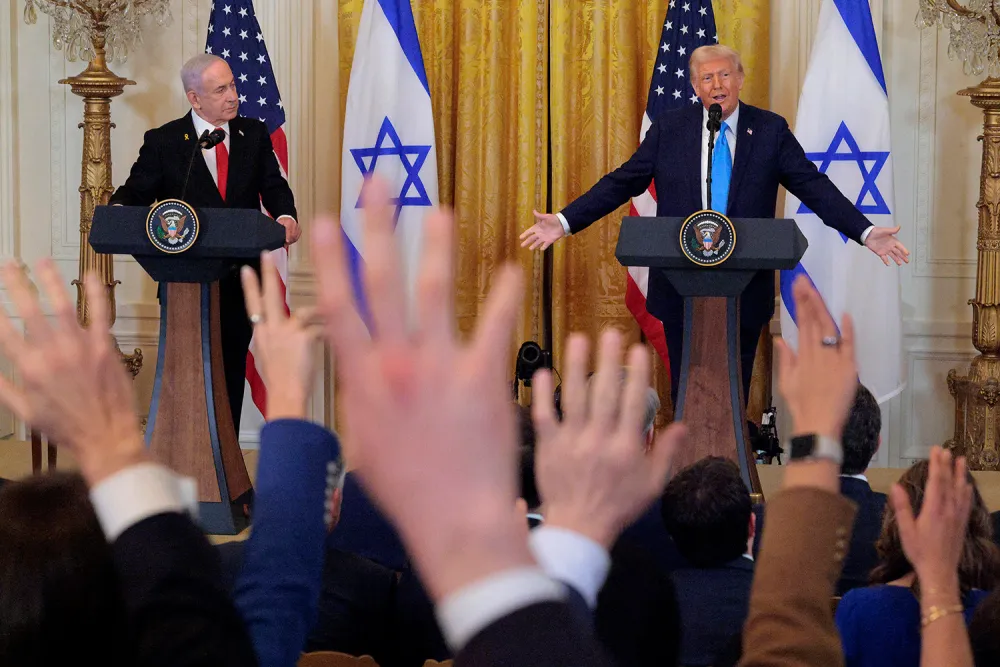

P.K. Balachandran/The Daily Times of Bangladesh
Colombo, March 4 – Col Douglas Macgregor, who was an adviser to the US Secretary of Defence in the first Trump administration, said in a video interview with Norwegian political scientist Glenn Diesen that the Iran war is going badly for the US and, if not stopped quickly, Washington could lose its prestige and quit West Asia.
A former US Army officer, Col Macgregor said the US had expected Iran to capitulate swiftly after its supreme leader Ayatollah Khamenei was killed by Israel. But, to its dismay, Iran did not. On the contrary, it has been firing missiles and launching drones in large numbers, targeting at least 27 US bases across West Asia, including Israel.
He argued that US defence systems had been deceived by decoy drones and that Israel’s “Iron umbrella” had proved porous. He warned that the US could soon run short of missiles, possessing only around 40,000 compared with Iran’s estimated stockpile of 450,000.
The US would find it difficult to neutralise Iranian missile batteries because they are dispersed across Iran, a country comparable in size to Europe. Many are also mobile, making them harder to target. Iran, meanwhile, has struck US bases that are static.
Commenting on the decapitation of Iran’s leadership through the killing of Ayatollah Khamenei, Macgregor described it as merely a tactical success that gave the US and Israel an initial advantage. However, he cautioned that “battles are won by tactics, but wars are won by strategy”.
He said the US and Israel lack a coherent strategy for confronting a country like Iran. In his view, American and European strategists mistakenly assume that Asian societies think as they do. But, he argued, civilisations in West, South and East Asia have distinct historical and cultural foundations. Iran, as Persia, has a recorded history of around 2,500 years, while China and India trace civilisational roots back 5,000 years. With such deep legacies, they are unlikely to surrender easily. They view Western intervention as a civilisational threat, Macgregor said.
“While the Americans and Israelis are fighting to win, the Iranians are fighting for survival and therefore fight much harder,” he added.
He said this mindset is evident in Iran, where support for Khamenei has reportedly grown after his death. The US, he argued, had inadvertently made him a martyr — a status he may have anticipated given his understanding of his people.
Macgregor also rejected the view that Iran promotes Islamic terrorism. If a state were to be named in that connection, he said, it would be Pakistan rather than Iran, describing Pakistan as an “incubator” of Islamic terrorism.
US Secretary of State Marco Rubio has acknowledged that President Donald Trump was surprised by Iran’s resilience. Rubio also said the US was compelled to strike Iran after learning that Israel planned to launch attacks first. In other words, Israel had prepared to strike Iran without informing its ally.
According to Macgregor, this was not surprising, as he believes Israel often dictates US policy rather than the reverse.
Trump has admitted that the Iran campaign has exceeded the timeframe initially envisaged but insisted it would last no longer than several weeks. He said the US has a “virtually unlimited” supply of ammunition and could wage war indefinitely, according to a post on Truth Social. The President also said weapons stored in other nations could be redirected for use in Iran.
Macgregor, however, said Iran is prepared for a prolonged conflict and has been stockpiling long-range weapons in underground facilities.
Meanwhile, Trump faces mounting economic risks. The closure of the Strait of Hormuz — and effectively the Suez Canal — has disrupted oil supplies to countries east of Suez. Oil prices could rise sharply, placing additional burdens on poorer economies in South and East Asia. Macgregor noted that India alone consumes around 2.6 million barrels of oil daily. India is also vulnerable because approximately 4.6 million Indians work in the Middle East and send billions of dollars home in remittances.
Domestic opposition is also growing. A recent Reuters poll indicated that 75 per cent of Americans do not support the Iran war. In June 2025, 60 per cent opposed military action against Iran, according to an Economist/YouGov survey. Congressman Ro Khanna submitted a motion in the House of Representatives stating that Trump could not enter a war without Congressional authorisation.
If Trump emerges weakened from the conflict, he could lose support even within his Make America Great Again (MAGA) movement, whose members were promised an end to foreign wars and a focus on domestic development.
Asked whether Russia or China might intervene if the conflict escalates, Macgregor said they could, particularly if Israel were to deploy a nuclear weapon. In such a scenario, they might even join the war on Iran’s side.
He urged mediation and suggested India could serve as a suitable intermediary, given its historic ties with Iran alongside its growing relations with the US and Israel. He said it is in the interest of all nations to end hostilities and restore normal commerce.
Even if the war ends, however, Macgregor believes America’s prestige in West Asia will have suffered lasting damage. “There will be new rules operating there,” he said, “not written by the US or the West but by Asians.”
Such a shift would shock Israel and its supporters in the US, who, he argued, have long envisioned a “Greater Israel” stretching from the Nile to the Euphrates.
END
