

By Veeragathy Thanabalasingham
Colombo, November 23 – The Sri Lankan government’s handling of the controversy over the Buddha statue in Trincomalee last week, and the reaction of the opposition political parties to it, have clearly shown that the polity in southern Sri Lanka has not learnt any lesson from the tragedies suffered by the country and its people as a result of communal politics so far.
The Trincomalee incident also demonstrated the challenges that lie ahead for the ruling National Peoples’ Power (NPP) government. Its stated position that it will never allow communalism and religious extremism to re-emerge in Sri Lanka is damaged. And the opposition parties have shown that they will not miss any opportunity to resort to majoritarian mobilization in the bid to comeback to power.
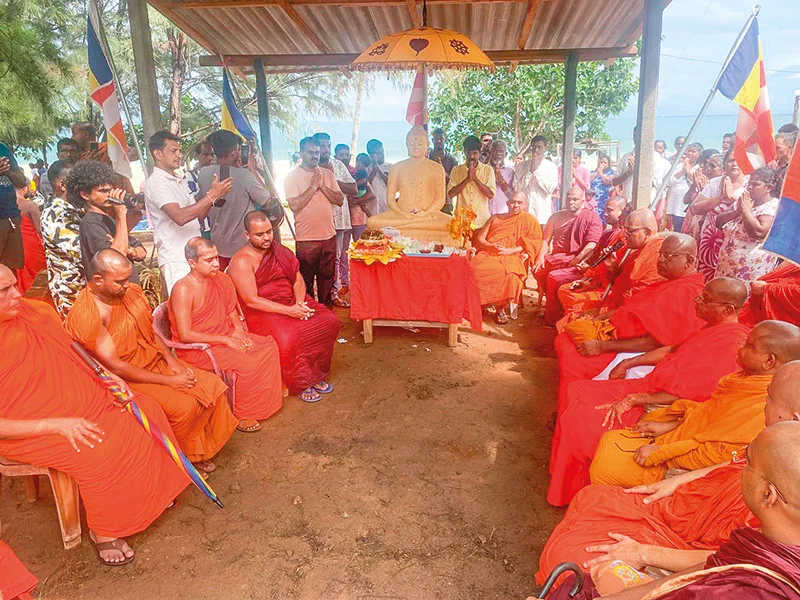
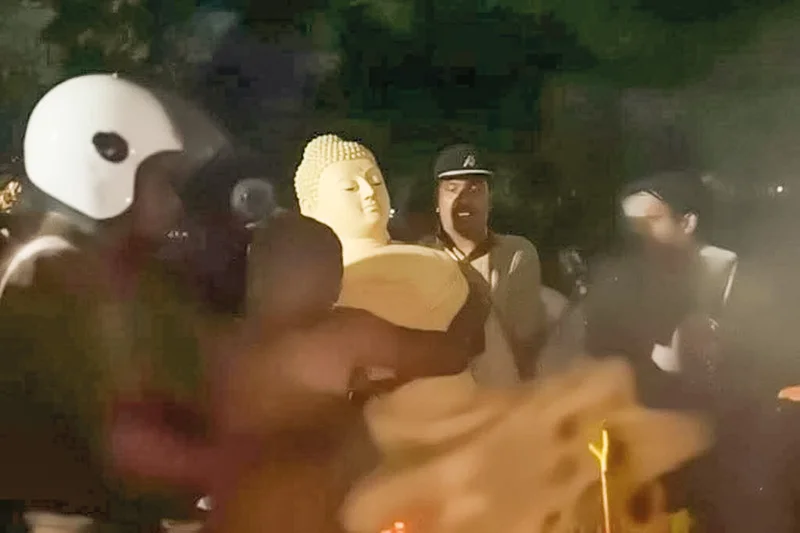
Despite the fact that the Buddha statue placed in the Sri Sambuddha Bodhi Rajamaha Vihara located on the Trincomalee coast, was removed by the police overnight on Sunday, November 16, amid fiery protest from the Buddhist monks, the statue was placed in the same spot with police protection the next day at noon.
Public Security Minister Ananda Wijepala had announced in Parliament earlier that day that the Buddha statue had been removed for safety reasons and would be put in the same place later.
Opposition parties immediately exploited the chaos at the Vihara during the removal of the statue to make inflammatory noises inside and outside parliament, as if Buddhism was facing a great danger in Sri Lanka.
Speaking about the Trincomalee incident in Parliament on November 18, President Anura Kumara Dissanayake said that although the dispute appeared to be about the establishment of a religious place of worship, there was another story within it. Stating that he had sought a report from the Defence Secretary on the incidents, the President said the opposition parties was bent on using the Buddha statue controversy to stoke communalism as there was no other tangible issue available for them to justify the protest against the government.
He reassured that his government will never allow communalism and religious fanaticism to reappear. According to him, the dispute had ended when the court issued an order.
It is well known that Buddhist monks bring Buddha statues overnight and then gradually build Viharas with the help of the state machinery especially the armed forces, not only in places they consider to be of archaeological importance in the Northern and Eastern Provinces, but also in places where Buddhists do not live. When there are protests from the people of the areas concerned, it is customary for the state machinery to support the monks.
Opposition politicians, including Leader of the Opposition Sajith Premadasa and Sri Lanka Podujana Peramuna’s (SLPP ) national organizer Namal Rajapaksa, always point out the primacy or foremost place given to Buddhism in Sri Lanka’s constitution.
But how can primacy be allowed to be misused as a shield by a section of Buddhist monks or by elements trying to create enmity between communities on religious grounds to justify their illegal or un-Buddhist activities?
It seems that a considerable section of the Mahasangha believe that the Government cannot interfere or take action in whatever they do.
Sajith Premadasa says that no one has the right to interfere in the freedom of a Buddhist monks to carry out any activity related to Buddhism. But, one cannot help asking how many incidents he had so far condemned in which a section of the Buddhist clergy had acted challenging the rule of law or incited enmity between ethnic and religious communities.
Meanwhile a controversial monk, who is known to have led violence against the Muslim community in the past and convicted by courts of blasphemy against Islam, visited Trincomalee last week after the Buddha statue controversy and made fiery speeches inciting communal conflict. He is hell-bent on getting involved in the Trincomalee controversy to show that he is striving to save Buddhism.
It is said that the majority of Sinhala Buddhists do not support the immoral activities of such monks or the racist forces. But, unfortunately, they do not come out openly against it. As Albert Einstein said, “The world is a dangerous place, not because of those who do evil, but because of those who do nothing to stop it.”
Hate politics against minority communities is not something new to the country. It is an obnoxious trend that has grown parallel to the evolution of Sinhala majoritarian politics in modern Sri Lanka.
What is of special concern is the southern polity’s failure to recognize the genuine grievances, rights and legitimate political aspirations of the minority communities, even after the three decade of political and military conflict.
One of the main reasons for the inability to find solutions to many of Sri Lanka’s problems is the propensity of the Buddhist clergy to exert great influence in politics. Some monks are directly involved in politics and are contesting elections. Even if their actions contradict the basic teachings of the Buddha, even the Mahanayakas are unable to prevent them from engaging in politics. In fact Buddhism has become a political religion in Sri Lanka.
The influence of the Buddhist clergy has had negative effects on the political history of southern Sri Lanka. Even a popular Prime Minister was assassinated by a Buddhist monk in the middle of the last century.
Today, an unprecedented trend of religious fanaticism is visible in the politics of Tamils too. This is due to the influence of Hindutva politics in India. There is no future for Sri Lanka if Sri Lankan society, whether it is Sinhalese or Tamil, does not separate religion from politics.
It is not enough for President Dissanayake and the NPP government to simply claim that their policy is to treat all citizens equally. A sense of egalitarian citizenship can be gradually instilled among the people of minority communities, only if the government shows a genuine interest in taking steps to alleviate the unique problems faced by them as a result of the discriminatory policies and repression practiced by the governments in the past.
The Trincomalee Buddha statue controversy has exposed the tendency of the opposition parties to use communalism and religious sentiments in the campaigns against the government. The people of the country should not forget that previous regimes, which vigorously pursued majoritarian communal mobilization to hide their misrule, corruption and abuses of power, had led the country into economic bankruptcy.
One of the serious lessons learnt from the past is that ethnic majoritarian mobilization should not be allowed to cover up misrule and corruption. If such mobilisation is allowed again, Sri Lankans will continue to grapple with the same problems that caused havoc in the past, forever.
END
