

By P.K.Balachandran/Sunday Observer
Colombo, March 30 – Last week, alleging war crimes, the UK sanctioned three former high-ranking Sri Lankan military officers, namely Gen.Shavendra Silva, Gen.Jagath Jayasuriya and Adm.Wasantha Karannagoda, besides the breakaway LTTE commander Karuna Amman.
The sanctioning, fifteen years after the Sri Lankan war ended, came as a surprise because there was no immediate provocation for it. In the last decade and a half, the atmosphere had cooled. Of course, the “war crimes” issue got salience once a year when it was taken up at the UN Human Rights Council in Geneva. But over the years, the Human Rights High Commissioner’s annual report and the debate on it, had become repetitive. The Sri Lankan government and the Tamil lobby would reiterate their respective positions and the Council would repeat its concerns and make demands for accountability. There would be no follow-up and few would make it an issue.
Then in 2024, the political situation in the Tamil areas of Sri Lanka changed dramatically. The Tamils of the Northern and Eastern provinces, who habitually supported the Tamil nationalist parties, took a right about turn and plumbed for the National Peoples’ Power (NPP), the hard core of which was the Sinhala nationalist Janatha Vimukhi Peramuna (JVP). The JVP had been vociferously against the Tamils’ demands for autonomy. It had also been a votary of a military solution to the Tamils’ demands.
Therefore, UK’s sanctions on the former Lankan Generals at this juncture, seemed completely out of sync with the thinking on ground zero in North and East Sri Lanka.
Nevertheless, the sanctions had an impact on Sri Lankans. The Tamils welcomed it and considered it a feather in their cap. The Tamils believed that the British sanctions flowed from genuine indignation over the rights violations against them. But the Sinhalese were indignant that they were faulted for doing the right things namely, defeating terrorists and safeguarding Sri Lanka’s territorial integrity. The Sinhalese were also sore that the British were judging them differently from the way they judged themselves on similar issues.
However, the truth about the sanctions lies elsewhere. The sanctions were not aimed at endorsing the Tamil cause or forcing the Sri Lankan government to meet the Tamils’ demands. The idea was to win the hearts of the Tamil voters in the UK as they had come to play a critical role in parliamentary and local elections.
In the UK, where electoral constituencies are small, every vote counts. And the Tamils, who are a tightly knit community, could determine the victory or defeat of a party in several constituencies.
British political parties, therefore, strive to be in the Tamils’ good books. An important way of being in the Tamil’s good books has been to support their cause back home in Sri Lanka. Even symbolic support by attending their events and verbally supporting them publicly do wonders in the UK.

Sri Lankan Tamils in the UK are about 200,000 or even 300,000. They are concentrated in London, especially in areas like Harrow, East Ham, Redbridge, and Tooting. There are concentrations in Leicester and Surrey too. Their political importance stems also from their historical grievances and ability to influence both domestic and international policy discussions on human rights issues in their country of origin, Sri Lanka. Being a community of educated professionals, they are articulate and make good lobbyists.
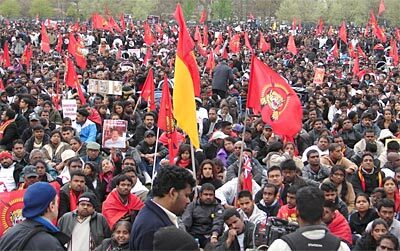
The British Tamil community is well-organized through groups like the British Tamils Forum (BTF), which engages MPs and policymakers. The BTF, established in 2006, has evolved into a grassroots organization that mobilizes Tamils and lobbies for their interests, including justice for war crimes committed during Sri Lanka’s civil war (1983–2009). Their activism, such as the 2009 Parliament Square protests, demonstrates their ability to draw attention to their cause.
The Tamil Chamber of Commerce estimates that Tamil-owned businesses in the UK generate a turnover of £1 billion. This economic clout enhances the Tamils’ visibility and influence. In contrast, the Sinhalese population in the UK is smaller and is also apolitical. There is no Sinhalese lobby to counter the Tamil lobby.
Close Ties with Labour
Traditionally, Sri Lankan Tamils in the UK have leaned toward the Labour Party, which has been more vocal on Tamil issues, including calls for accountability for alleged war crimes in Sri Lanka. However, there are Sri Lankan Tamil supporters in the Conservative Party and among Liberal Democrats, particularly business owners and professionals.
In May 2024, before the July parliamentary elections, the Labour Party reiterated pledges to the Tamils and called to refer Sri Lanka to International Criminal Court (ICC). Senior figures within the Labour Party addressed an event to mark “Tamil Genocide Remembrance Day” in the British parliament.
The Chair of the Labour Party and Shadow Secretary of State for Women and Equalities, Anneliese Dodds, delivered a message on behalf of Starmer, stating that “our thoughts as the Labour Party are with the Tamil victim-survivors and their loved ones”. She also spoke on the importance of referring the “perpetrators of these dreadful crimes to the International Criminal Court”.
Gareth Thomas, Shadow Minister for International Trade, said “It is almost incomprehensible as to why Magnitsky Sanctions haven’t been used against General Shavendra Silva, for example.
“If the US and Canada can do it, why can’t we do it here in the UK? We should be doing that,” he said.
John McDonnell, the former Shadow Chancellor of the Exchequer, recalled the events in Mullivaikkal in 2009, stating it was “a massacre of people on the beach, no defence, nowhere to go. It was systematic. It was planned.”
Speaking on sanctions that have been placed on Sri Lankan war criminals by the United States and Canada, McDonnell said “We’ve got a golden opportunity in these next few months to make sure that happens here”.
“Trade sanctions is another route,” McDonnell added. “We should not be trading with war criminals. We should not be trading or financially supporting a regime like this.”
“We have international laws for a reason,” said Dawn Butler MP. “So we are with you in this battle and this fight. We are with you every step of the way. We are behind you. We are beside you and we are with you,” Butler said addressing the Tamils.
James Murray, Shadow Financial Secretary to the Treasury, reiterated calls on the British government to “consider the recommendations of the UN High Commissioner for Human Rights to refer perpetrators of these crimes to the International Criminal Court”.
Keir Starmer, released a statement to mark the “15th year Mullivaikkal Genocide Remembrance Day” in which he said, “ “Mullivaikkal must also be a reminder that as well as commemorating those who are lost, we must bring the perpetrators of atrocities to justice. As Tamil communities across our country pause and reflect upon this solemn day, the Labour Party reaffirms our commitment to work towards lasting peace, reconciliation and a long-lasting political solution for the Tamil people.”
No Bargaining Chip
Sanctioning top military officers of another country to gain votes in domestic elections may seem to be too risky as it could jeopardise bilateral relations to the detriment of the UK. But the reality is that the UK has little to lose vis-à-vis Sri Lanka because it has no stakes in the island after its tea plantations and military bases were taken over. Colombo has no hold over London now, no bargaining chip as it were. This is another reason for the brazenness of the British action.
END
