

By Laxmi/Substack
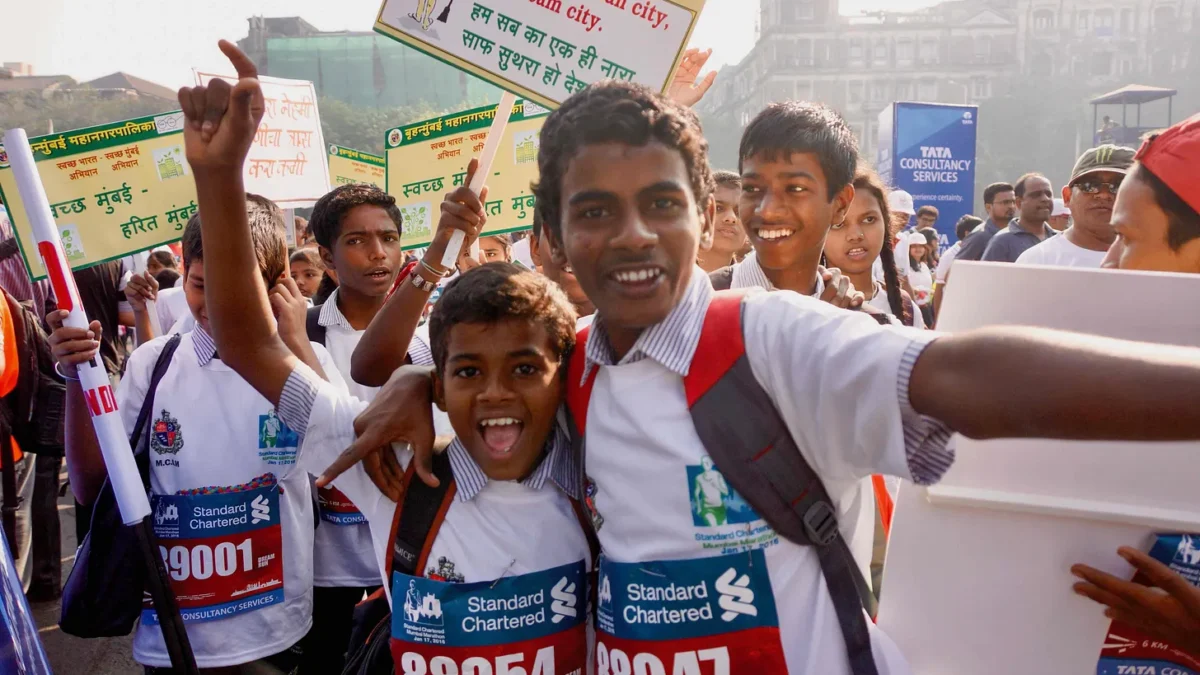
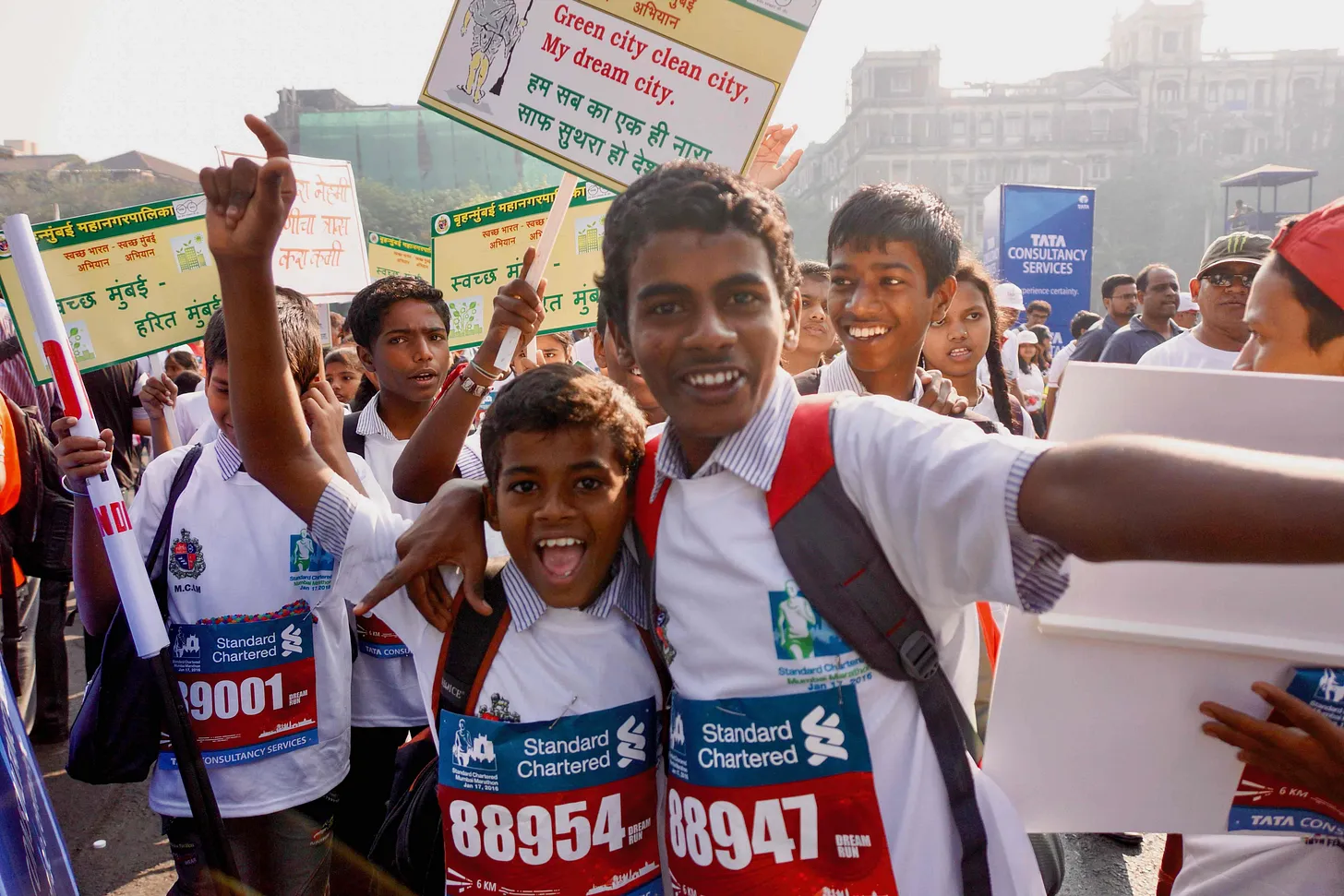
Mumbai, January 18 – The Pre-dawn Masala – As every Apple user knows, nostalgia has a way of surging through you the moment a “Memory” pops up on your iPad. Today, as that rhythmic, swelling soundtrack began to play, a series of photos from exactly ten years ago flashed across my screen—January 17, 2016, the day I witnessed one of India’s most distinctive spectacles: the Mumbai Marathon.
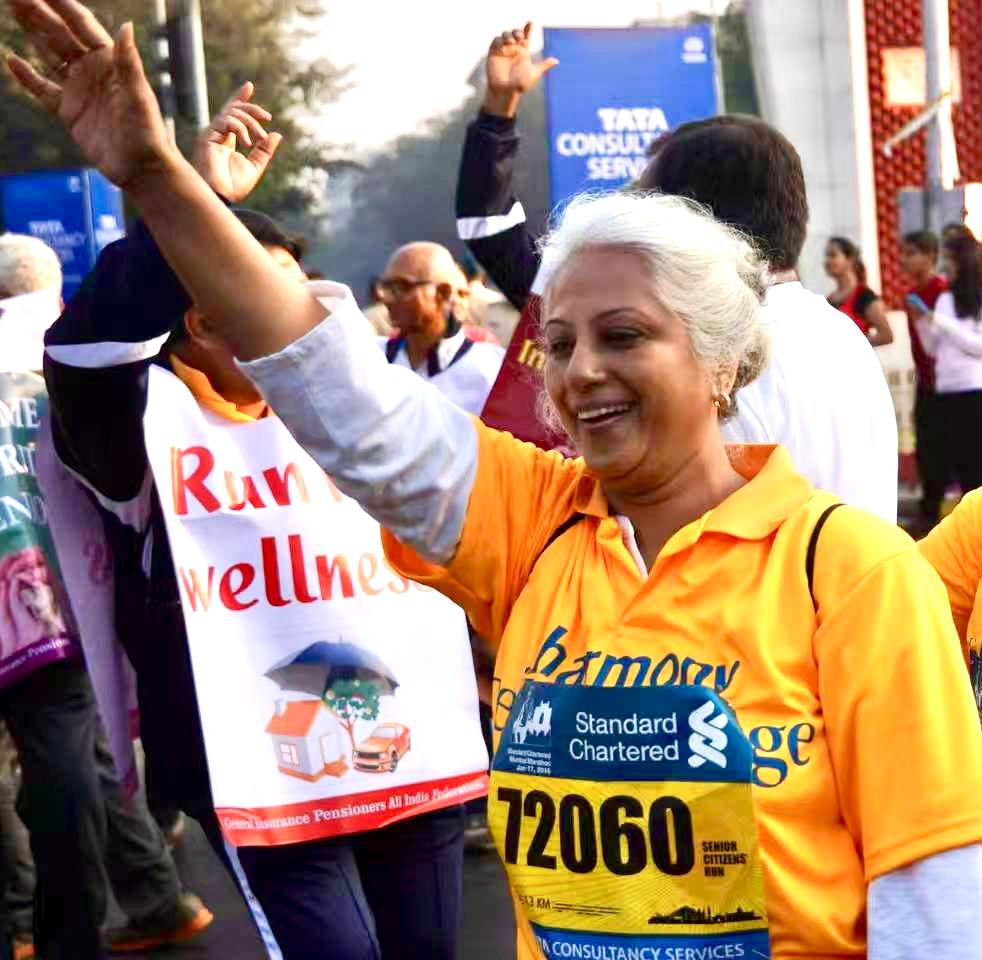
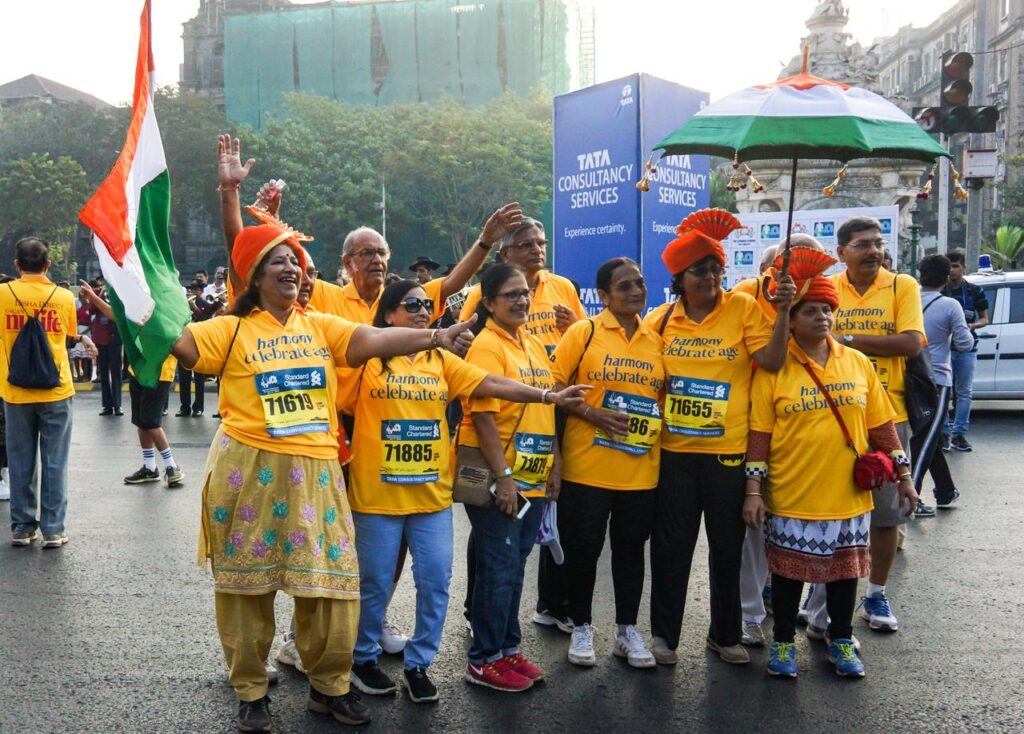
While it is a prestigious Global Gold Label event, the Mumbai Marathon’s true soul lies in its complex social layering. Beyond the elite professional races, it features deeply human categories: the festive “Dream Run”, the “Senior Citizens’ Run” (4.3 km), and the “Champions with Disability” (1.75 km). This unique structure transforms a pure sporting competition into a massive, city-wide social carnival.
To ensure I didn’t miss a single moment of this long-awaited spectacle, I stepped out into the salty sea breeze at 3:00 AM. I made my way toward Victoria Terminus, the central gathering point where the energy was already electric. Here, amidst the crowds of senior citizens and resilient athletes, I waited to witness the uniquely Indian “Masala” (a blend of spices) that would begin at 5:40 AM.
Why the 5:40 AM Start? This timing is a necessity dictated by Mumbai’s geography—a sprawling, narrow peninsula where traffic is legendary and gridlock is paralyzing. To reclaim the iconic Marine Drive for thousands of runners without shutting down the city’s lifeblood during the day, organizers are forced to start in the dark.
On that same track, you could see elite East African athletes chasing world records alongside massive corporate contingents marching in uniform. Most striking of all were the carnival-like walking performances—participants dressed in elaborate costumes or uniforms, clutching vibrant placards. These signs ranged from grand national visions like “Make in India” and “Startup India” to fundamental social pleas like “Save the Girl Child” and environmental calls to protect the planet.
In that chilly pre-dawn air, I realized that this was more than just a race; it was a miniature model of a nation in motion. Every participant had turned the track into a flowing stage for their own convictions, running—or walking—toward their own version of the future.
The Morning Prelude: Finding Order in Chaos. From the vintage mechanical clocks striking 6:00 AM at Victoria Terminus to the resilient face of a veteran runner, these fragments reconstruct the raw texture of a marathon morning.
Ten years ago, I stood at the heart of Mumbai, witnessing tens of thousands pouring into the streets before dawn. It wasn’t just a race; it was a rhythmic pulse of a city that never sleeps, yet always dreams.
These moments were captured through my lens in the pre-dawn streets of Mumbai, January 2016.
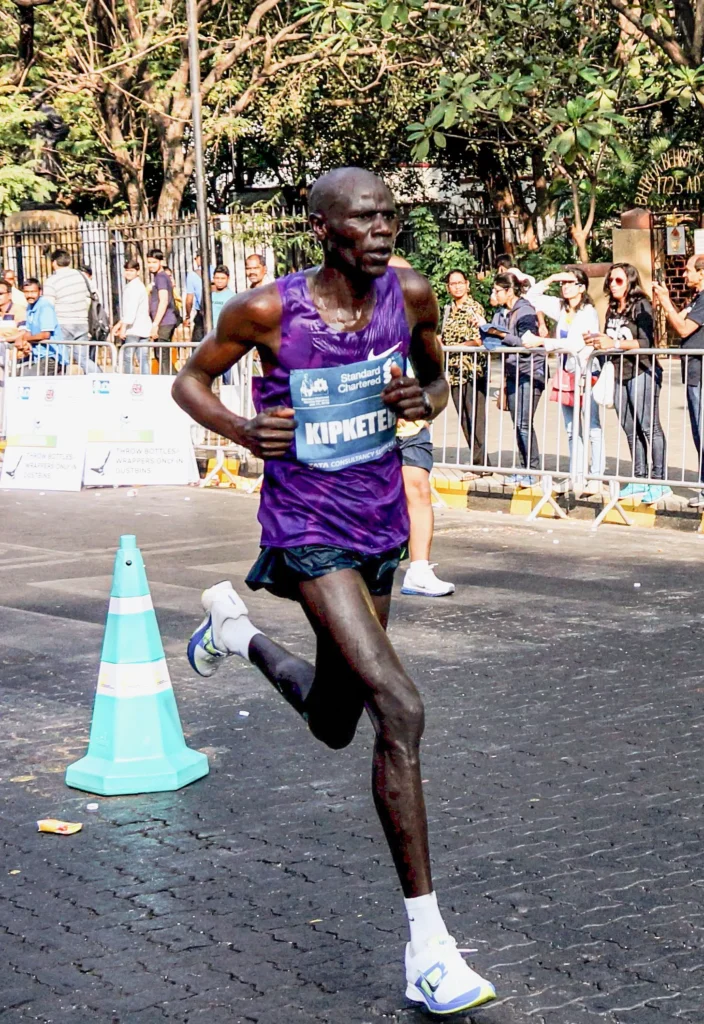
I. Speed: The Elite and Corporate Power
Peak Performance: The eventual champion pushing the pace through the crisp Mumbai morning. It is a moment of pure focus, where the elite athletes become the driving engine of the race.
The Visual: Professional athletes from East Africa leading the pack, followed closely by the Corporate Challenge contingents. You could spot CEOs from India’s top conglomerates and massive corporate teams running for brand and glory.
The Context: Mumbai is India’s financial heart. The marathon is as much a display of corporate stamina as it is of athletic prowess.
The Insight: This group represents the “Engine of India”—fast, competitive, and highly organized. It is where the boardroom meets the pavement.
II. Ambition: National Slogans & Individual Starts
Youths with “Youth are not useless” banner, a runner with “Make in India” gear, and “Start-up India” participants.
The Pulse of a New Generation: Mumbai’s youth take to the streets not just to run, but to be heard. From the “Start-up India” initiative to bold slogans challenging social perceptions, these young runners turn the 42-kilometer course into a vibrant parade of national aspiration and identity
Standing in 2026 and looking back at these three images, we can see the “Decade of India” was already written in these placards.
1. The Startup Euphoria: “Run for Beginning” The blue sign “Run for Beginning” perfectly captured the social pulse of 2016. At that moment, India was in a state of “commencement,” with youth believing that running was all it took to start a new era. The Reality: Today, Startup India stands as the most tangible legacy. It didn’t just create the world’s third-largest ecosystem; it fundamentally rewired the Indian success story—replacing “civil service exams” with “entrepreneurship” as the ultimate ambition.
2. Manufacturing Romanticism: From “Lion Flags” to Factory Floors In 2016, “Make in India” was in its romantic phase. The Lion symbol wasn’t just a government logo; it was a “passport to a decent job” for the students waving it. The Reality: A decade later, it is an arduous transition. While India has broken into the electronics assembly chain (like iPhone), manufacturing’s share of GDP still hovers at 16-17%, missing the 25% goal. The children waving those flags are now navigating the gap between grand political visions and the hard reality of the workshop.
3. The Chilling Truth: “NOT USELESS, but USED LESS” This remains the most prophetic and cold-blooded image in the collection. Amidst the grand narratives of “Startup” and “Manufacturing,” this sign points to the unresolved core: Structural Employment. The Reality: The phrase “NOT USELESS, but USED LESS” remains a haunting verdict on India’s demographic dividend. Ten years later, even with a booming digital economy, providing meaningful “use” (jobs) for the vast majority of the youth remains the ultimate unanswered exam paper for this land.
III. Responsibility: Satire and the “Green” Conscience
Runner with PK mask and water barrel protesting water scarcity at Mumbai Marathon
The Silent Protest: A runner wearing a “PK” mask carries a heavy water barrel, turning the race into a desperate plea for water security in a parched nation.The PK Satire: The yellow helmet channels “PK”, the alien from Aamir Khan’s film who asks “naive but fatal” questions. His sign—”Paani Kahan?” (Where is the water?)—is a biting linguistic play: “Badal hai sir pe, Paani Kahan?” (Clouds are above, so where is the water?). It remains a haunting prophecy of the gap between bureaucratic promises and the parched reality of Mumbai.
Young man holding a Green City placard at Mumbai Marathon.
A Future to Live In: A young participant holds a placard for “Green Cities,” representing the urban aspiration for livability amidst rapid industrialization.
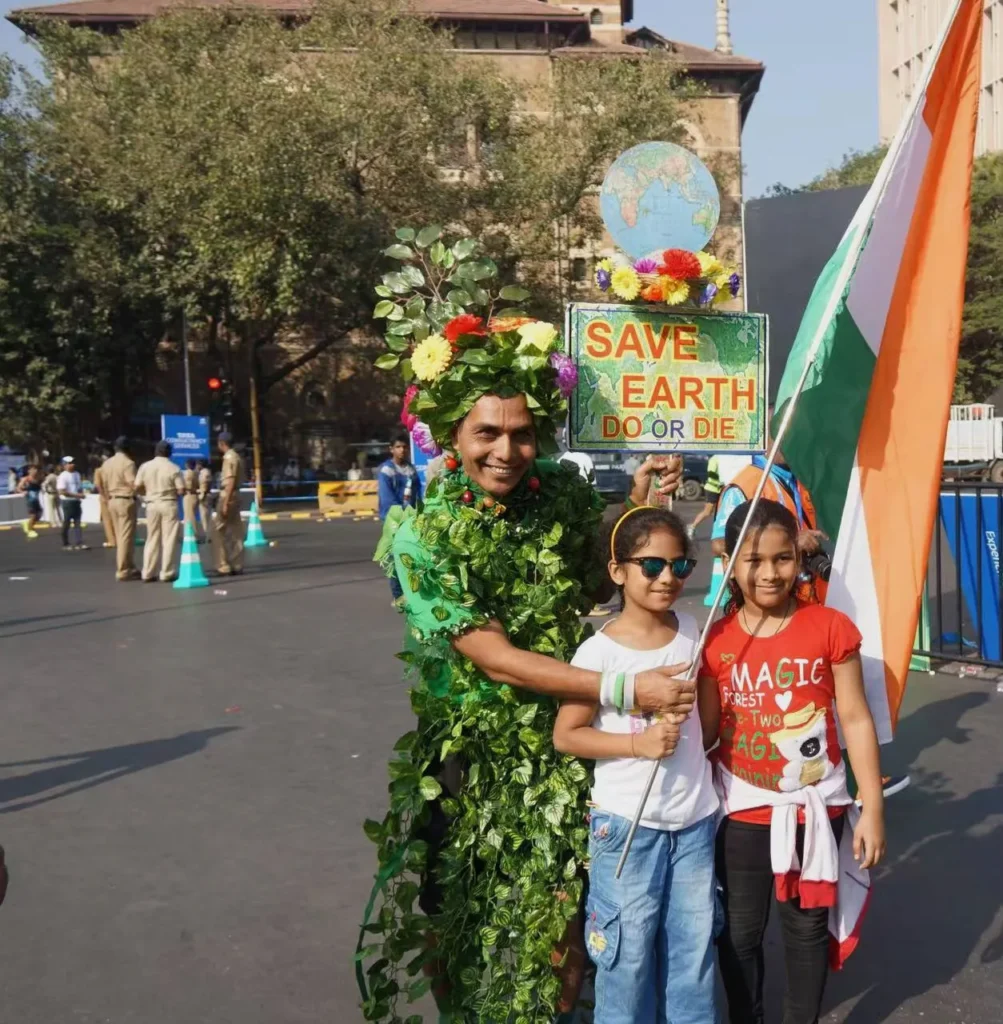
Participant in a tree costume with a Save Earth sign.
Guardians of the Earth: Dressed as a tree, this runner reminds the thousands watching that the ultimate marathon is the one we run to save our planet.
The Visual: A marathon of advocacy—from the “PK” runner highlighting the urgent water crisis to the vibrant pleas for “Green Cities” and “Saving our Earth.”
The Context: These grassroots messages, carried on the backs of everyday citizens, reflect the fundamental anxieties of India’s rapid urbanization: resource scarcity and environmental sustainability.
The Insight: While India strides toward becoming a global economic powerhouse, the local reality of water security and urban livability remains a daily marathon for its 1.4 billion people. True resilience is found in those who run not for a medal, but for a future they can live in.
IV. The Fabric: A True Mass Movement?
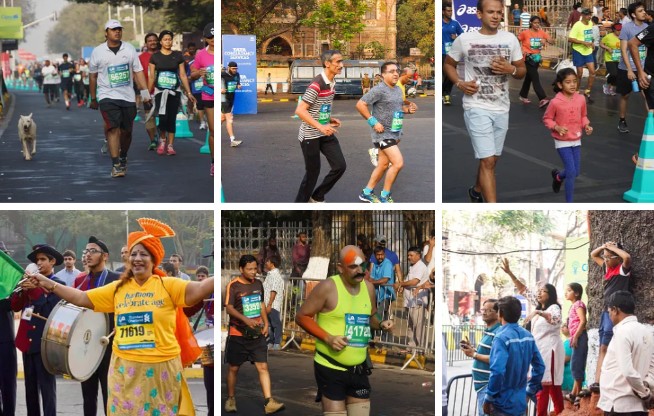
A comprehensive gallery of the 2016 Mumbai Marathon: featuring traditional drummers, a runner with Indian flag face paint, spectators cheering from trees, a stray dog running with athletes, a father and young daughter running together, and diverse citizens in motion.
The Living Tapestry: From the thunderous beats of traditional drums celebrating harmony to the quiet devotion of a father guiding his daughter; from a stray dog finding its rhythm on the asphalt to the spirited gaze of spectators under the city’s ancient trees. This is Mumbai’s soul in motion—a 42km parade where every life, every culture, and every dream finds its pace on the same open road
The Insight: In a city of 20 million defined by its complex social layers, the marathon acts as a grand equalizer. For one morning, the asphalt doesn’t care about your bank account or your background; it only cares about your stride. This is the “Fabric” of India—diverse, chaotic, yet moving in the same direction.
V. The Unstoppable: Beyond the Limit
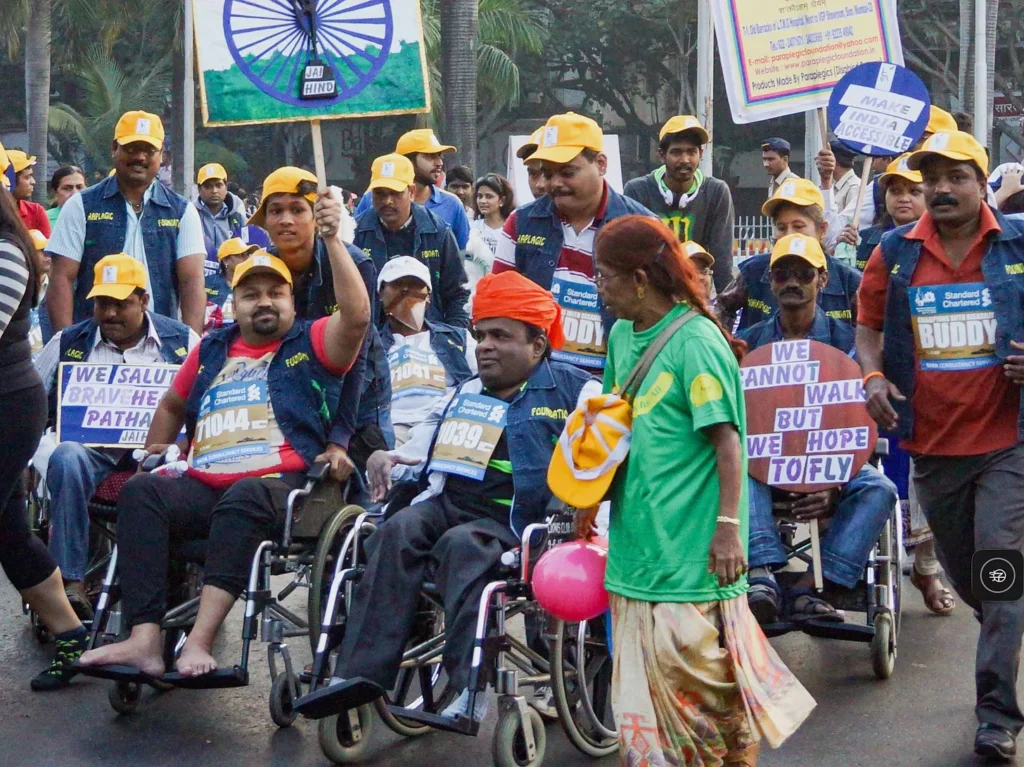
A large group of wheelchair participants at the Mumbai Marathon with a banner saying We hope to fly.
“We Hope to Fly”: A sea of wheelchairs surges forward. For these athletes, the marathon isn’t just a race; it’s a declaration of freedom and a collective demand for a more inclusive world.
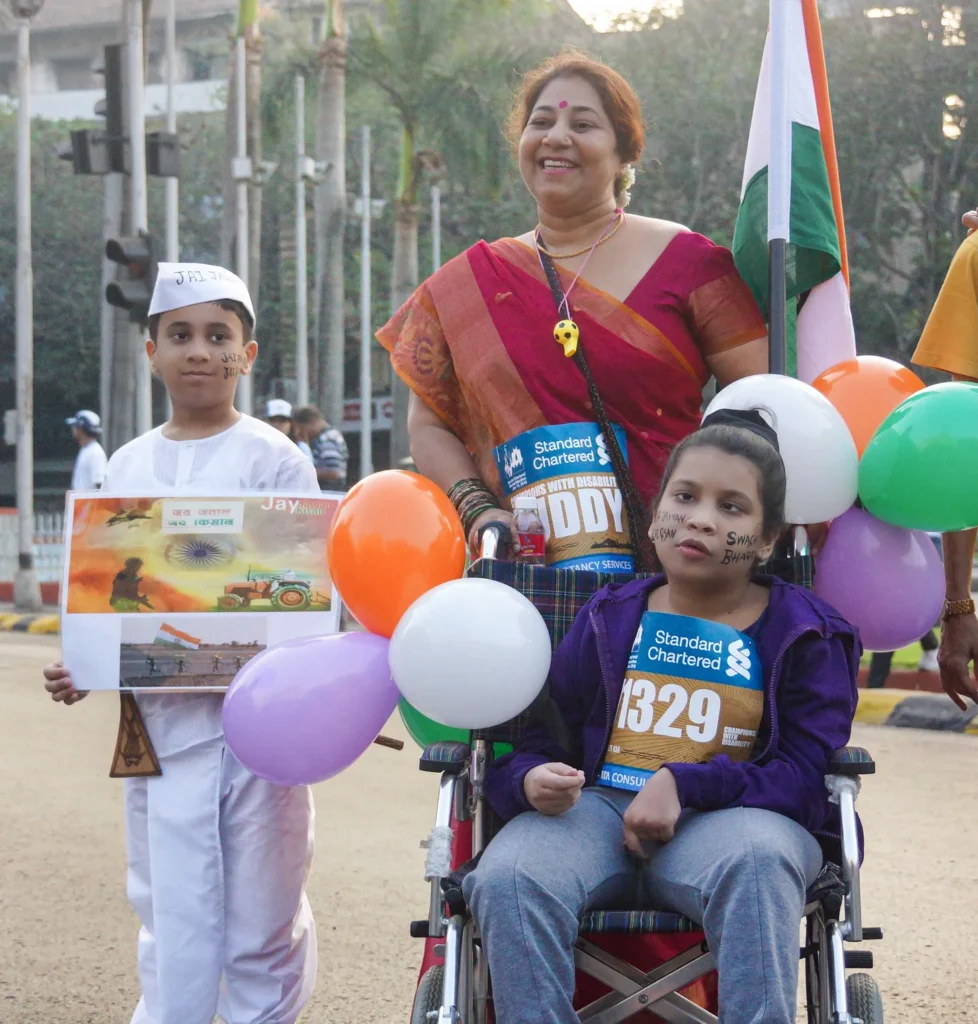
A mother and a child with balloons participating in the marathon together.
The Strength of Love: A mother and child with balloons, moving amidst the crowd. It’s a reminder that behind every “unstoppable” spirit is a silent, enduring support system that refuses to let them walk alone.
A disabled participant moving forward on his knees during the Mumbai Marathon.
Victory of the Soul: When the legs can no longer carry the weight, the spirit takes over. Every painful inch gained by this participant is a monument to human willpower that transcends physical limits.
The Imagery: Dignity in the Sea Breeze In the “Champions with Disability” category (1.75 km), colorful balloons tied to wheelchairs fluttered in the pre-dawn wind. One participant’s sign stood out under the streetlights: “We cannot walk, but we hope to fly.”
The Insight: The Deficit of “Divine” Rhetoric The Mumbai Marathon is more than a race for the strong; it’s a stage for the marginalized. In 2016, “flying” was a vision tied to those balloons. Shortly after, the government rebranded the disabled as “Divyang” (Sanskrit for “Divine Bodies”).
The Reality: Ten years of reflection remind us that this community needs functional elevators and tactile paving more than “divine” titles. Sacralization in rhetoric often masks the deficit in infrastructure.
The Truth of the Track: Those balloons fluttering on Marine Drive symbolize a longing that transcends physical limitations. In the race of society, dignity is a more important finish line than speed.
VI. The Enduring Spirit: A Journey of Dignity
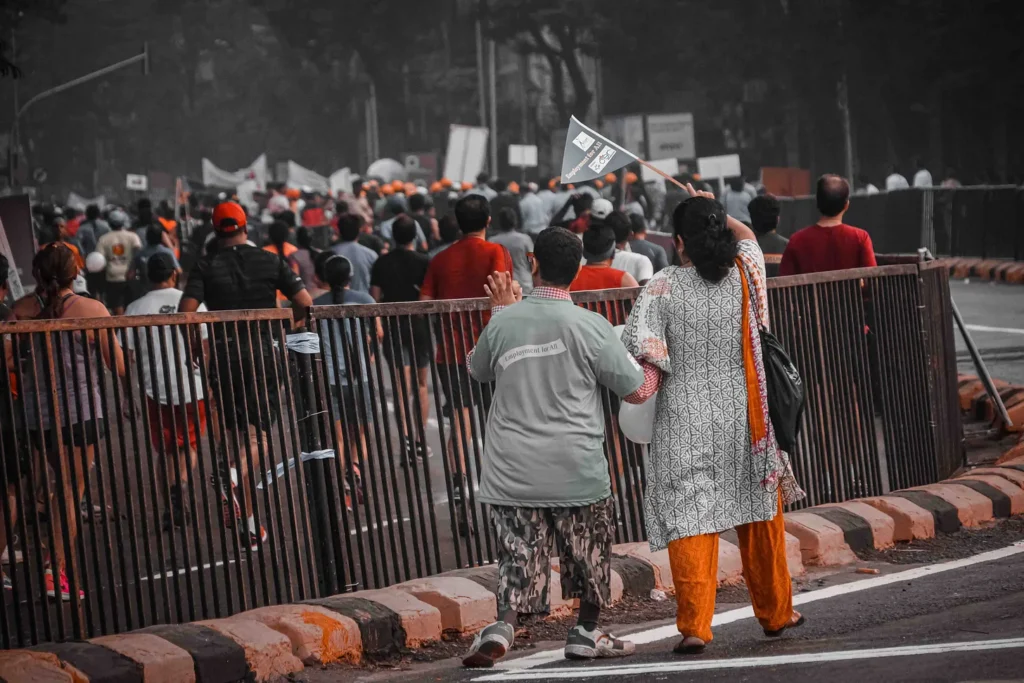
In the flowing tide of marathon runners, I caught sight of a mother and her son. The boy walked with a noticeable struggle, his leg impairment making every step an act of courage. But his mother held his hand with an unwavering steadiness, guiding him through the crowd. What moved me most was the race bib pinned to the boy’s chest—he was not a mere spectator, but a registered athlete. In that moment, it was clear that his mother wasn’t just showing him the world; she was empowering him to claim his place within it, teaching him that the spirit of the marathon belongs to everyone who dares to start.
A side profile of a mother in a traditional patterned tunic and an orange dupatta, holding colorful balloons, walking alongside her son during the marathon.
The Quiet Beginning: Amidst the roaring crowds, a mother and son find their own rhythm, proving that every journey is personal.
A back view of the mother and son walking together, the mother’s hand gently guiding or supporting her son as they navigate the marathon course.
The Silent Bond: A simple touch, a shared pace. It’s a reminder that behind every “unstoppable” spirit is a silent, enduring support system.
A cinematic final shot of the mother and son walking hand-in-hand into the hazy distance, symbolizing hope and the enduring human spirit of the Mumbai Marathon.
Toward the Future: As the city fades into the background, their silhouette remains—a testament to the dignity of walking together, no matter the difficulty.
As someone who once joined the historic path of the Salt March—retracing Mahatma Gandhi’s steps from Ahmedabad to Dandi—I remember the 3:00 AM wake-up calls and the long walks into dusty villages. We rested in temples and knocked on farmers’ doors, not just to move forward, but to connect with the soul of the land. It was then I learned that truest endurance, as Gandhi taught us, is measured in heartbeats and human connection, not just kilometers.
Years later, on the streets of Mumbai, I saw that same spirit once again—not in a historic march, but in the simple, steady act of a mother holding her son’s hand. I recalled a sentiment I had read somewhere, which perfectly captured the moment:
“A nation’s true progress is measured not by how fast it runs, but by its willingness to hold the hands of those who walk with difficulty.”
END
https://partsofthegods.substack.com/p/the-prophecy-of-2016-a-decade-reflection?r=393ml&utm_medium=ios&shareImageVariant=overlay&triedRedirect=true
