

By P.K.Balachandran/Sunday Observer
Colombo, January 25- US President Donald Trump has been sabre-rattling about invading Greenland to incorporate it into the United States. But an actual invasion appears very much on the cards as he has found no section of opinion, whether in Greenland, Denmark or Europe, for his alternative peaceful plan, namely, an offer to “buy” Greenland, which President Harry Truman had made years ago, at the start of the US-USSR Cold War.
Denmark rejected the offer, back then, as now, but agreed to allow US military access. In 1951–52, the United States established the Pituffik Space Base, a radar station. During his first term (2017–21), Donald Trump revived the old proposal to purchase Greenland. But Danish and Greenlandic leaders again rejected it. However, the 2022 Russian invasion of Ukraine brought Arctic security to the forefront and Greenland became a matter of concern. Trump stepped up his demand for Greenland. In late 2025, he appointed Louisiana Governor Jeff Landry as a special envoy to Greenland, who even said that he intended to “make Greenland a part of the US.”
Alarmed, Danish Prime Minister Mette Frederiksen warned that a US attack on Greenland would mean the end of NATO. But still, she proposed greater military facilities to the US. Trump, however, wanted outright ownership, though Secretary of State Marco Rubio offered to purchase Greenland. NATO suggested that a collective European approach be a compromise. But Trump told “The New York Times” that he wants to own Greenland because “ownership gives you things and elements that you can’t get from just signing a document.”
According to the British paper Daily Mail, Trump has ordered his senior commanders to draw up a plan for a potential invasion of Greenland. According to the paper, the Joint Chiefs of Staff are not in favour of war, arguing that the move will be illegal and lacking in Congressional support. One source told the paper that senior generals “tried to distract Trump by talking about less controversial measures, such as a strike on Iran.”
But the Daily Mail also said that the push to seize Greenland is led by several of Trump’s advisers, including his political aide Stephen Miller, who, emboldened by the recent successful attack on Venezuela, wants to move quickly to secure the Greenland before Russia or China make a move.
Therefore, given the backing of his MAGA colleagues, Trump could very well launch a lightning operation to seize Greenland. And, as in the case of Venezuela, the world would meekly accept it as a fait accompli. Indeed, a helpless world appears poised to meekly accept the change from a “Rule-Based Order” to a “Force-Based Order” where might is right, both instituted by the US.
Mineral Wealth
This raises the question as to why Trump is fixated on acquiring Greenland by any means, fair or foul. His objective in acquiring Greenland is generally stated to be gaining sole proprietorship of over the enormous mineral wealth of Greenland.
According to a 2023 survey, 25 out of 34 minerals deemed “critical raw materials” by the European Commission were found in Greenland. The US, Canada, China and Russia are now eyeing these resources. Greenland’s rare earth minerals are used in hightech industry besides batteries.
Strategic Location
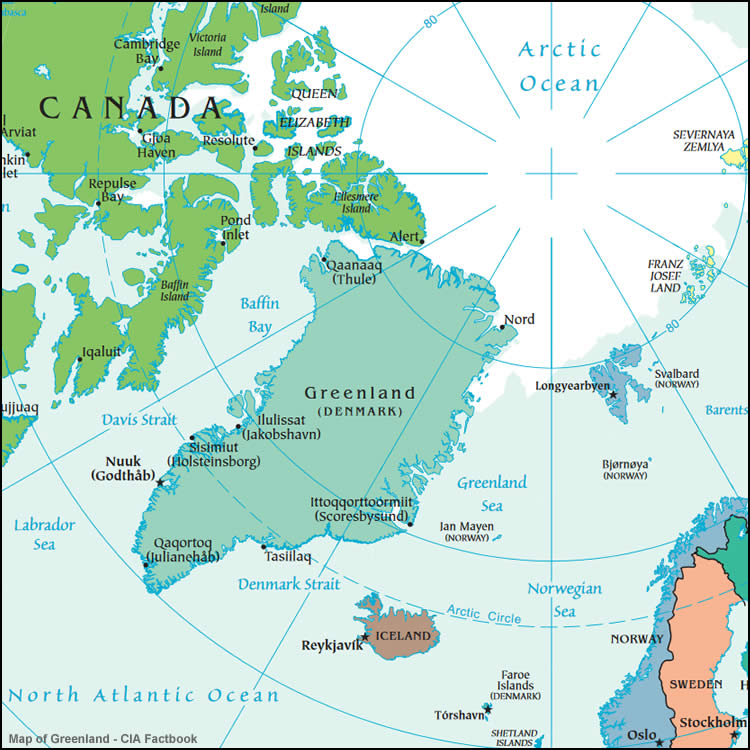
Greenland is at the intersection of North America, Europe, and the Arctic, making it critical for military movement across the northern Atlantic. As geopolitical competition with Russia and China intensifies, the US is focusing on preventing them from gaining a foothold in the Arctic region.
The primary concern is Russian naval and missile activity, with Chinese naval activity and investment in Arctic infrastructure being a close second in importance. The US believes that the current Danish-US defence agreement is not suited for meeting a Russian military threat, hence the need for direct ownership.
Trump believes that Greenland’s seas are bristling with Russian and Chinese ships. Western security circles are keen that the GIUK Gap, a maritime choke point formed by Greenland, Iceland, and the UK, be fully in West’s control.
Northern Sea Route
As stated earlier, the Northern Sea Route (NSR), a maritime route in the Arctic Ocean, is becoming easier to navigate now due to melting ice. The NSR can cut shipping time between continents significantly.
Russia is hoping to use the NSR to trade more with Asia than Europe, due to Western sanctions. Last year, the number of oil shipments from Russia to China via the NSR rose by a 25%.
Russia and China have been working together to develop Arctic shipping routes because Russia seeks to deliver more oil and gas to China amid Western sanctions and China seeks an alternative shipping route to reduce its dependence on the Strait of Malacca.
Russian President Vladimir Putin said at the March 2025 International Arctic Forum in Murmansk (the largest city in the Arctic Circle), that Russia is beefing up its military capabilities in the Arctic circle as Trump was serious about taking Greenland.
According to the Director of Ukraine’s National Security Institute, Bohdan Ustymenko, maritime strategy has long played a significant role in Vladimir Putin’s thinking. In August 2024, Putin ordered the establishment of a Russian Maritime Collegium headed by his close advisor Nikolai Patrushev, who formerly led Russia’s FSB security service and the country’s National Security Council.
Ustymenko says Russia is engaging in a wide range of hostile naval actions, including the sabotage of undersea cables in the Baltic Sea and surveillance activities off the coast of Britain and other NATO countries. Putin views the Northern Sea Route as part of Russia’s national transport infrastructure and has sought to control access for shipping from other nations.
The Northern Sea Route covers a vast area and some of the areas currently claimed by Moscow are situated well beyond the territorial waters of the Russian Federation, Ustymenko points out.
Geopolitical tensions are likely to be further heightened by a deepening involvement of China in partnership with Russia, Ustymenko says. Arctic waters provide a military advantage to Russia and China because of the North Pole’s proximity to several European nations.
Allowing Russia to gain the ascendancy in the Arctic would lead to unpredictable geopolitical consequences, Ustymenko warns. Control over the oil and gas resources of the Arctic region could dramatically increase Russia’s State revenues and the windfall would be used by the Kremlin to finance its wars.
China’s Stakes
Daniel Michaels and Sune Engel Rasmussen, write in the Wall Street Journal that Chinese research submarines have travelled thousands of feet beneath the Arctic ice, a technical feat with “chilling” military and commercial implications for America and its allies.
According to the US Department of Homeland Security, Chinese military and research vessels have operated around Alaska’s Arctic waters in unprecedented numbers. US Air Force Gen. Alexus Grynkewich has said that Chinese vessels on research missions often serve a military purpose. China has already declared itself a “near-Arctic power,” displaying its strategic aim, he points out.
The US expects China to send armed submarines to the North Pole within a few years. China already has military-grade surface vessels in the Arctic region while expanding its fleet of ice-breaking ships. On their part, the US and its allies are training more Arctic troops in response to new dangers. They have beefed up sub-hunting patrols out of Iceland and other locations.
US as Gatekeeper at NSR
The US under Trump is aiming at becoming the sole gatekeeper of the Arctic Sea Route also called the Northern Sea Route, which could significantly cut the sailing time from North America to the Far East. The US could checkmate the growing commercial and military activities of Russia and China in the Arctic region.
While the Biden administration, pivoted US foreign policy towards the Indo-Pacific, Trump is pivoting it towards the Western Hemisphere, the Americas and the Arctic. He is using America’s economic and military power not just to display hegemony for hegemony’s sake but to gain concrete economic advantage.
Rejection of NATO
Trump has refused to take Europe and NATO along in his Greenland acquisition campaign, thus wilfully abandoning a cardinal principle of the Cold War-era politics, that the defence of America and Europe is inextricably tied.
Trump has been giving enough hints that he does not value Europe and NATO, seeing both as a burden on the US taxpayer, with all obligations cast on the US and none on Europe.
He had been asking NATO countries to contribute more by allocating at least 5% of their GDP for their defence and not expect the US to do all the financial heavy lifting. Today, the US accounts for 16% of NATO’s expenditure while other members of the 32-nation alliance are trailing far behind.
Given the reluctance of NATO members to play their part, Trump has threatened to abandon them altogether and go it alone, although Art 5 of NATO pact mandates every member to consider an attack on one as an attack on all. Denmark is a NATO member (Greenland is but an autonomous region of Denmark).
Europeans see Trump’s action as political cannibalism, not seen in NATO since its inception in 1949. The Daily Mail said that Trump is destroying NATO “from the inside.”
The Daily Telegraph reported that European NATO members are discussing possible deployments to Greenland, including troops, ships, and aircraft, to guard the Arctic and assuage Trump’s concerns.
Nevertheless, Trump credits himself with being NATO’s chief benefactor. “I did more for NATO than any other person alive or dead. The big fear I have with NATO is that we (Americans) spend tremendous amounts of money on NATO, and I know we’ll come to their rescue, but I just really do question whether or not they’ll come to ours,” Trump said.
Russia’s Interpretation
The Russian Foreign Minister Sergey Lavrov dismissed Washington’s claims that it needs to annex the island to prevent a Russian or Chinese takeover of the Danish autonomous territory, stating that the US knows perfectly well that Moscow has no such plans.
Lavrov observed that the internal Western crisis over Greenland has raised questions about the very preservation of NATO. It represents a breakdown of the international rules of conduct and has upended and replaced by a game of “might makes right.”
He stressed that Russia will not play this game and will continue to treat other countries on the basis of equality and will stand up for its interests without imposing on anyone else’s legal rights.
Lavrov argued that Euro-Atlantic institutions like NATO and the EU, are “discredited” and in deep crisis, having transformed into anti-Russian tools instead of platforms for equal dialogue. In contrast, he positioned the UN as a crucial venue, highlighting Russia’s efforts to preserve the UN Charter’s original principles against Western attempts to replace them with their own rules.
Lavrov reiterated that the world is moving towards multipolarity, asserting that the era of Western dominance is over and that new centres of power must negotiate a balanced world order based on sovereign equality, not “rules” set by the West.
END
