
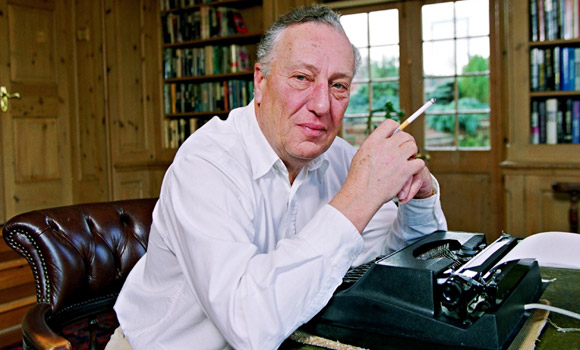

By D B S Jeyaraj/Daily Mirror
Is there a connection between popular English novelist Frederick Forsyth who breathed his last on 9th June 2025 and the Liberation Tigers of Tamil Eelam (LTTE) that was militarily defeated by the Sri Lankan armed forces in May 2009?
The answer to this question would be a simple “no”. However It must be said that for a while there was intense speculation that a device featured in a novel written by Frederick Forsyth had been copied by the LTTE known as the Tigers to assassinate people!
It all began with the assassination of former Indian Prime Minister Rajiv Gandhi by the LTTE on 21st May 1991 at Sriperumbudhoor in the Tamil Nadu state of India. Rajiv Gandhi, the leader of India’s Congress Party, was in Sriperumpudhoor to address an election propaganda meeting in support of Congress Party candidate Maragatham Chandrasekhar.
It was then that a Sri Lankan Tamil girl known by the name of “Dhanu” got close to Rajiv Gandhi and gave him a sandalwood garland. The be-spectacled girl in an orange and green churidar then bent down respectfully to touch Rajiv’s feet. She set off an explosive device concealed in a belt that was strapped to her body. Rajiv Gandhi, the assailant Dhanu and at least 18 others were killed in the blast. 42 were seriously injured.
The assassination rocked India and caused shock waves around the world. This was the first instance of an explosive-packed “suicide belt” being used in an assassination attempt. Explosive-laden vehicles had previously been used; but the Rajiv assassination was the first recorded incident where a suicide belt was used. In later years the LTTE was to use suicide bombers known as “Black Tigers” in many attacks .It became a hallmark of the LTTE.
“The Negotiator”
It was but natural for the Rajiv Gandhi assassination to become a hot topic of media discussion in India. Many theories were floated. One such theory which caused much excitement was that the Tigers had got the idea of an explosive-laden suicide belt from the Frederick Forsyth best-seller “The Negotiator” published in 1989. In that fictitious novel the bad guys use a bomb belt to kill the son of a US president.
In a bizarre co-incidence, there were many similarities between the explosive belt used in the fictitious novel and the real explosive belt worn by the Tiger assassin Dhanu to kill Rajiv. According to media reports quoting Indian investigators and analysts, both belts were made of leather and denim with a Velcro closure; both belts were three inches wide with the inserted explosives being strapped to the backbone.
There was a tremendous media buzz then linking Forsyth’s novel with the Rajiv killing. If I remember correctly, one Indian journalist even interviewed Frederick Forsyth. Although speculative theories and arguments were galore, no concrete linkage was ever proved that the LTTE had got the idea of an explosive-laden suicide belt from “The Negotiator”.
It may or may not have been an example of life imitating art. However it did serve to re-inforce the impression that Frederick Forsyth was indeed the “master of the geo-political thriller”, as the “New York Times”chose to describe him.
Three British Writers
There were three British writers whose “spy thriller” novels I was immensely fond of reading (still am). The first, Ian Fleming passed away decades ago in 1964. The second, who breathed his last some years ago in 2020 was John le Carre. The third, who died a few days ago, was Frederick Forsythe. Fleming’s James Bond was a romanticised man of action. Le Carre’s George Smiley was a calculating thinker relying more on psychology. Forsythe however was different.
Frederick Forsyth had no regular hero. He wrote about different characters in his books. His diverse plots were based on different issues relating to subjects like intrigue, surveillance, geo-politics, statecraft, national security, realpolitik and the deep state. His well researched writing was meticulously precise and instructively informative. He was a gripping story-teller whose riveting narratives were intricate yet believable and above all easy to comprehend and relish.
Forsyth’s ability to feature realistic international crises and his insider’s descriptions of military and governmental operations have been especially noted by critics.As “Dictionary of Literary Biography” contributor Andrew F. Macdonald observed about Forsyth, “the sense of immediacy, on an insider’s view of world affairs, of all-too-human world figures, as well as quick-paced plots, are the keys to the author’s popularity.”
Documentary Thriller
According to the encyclopedi.com: “Realism is the key word behind the novels of Frederick Forsyth. Often credited as the originator of a new genre, the “documentary thriller” a genre first made popular by Truman Capote’s “In Cold Blood”. The detail in Forsyth’s novels depends not only on the months of research he spends on each book but also on his own varied personal experiences, which lend even greater authenticity to his writing.
Despite the success and popularity of his books, Frederick Forsyth was looked down upon by many literary pundits and highbrow critics. His simple prose though lucid was dismissed snootily as inelegant and pedestrian. His attention to realistic detail was mocked as a “graceless prose style.”. He was also accused at times of being a painstaking reporter and not an imaginative writer. The literary critic Julian Symons dismissed Forsyth as having “no pretension to anything more than journalistic expertise”.
Forsyth however took this criticism lightly saying that he had no pretensions of being a literary icon. He wrote to entertain readers and earn money ,said Forsyth, citing the millions of his published books being sold as proof.
Languages
Frederick McCarthy Forsyth was born on 25 August 1938 in Ashford, Kent. His parents ran a business at 4 North Street, with his mother Phyllis selling dresses and father Frederick snr selling furs. Young Frederick studied at a private school in Tonbridge, Kent. He displayed a flair for languages and became proficient and fluent in French, German, Russian and of course English.
Pilot
Being an only child, Frederick was lonely during childhood and took to reading books avidly. Fascinated by Ernest Hemingway’s book on bullfighting in Spain, “Death in the Afternoon”, Forsyth enrolled at the Granada University in Spain to study Spanish while trying to become a bullfighter. After some months he returned home and enlisted in the Royal Air Force. He became a fighter pilot and was designated as flying officer in 1958.
Journalist
Though Forsyth wanted to be stationed overseas in a RAF frontline squadron, he was posted to the Royal Auxiliary Air Force locally. This was not to his liking. The fighter pilot quit the RAF and became a journalist at the Eastern Daily Press. After a few years, Forsyth joined the news agency Reuters and was posted to the news bureau in Paris and later in Berlin. Some years later he went back to Britain and joined the British Broadcasting Corporation(BBC) as a diplomatic correspondent.
Biafra
A pogrom unleashed against the Igbo people of Nigeria in 1967 in which thousands were slaughtered and millions displaced resulted in the Igbo majority areas of Eastern Nigeria seceding and declaring the independent state of Biafra. BBC sent Forsyth as its correspondent to Biafra.
However the Nigerian Govt refused to let Biafra secede and a brutal civil war ensued. Soon British policy turned against Biafra. Frederick Forsyth fell foul of the British authorities as well as BBC bigwigs for being supportive of the secessionists.
Spy
Forsyth quit the BBC but stayed on in Biafra as a freelance journalist. He became a close associate and friend of Biafra’s ruler Gen. Odumegwu Ojukwu. At the same time, Forsyth also became a spy and informant of the British Secret Intelligence Service known as M16. The Biafra secession was gradually suppressed militarily.
In 1969 Forsyth in a Quixotic attempt to aid the Biafrans wrote and published a book “The Biafra Story”.Seven months later the Biafran revolt was totally crushed. Forsyth returned to Britain a few weeks before the Biafran civil war ended. Years later, Forsyth expanded his book on Biafra and published it under the title “ The Making of an African Legend: The Biafra Story”in 1977.
Charles de Gaulle
Frederick Forsyth was now back in Britain without a job. He was financially in dire straits. A kind friend gave him a bed in his flat. A desperate Forsyth thought of writing a book to earn some cash.When Forsyth was working in Paris for Reuters, there had been some attempts by some French ex-army officers to assassinate the then French president Charles de Gaulle. They were angry with De Gaulle for granting freedom to the French north African colony of Algeria. None of the assassination attempts succeeded.
Forsyth now thought of writing a book based on those assassination attempts. Since De Gaulle was never assassinated, the novel was going to be an imaginary attempt that failed. It would be about a British assassin codenamed “Jackal” being hired to kill De Gaulle and the French Police trying to prevent it. Forsyth wrote the book “Day of the Jackal” in 35 days.
The Day of the Jackal
Mike Ripley writing an obituary for Frederick Forsyth in “The Guardian” states as follows – “ Frederick Forsyth always claimed that when, in early 1970, as an unemployed foreign correspondent, he sat down at a portable typewriter and “bashed out” The Day of the Jackal, he “never had the slightest intention of becoming a novelist”.
“Forsyth’s manuscript for The Day of the Jackal was rejected by three publishers and withdrawn from a fourth before being taken up by Hutchinson in a three-book deal in 1971. Even then there were doubts, as half the publisher’s sales force were said to have expressed no confidence in a book that plotted the assassination of the French president assassination of Gen. Charles de Gaulle – an event that everyone knew did not happen.”
“The skill of the book was that its pace and seemingly forensic detail encouraged readers to suspend disbelief and accept that not only was the plot real, but that the Jackal – an anonymous assassin – almost pulled it off. In fact, at certain points, the reader’s sympathy lies with the Jackal rather than with his intended victim.”
“It was a publishing tour de force, winning the Mystery Writers’ of America award for best first novel, attracting a record paperback deal at the Frankfurt book fair and being quickly filmed by the US director Fred Zinnemann, with Edward Fox as the ruthless Jackal. Forsyth was offered a flat fee for the film rights (£20,000) or a fee plus a percentage of the profits – he took the flat fee, later admitting that he was “pathetic at money”. The 1972 paperback edition of The Day of the Jackal was reprinted 33 times and is still in print”.
The Odessa File
“Day of the Jackal” was the first of a trilogy. The second was “The Odessa File” published in 1972. It was about a reporter who is trying to track an ex-Nazi war criminal hiding in Germany. He is allegedly protected by a secret ex-Nazi organisation named ODESSA. The novel was made into a film starring Jon Voight, Mary Tamm, Maximilian and Maria Schell.
Dogs of War
The final novel in the Trilogy was “Dogs of War”. This was about a British mining executive hiring mercenaries to overthrow an African Govt and install a puppet regime that would allow cheap access to a huge platinum-ore deposit . This novel too, was made into a film starring Tom Berenger and Christopher Walken.
Triple Jewels
Frederick Forsyth in a creative writing career spanning more than five decades wrote several novels and many short stories. They were all published and well received. The triple jewels in his writing crown were his three early novels – “Day of the Jackal”, “The Odessa File” and “Dogs of War”. All three bestsellers were made into films and all were box office hits too
Frederick Forsyth married a former model Carole Cunningham in 1973. The couple had two sons. After an amicable divorce in 1988, Forsyth wedded Sandy Molloy in 1994. She died in 2024. Forsyth was also linked romantically to actress Faye Dunaway briefly. Frederick Forsyth died on June 9th 2025 at his home in Jordans, Buckinghamshire at the age of 86 after a short illness.
END
DBS Jeyaraj can be reached at dbsjeyaraj@yahoo.com
