

By Laxmi/ Substack/January 23, 2026
During the 2026 World Economic Forum (WEF) in Davos, veteran Indian columnist Vir Sanghvi delivered a scathing verdict: *”Davos is where wealthy Indians go to feel important—for free.”*While the trip’s “freeness” is a convenient myth—with travel bills footed by shareholders and taxpayers—the psychological payoff remains peerless.
Many comments on social media were equally caustic: “Is this the World Economic Forum, or the Indian Economic Forum?” Faced with this year’s spectacle of multiple chief ministers gathering in the snowy mountains for a flurry of meetings, public commentary delivered a sharp rebuke: Why travel to such great lengths to Switzerland for show when these meetings between governments and companies, or between companies themselves, could easily have been held within India?
The Efficiency Paradox: Solving the “Administrative Jet Lag”
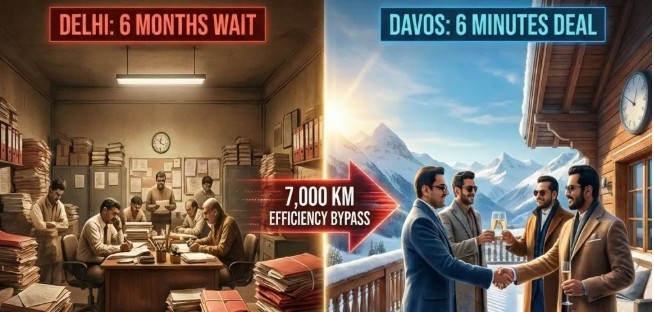
Yet, beneath the veneer of vanity lies a cold, pragmatic “Administrative Jet Lag” that Davos uniquely cures. In the power corridors of Delhi or Mumbai, a formal meeting between a Chief Minister (CM) and a tycoon is a Herculean task of protocol. Even when both principals are in agreement, the bilateral administrative barriers can result in a 6-month wait.
Visitors often find themselves spending weeks navigating the labyrinth of multiple secretariats’ schedules and protocol requirements, with these barriers frequently delaying crucial meetings until the very last day of their stay in the city.
In contrast, along the lakeside promenade in Davos, these top-tier collisions take as little as 6 minutes at their fastest. The greatest value of this summit is its “Protocol Immunity”—it forcibly bypasses the bureaucratic jungles, allowing a 6-minute stroll to catalyze a deal that months of domestic maneuvering could not finalize.
The Rise of the “Sub-national CEO”: From Naidu’s Legacy to the Modi Template
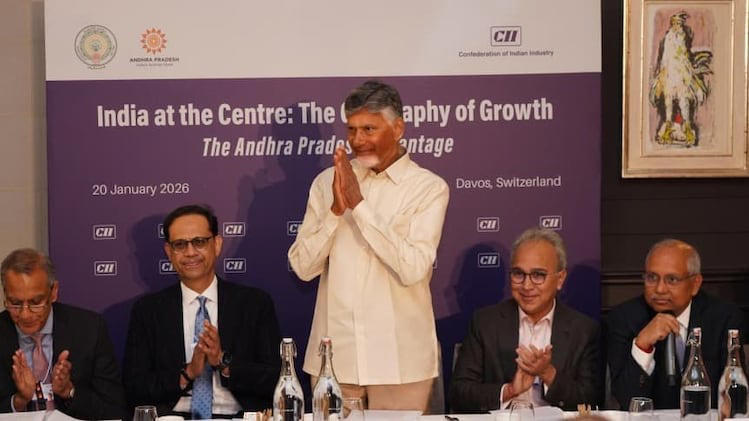
This “exodus of regional leaders” is no overnight phenomenon; it is the culmination of a thirty-year generational evolution of power within India’s states. In the Davos snow in 2026, N. Chandrababu Naidu, the Chief Minister of Andhra Pradesh, remains an unmistakable figure in his signature brown Sahari suit. Due to his efficient and process-driven management style, Naidu earned the nickname “CEO” long before it was fashionable for politicians.
Naidu is no stranger to these slopes. As early as 1996, he stormed the mountains under the title of “CEO of Andhra Pradesh,” single-handedly cornering Bill Gates and putting Hyderabad on the global tech map. Reflecting on his first attendance, Naidu remarked, “Back then, hardly anyone knew about Indians.” His purpose then was to learn, build connections, and promote India. Thirty years later, he observed a complete transformation: Davos now widely acknowledges that “this is India’s moment.”
Naidu, the “Patriarch” of this movement, points to a staggering 10 Indian states sending their own delegations this year. He defines this evolution as a transition from “Ease of Doing Business” to “Speed of Doing Business.” It is a path that even Prime Minister Narendra Modi followed. Modi made his Davos debut in 2008 as the Chief Minister of Gujarat. By aggressively promoting the “Vibrant Gujarat” summit on this global stage, Modi successfully rebranded himself from a controversial regional politician into the “Vikas Purush” (Man of Development). Since then, the Davos ticket has become a mandatory rite of passage for India’s regional titans.
The Global Audition: “One State, One Nation” Scale
Today, this mountain-top roadshow has evolved into a “Global Audition” for future leaders. These “Sub-national CEOs” manage economies that rival global powers.
Devendra Fadnavis: Having attended Davos consecutively last year and this year, Fadnavis represents Maharashtra—India’s economic heartland. Boasting a population of 120 million (equivalent to Japan) and a GDP ranking among the world’s top 20 economies, his sophisticated narrative style and fluent English have effectively dissolved old stereotypes about Indian regional officials.
Yogi Adityanath: The “monk-politician” who rarely travels abroad. In 2023, Yogi made an appearance at Davos that caused quite a stir, but this year he chose to remain in India. Yet, his state, Uttar Pradesh, is a 240-million-strong behemoth—if it were a country, it would be the fifth most populous in the world. By sending a high-powered delegation while remaining at his post, Yogi signaled a focus on domestic stability—”leadership by presence” even in absence.
The Battle for AI “Definition”: Scenario Sovereignty vs. Compute Colonialism
This was the most intense “narrative war” of Davos 2026. In the Congress Centre, IT Minister Ashwini Vaishnaw clashed directly with the IMF Managing Director, Kristalina Georgieva. Responding to the IMF’s “AI Preparedness Index” (AIPI), which condescendingly placed India in the “second tier,” the Minister’s rebuttal was surgical:
“While you are obsessed with compute models in the climate-controlled comfort of laboratories, India is obsessed with real-life application scenarios for 1.4 billion people.”
To shatter the western illusion of “parameters as justice,” the Minister offered a technical reality check. While OpenAI’s GPT-4 pursues “brute-force” intelligence with trillions of parameters, and DeepSeek-V3 pushes limits with over 600 billion, India is pursuing a different dimension of efficiency. The ultimate embodiment of this pragmatism is the heavy-hitting sovereign model set to debut next month. Expected to feature 120 billion parameters, this model is the “Optimal Solution for a Great Power.” It doesn’t seek to consume half a nuclear plant’s energy for trillion-parameter experiments; instead, it aims to precisely cover India’s dozens of official languages and complex administrative logic. This is a declaration of “Scenario Sovereignty” against “Compute Colonialism.”
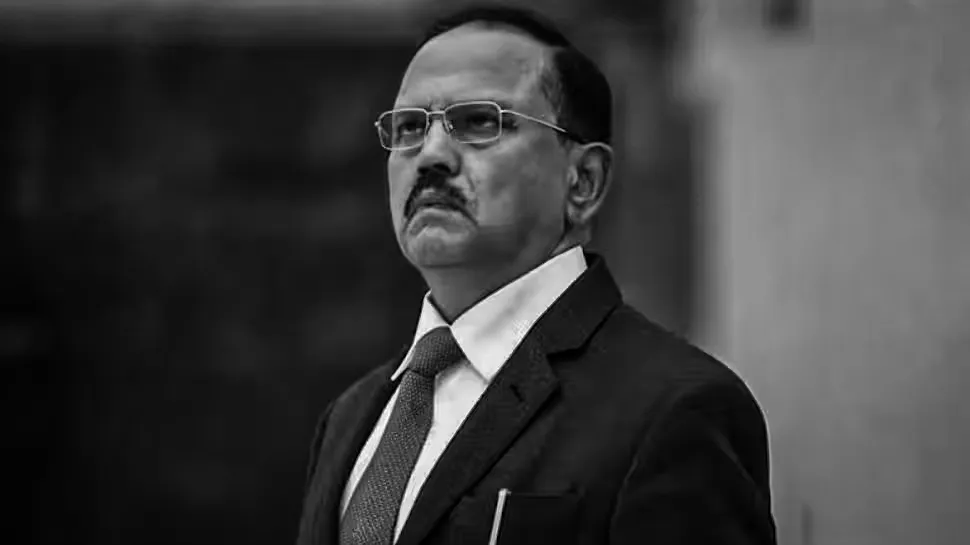
Ajit Doval
The Shadow Commander’s “Security Seal”: When Geopolitics Hijacks Economics
Amid the cacophony of investment deals, one figure appeared strikingly “out of place”—National Security Advisor Ajit Doval, the “Shadow Commander.” A man of the shadows who almost never appears in commercial settings, Doval’s presence at Davos serves as a silent footnote to the total takeover of economics by geopolitics.
As the Adani Group unveiled its $72 billion roadmap for AI and green energy, the NSA’s presence functioned as a visible “State-level Security Seal.” The division of labor is sophisticated: Chief Ministers are at the front “courting” capital, while Doval remains in the back, performing the “security check.” He ensures that every deal is anchored within the bedrock of strategic safety. This signals an unspoken truth: in 2026, all prosperity and growth must first pass the ultimate test of national security.
Returning to the questions raised on social media: the “sense of importance” purchased by India’s elites may be mere vanity. But the billion-dollar contracts they bring home, along with the political capital chief ministers accumulate through these “global interviews,” are very real indeed.
While the rest of the world is busy watching the snow, India is busy redistributing the global oxygen.
END
