
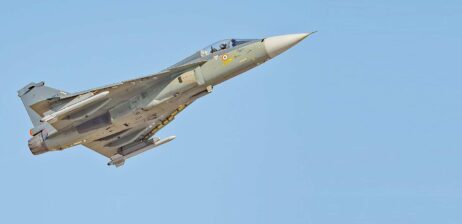

Ajai Shukla/The Diplomat
New Delhi, December 1 – On November 21, an Indian Air Force (IAF) test pilot was killed in the Dubai Air Show 2025, while landing a Tejas light combat aircraft (LCA) at the end of a flight demonstration.
This was the Tejas LCA’s first fatal crash in 24 years of flying operations. One Tejas had crashed earlier in 2021. In that incident, the pilot managed to bail out, deploy his parachute, and survive.
However, the Dubai crash has triggered an acrimonious debate across India’s military-industrial complex over whether the Tejas, like the MiG-21 before it, is an inherently unreliable “flying coffin” or “widow maker.”
There is already speculation that the pilot might have pushed his Tejas fighter beyond its proven flight envelope in order to demonstrate to potential buyers its capability as a highly maneuverable dogfighter.
The cause of the crash will be determined by a Court of Inquiry that has been convened for the purpose.
The development of the Tejas has proceeded slowly, and its indigenization has neither been as quick or comprehensive as the Defense Research and Development Organization (DRDO) and Hindustan Aeronautics Ltd. (HAL) have projected. However, before this crash, the Tejas could legitimately boast of the most enviable flight safety record among light fighters.
That record of the Tejas has been sullied after the crash in Dubai. In front of a discerning and critical audience of military planners and buyers, a question mark has been placed against the aircraft’s combat readiness, operational robustness and suitability for frontline service.
The Tejas has been designed and developed by India’s DRDO and is assembled and integrated by HAL. Its rivals in the light fighter segment include the U.S.’ Lockheed Martin (F-16), Russia’s MiG-29, Sweden’s Gripen E, Korea’s T-50 Golden Eagle, the Sino-Pakistani JF-17 Thunder and China’s J-50 Shenyang fighter.
Since the Tejas LCA’s first flight in 2001, it has undergone an extensive flight-testing program and capability upgrade to a far more advanced Tejas Mark 1A and Tejas Mark 2 versions. The Indian Ministry of Defense (MoD) has placed great reliance on the Tejas Mark 1A by ordering 180 fighters for the IAF. This upgraded version is being marketed aggressively in Southeast Asia and West Asia.
With production of the Tejas Mark 1A starting in 2024-25 with 16 fighters being delivered every year, the IAF’s first order for 83 fighters would be completed by the end of 2028-29.
With Tejas Mark 1A production ramping up to 24 fighters per year, the IAF’s second order for 97 fighters would have been delivered by 2035-36. Meanwhile, production of the 5th-generation Advanced Medium Combat Aircraft (AMCA) would have begun by 2033-34. Within four years, i.e., by 2035-36, the IAF’s planned fleet of 96 AMCAs would be in operational service in the IAF.
That would provide the IAF with an indigenous fleet of 454 combat aircraft: 96 AMCAs, 138 Tejas Mark 2s, 180 Tejas Mark 1As, and 40 Tejas Mark 1 fighters. In addition, the MoD anticipates an uncertain number of foreign sales, which would be added to these.
India’s defense planners have long grappled with the question of the size of the IAF’s combat aircraft fleet. Most experts acknowledge that the IAF requires about 42.5 combat squadrons, which adds up to about 900 fighters, bombers, electronic warfare, and command and control aircraft.
On the ground, the IAF functions with a shortfall of 10-12 combat squadrons, or a deficiency of about 220-250 aircraft. This shortfall stems, to a significant degree, from its unacceptably high accident rate, which has eroded its bank of combat aircraft as well as skilled pilots.
The IAF’s accident figures for the 70 years from 1952 to 2021 have been extensively analyzed. This period can be divided into seven segments, each a decade long. During these seven decades, the IAF has lost 2,374 aircraft to crashes, including 1,126 fighters and 1,248 non-combat aircraft. In addition, 229 trainers and 196 helicopters have crashed. These crashes have resulted in the deaths of 1,305 skilled pilots, each of whom had cost the government several billion rupees. The number of combat aircraft lost exceeds 50 squadrons.
In an article titled “Cost of IAF’s lesson: 50 squadrons lost” that Devesh Kapur and I published in Business Standard on September 1, 2023, we wrote: “Some of these aircraft and pilots were lost in action in the wars that India fought against Pakistan in 1947-48, 1965, and 1971; and to a smaller extent in the Kargil conflict in 1999. In the 1962 war, for reasons that are still being debated, the IAF did not fly combat operations. In the 1965 war, it lost 59 aircraft on the ground, many during pre-emptive strikes by the Pakistan Air Force (PAF) in Pathankot and Kalaikunda, in what turned out to be a deplorable failure of Indian intelligence and preparedness. The IAF’s own history of its operations in the 1965 war acknowledges it ‘suffered disproportionately higher losses’ than the PAF. A mitigating factor in 1965 was that the IAF was flying vintage aircraft while the PAF had the most advanced U.S. fighters in Asia. With greater experience, the IAF did much better in the 1971 war. Overall, of all the IAF’s losses, just 143 aircraft – or one out of eight aircraft lost overall – were combat casualties.
Through practically the entire decade of the 1990s, the IAF bled from losing an average of two aircraft and a pilot every month. An audit report, entitled “Aircraft Accidents in the Indian Air Force, 2002,” by the Public Accounts Committee concluded that the IAF’s accident rate per 10,000 hours of flying ranged “between 0.89 and 1.52 during the period 1991-97.” For fighters, it “ranged between 1.89 and 3.53,” while for MIG-21 variants it “ranged between 2.29 and 3.99.”
How did the IAF accept such heavy and persistent losses of aircraft and pilots? And further: How much of this steady bleeding from peacetime losses is responsible for the persistent shortfall of combat squadrons?
This question must be answered, given the exorbitant cost of combat aircraft and the expenditure on training fighter pilots. In comparison, fighter aircraft accident rates in the U.S. Air Force were 0.29 in the 1990s, 0.15 in the 2000s, and 0.1 between 2010-18.
It was only at the turn of the century that the IAF got down to analyzing its accident rates and instituting remedial measures. The APJ Abdul Kalam Committee was set up. It demanded the implementation of various measures, including simulators and flight safety infrastructure at the base, among others. All those recommendations have been implemented. These measures had a discernible positive impact on accident numbers thereafter.
During the Eleventh Plan, covering the five years between April 1, 2007, and March 31, 2012, the IAF lost 65 fixed-wing and rotary-wing aircraft. During the Twelfth Plan, covering the five years between April 1, 2012, and March 31, 2016, the IAF’s losses due to accidents dropped to 28 fixed-wing and rotary-wing aircraft.
Questions have long been asked about why neither the IAF nor the Indian Navy has shown any enthusiasm for buying the Tejas LCA. Nor have either of those services contributed significant funding for the development of the Tejas. International aerospace watchers will now be waiting to see whether the crash in Dubai results in any structural reforms that push the Tejas project onto the pathway to success.
The question mark that last week’s crash has placed over the Tejas LCA will have to be addressed before confidence is restored in one of the Indian military’s showpiece high-technology projects.
(Ajai Shukla, Contributing Author, is a commentator on defense and strategic affairs, who served in the Indian Army from 1976 to 2001)
