
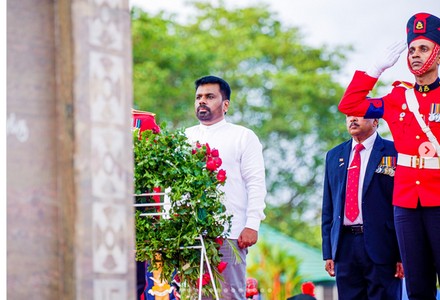

By Veeragathy Thanabalasingham
Colombo, May 31 – While addressing the 60th anniversary celebrations of the Janatha Vimukthi Peramuna (JVP) at Vikaramahadevi Park in Colombo on May 14, President Anura Kumara Dissanayake spoke highly of the “conscience” that guided their movement.
He said that throughout history, their conscience has shown them the right path and has given them the courage to face future challenges too, adding that they were dedicated to protecting that conscience.
One wonders whether conscience was the reason for President Dissanayake’s hesitation in taking a firm decision regarding his participation in the 16th National War Heroes Commemoration event held in Battaramulla five days later on May 19. It cannot be said that he would have taken a principled decision to avoid the annual event to honour the war heroes.
But, one does not know how many people believed that the government, which first announced that President Dissanayake and Prime Minister Harini Amarasuriya would not attend the commemoration event and that it would be led by Deputy Defence Minister retired Major General Aruna Jayasekera later said that the announcement was a result of miscommunication.
In the end, the President could not avoid attending the commemoration. The JVP has always boasted that it encouraged and supported the government of President Mahinda Rajapaksa to wage war against the Liberation Tigers of Tamil Ealam (LTTE ) in full swing. As such, it is difficult to understand the reason for the initial reluctance of the present leader of the JVP who is the Executive President of the country and the Commander – in – Chief of three armed forces to participate in the event of honouring soldiers.
Although the late Somawansa Amarasinghe was the leader of the JVP when it supported the war, there is no record that Dissanayake had a different view of the escalation of the war. It must be reminded that it was under his leadership that organizations of retired soldiers and police officers were formed in the National People’s Power (NPP).
At the same time, given the approach and actions of the JVP led NPP government in handling the problems of the minority communities in after it came to power, it is difficult to believe that the President would have shown any reluctance to participate in the War Heroes Commemoration in order to avoid hurting the sentiments of the Tamils who had suffered more than any other community as a result of the three-decade war.
In any case, there is no doubt that the President changed his mind in the face of criticism from nationalist forces. The events of the past week are the latest evidence of the extent to which President will be forced to bow to the nationalist forces in dealing with the problems of minority communities, including attempts to find a political solution to the national ethnic problem.
Against a backdrop where Sinhala Buddhist nationalism has become intertwined with triumphalism after the end of the civil war, it is politically untenable for either the President or the government to do anything that might appear to insult the memory of the war heroes whom the people of the majority community revere as those who sacrificed their lives to protect the country’s unity and territorial integrity. It is, therefore, a matter of great mystery as to why the President subjected himself to such impropriety.
Last year, the 15th National War Heroes Commemoration was held under the patronage of the then Prime Minister Dinesh Gunawardena. The President at that time Ranil Wickremesinghe was not present. But, his absence created not even a ripple.
Pivithuru Hela Urumaya leader and former minister Udaya Gammanpila even claimed that it was because of the pressures from the Tamil diaspora and communal political forces that the President first decided to refrain from participating in the War Heroes commemoration.
Last week, the Rajapaksas, for the first time since stepping down from power, held a separate commemoration of the war heroes on behalf of their Sri Lanka Podujana Peramuna (SLPP) titled” “True Independence of the Motherland.” The Rajapaksas, during their rule firstly engaged in the majoritarian mobilisation using war and after the end of the war they did the same using war triumphalism. They will not miss out on any opportunity to whip up communalism.
The Rajapaksas are entertaining a belief that the Sinhala people are indebted to them because the war was brought to an end during their rule. They also believe that no one has the “legitimate right” to claim credit for the war victory except their family and their party. Despite losing popular support due to their misrule, the Rajapaksas still enjoy the confidence of Sinhala nationalist forces.
Although government leaders have been declaring that they will never allow racism and religious extremism to take hold again, it is obvious that their actions are beginning to alienate them from minority communities further. The Tamil nationalist parties in the North and East have campaigned that there is no difference between the previous governments and the NPP government in dealing with the problems of the minority communities. The situation has changed so much that they could win back the support of the Tamils in the local elections.
But while the NPP government is facing popular discontent considerably over its inability to deliver on its election promises, it is careful not to alienate the nationalist forces in southern Sri Lanka in dealing with minority issues. It is possible that opposition parties and nationalist forces, unable to mobilise the masses against the government on issues affecting all communities, including the economic crisis, may seek to embark on strategies against the NPP on the basis of communal politics.
The criticism of the President in connection with the commemoration of the war heroes are a proof of this.
In any case, President Dissanayake’s speech at the war heroes commemoration event is certainly to be commended. It seems that he is of the view that the event should not be treated as a celebration of war victory like the Rajapaksas did. But the nationalist opposition and social media have been harsh on him in their criticism. The claim that Ppresident Dissanayake has reduced the war heroes to ordinary soldiers.
The President eloquently spoke on the tragedy of the war and stressed the highest form of justice the country could provide for those who gave their lives was to create enduring peace in this nation.
” This commemoration is not merely a remembrance of the war’s conclusion but also a pledge to unite all communities in building a nation rooted in brotherhood and harmony, rather than allowing divisions to reignite. War is a tragedy. As a nation that has endured this immense sorrow, it is our duty to ensure that such a conflict does not arise again. We must strive to build a society characterised by peace, unity and compassion, replacing suspicion, anger and hatred with brotherhood and love.
” Not only in the South, but also in the North, people hold up photographs of their husbands and children on the streets and mourn their deaths. To every parent, their child is precious. So, as a country that has faced such a massive tragedy, our responsibility is to prevent such a war from happening again.”
” This memorial reminds us that true homage lies in forging unity. Let us vow never to permit division again. Instead, let us build a society where brotherhood triumphs over enmity. True freedom of our homeland remains elusive, even after ending the war, we have yet to fully secure the complete liberation of our motherland.”
” We must build a society where our children will no longer live in fear of war.This is an incredibly difficult task, yet it is one we must successfully accomplish. Although this may not be the ideal moment, I feel compelled to say that in both the North and the South , the flames of ethnic conflict have been rekindled, fuelled not by any cause other than the struggle for power” President stated.
While honouring and remembering the soldiers who sacrificed their lives to end the war, the President’s avoidance of mention of the war victory sets last week’s event apart from other memorial events so far.
While Sinhala nationalist forces have strongly condemned his speech, it is unfortunate that Tamil political forces did not welcome it. The President’s message must be properly understood. May 19 is not a day to celebrate war. This comes from a Sri Lankan President for the first time.
(The writer is a senior journalist based in Colombo)
