

By Nivedha M. ,Sambavi Parthasarathy,Devyanshi Bihani,Vignesh Radhakrishnan
Chennai, January 21 – Shortly after Governor R.N. Ravi walked out of the Assembly without delivering the customary address on Tuesday, the Lok Bhavan issued a press release detailing the reasons for his action.
A fact check of the claims in press release shows many reasons stated were wrong or the data was cherry-picked.
The Lok Bhavan claimed that four years ago Tamil Nadu was the fourth largest recipient of Foreign Direct Investment (FDI) but “today is struggling to remain at the sixth”. This is factually wrong.
According to latest data from the Department for Promotion of Industry and Internal Trade, for FY26, the FDI equity inflow to Tamil Nadu stood at $3.5 billion for the April to September period, the third highest among States. In FY22, Tamil Nadu ranked fourth and a year earlier it had ranked sixth.
MSMEs in State
The press release said over 55 million Micro, Small, and Medium Enterprises (MSMEs) were registered in India, of which four million are in Tamil Nadu. These figures show discrepancies with the data in the Ministry of Micro, Small and Medium Enterprises dashboard, which shows there are 75 million registered MSMEs in India, of which six million are in Tamil Nadu, the third highest among States.
Suicides
The Lok Bhavan said Tamil Nadu recorded 20,000 suicides in one year, “nowhere else in the country the situation is so alarming and Tamil Nadu is being referred to as the suicide capital of India”.
According to the latest National Crime Records Bureau data, Maharashtra recorded more suicides than Tamil Nadu in 2023 — a trend consistent with previous years. This raises questions as to why Tamil Nadu is labelled the “suicide capital” in the Lok Bhavan statement.
Still, it is concerning that Tamil Nadu has ranked second in the number of suicides every year between 2013 and 2023 (irrespective of which party is in government).
Narcotics cases
As for drug use, data shows cases filed under the Narcotics Drugs and Psychotropic Substances (NDPS) Act in Tamil Nadu rose about 100% — from roughly 13,450 (2018-20) to 27,300 (2021-23). But, other States saw even sharper increases: cases in Assam rose by 260% and Telangana by 220%, while Kerala, Karnataka, Bihar, and Andhra Pradesh also saw spikes ranging from 125% to 180%.
Rape cases
A claim about the rise in POCSO Act rape cases is missing a clear time frame for comparison. The Supreme Court recently observed that the POCSO Act was weaponised by families to punish young people, which cast doubt on the higher numbers.
Crimes against Dalits
The release also claims atrocities against Dalits are sharply increasing. However, NCRB data shows that between 2018 and 2023, Tamil Nadu has consistently ranked between eighth and thirteenth in cases filed under the Prevention of Atrocities Act (data for SCs considered). Much like the trend seen with drug-related cases, this rise in reported incidents was observed in several other States as well.
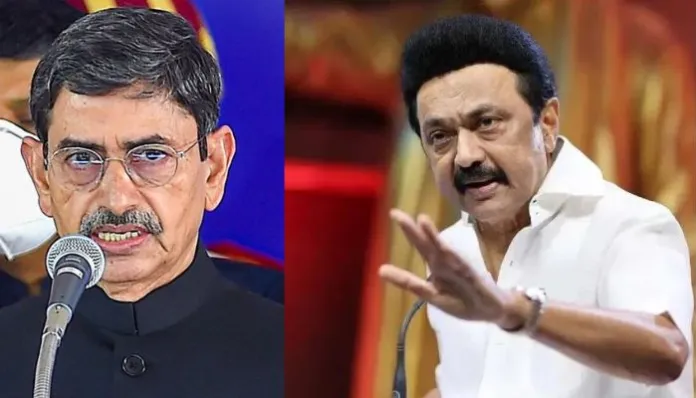
In what has now become a familiar scene, Tamil Nadu Governor R.N. Ravi declined to read out his customary speech prepared by the State government on the floor of the State Legislative Assembly on Tuesday (January 20, 2026), and walked out of the House.
Shortly after his exit, the Lok Bhavan issued a statement saying that Mr. Ravi had declined to read the speech as it contained “numerous unsubstantiated claims and misleading statements”. Besides, several crucial issues troubling the people were ignored and the Governor’s microphone “was repeatedly switched off and he was not allowed to speak,” it said.
Disapproving of Mr. Ravi’s action, Chief Minister M.K. Stalin moved a resolution urging the Assembly to take on record only the approved Governor’s Address. The House adopted the resolution unanimously. Mr. Stalin announced that his DMK party would take steps for a Constitutional amendment to do away with the practice of commencing the first Assembly session of the year with the Governor’s address.
During the remainder of the session, a debate will be held on the Motion of Thanks to the Governor’s Address to the House.
On Tuesday (January 20, 2026) morning, soon after the Governor was escorted in, all members stood for the singing of the Tamil Thaai Vaazhthu, the State anthem. While others settled in their seats after the song, the Governor initially kept standing, as the tablet placed in front of him displayed the text of the prepared speech, to help him read from. He later took his seat.
The Governor began by extending New Year wishes to the members but then went on to digress from the prepared speech. Speaker M. Appavu, seated next to him, stood up and requested the Governor to read out the speech given to him by following the procedure. Realising that the Governor had ignored his request, the Speaker continued to plead with him to read out the prepared speech.
An uneasy silence prevailed among members of the House, with Mr. Stalin and Leader of the Opposition Edappadi K. Palaniswami in attendance, as the customary procedure was not being honoured, yet again. During the past three years, the Governor has either digressed from the prepared speech or refused to read it out and walked out of the House.
Citing Constitutional provisions, the Speaker reminded the House about the duties of the Governor. “The Governor cannot voice out his opinion in the Assembly. Please follow the procedure,” the Speaker requested repeatedly, reminding the Assembly that only its 234 elected members are permitted to express their opinions on the floor of the House.
Later, the Governor chose to walk out of the House. Sources said that Assembly officials escorted the Governor and his aides to his convoy.
Addressing the Lok Bhavan’s contention that the national anthem was “insulted”, the Speaker said it was a “settled issue” and his decision to play the State anthem at the beginning and national anthem at the end of the day’s session had been announced last year too. After the Speaker completed reading out the Tamil version of the Governor’s speech in the House, the national anthem was sung.
During a press conference later in the day, Mr. Appavu clarified that whenever the Speaker’s microphone was on, other microphones remain turned off. Replying to a query, Mr. Appavu reiterated that the State government had prepared the speech and as per the custom, it was the duty of the Governor to read it out in the Assembly. To another query, he said: “He [the Governor] is not a politician. If he wants to express his opinion, he can come out of the Raj Bhavan and join any of the political movements and then voice out his opinion.”
END
Governor’s address flags ‘grave concern’ over Centre’s adverse attitude towards T.N. over fund release
It points to the continued denial of approvals and financial allocations for several essential projects
Even when massive damage was caused due to natural disasters such as cyclones Michaung and Fengal, the Union government released only meagre amounts in assistance, the Governor’s address said.
Tamil Nadu Governor R.N. Ravi’s customary address, which was deemed to have been read in the Assembly on Tuesday, recorded that it was a “matter of grave concern” that the Union government has been adopting an adverse attitude towards the State government, leading to the continued denial of approvals and financial allocations for several essential projects. (Though the Governor declined to read out the prepared speech and walked out, a resolution was adopted in the House that the speech prepared by the State government and sent to him would be considered as having been read out by him in the House.)
For various programmes implemented by the Tamil Nadu government, the Union government was not only creating significant obstacles for their implementation by imposing conditions contrary to the State’s policies but has also created circumstances because of which such schemes “may come to a complete halt,” the address said. “This situation poses a major impediment to the State’s development. It is disappointing that even during the difficult times faced by Tamil Nadu, when massive damages were caused due to natural disasters such as Cyclones Michaung and Fengal, the Union government has released only meagre amounts, without fully accepting the State’s demands for relief assistance.”
The Union government has also not fully released the funds approved by the Project Approval Board for the Annual Action Plan of the Samagra Shiksha Scheme, the Governor pointed out. Due to the non-release of ₹3,548 crore, the State government has borne the entire expenditure of these programmes. “At a time when States are facing significant loss of tax revenue due to the rate rationalisation in the Goods and Services Tax, our [the Tamil Nadu] government urges the Union government to refrain from levying cesses and surcharges, which divert the tax revenues that should legitimately be shared with the States.”
The Jal Jeevan Mission was being implemented with the contributions of both the Union and State governments, with the objective of providing 55 litres of safe drinking water per person per day. “Despite the exemplary performance of the State government, funds to the tune of ₹3,112 crore, required for the implementation of this scheme in Tamil Nadu have not been released by the Union government for the past one-and-a-half years, nor has approval been accorded for any new projects. Therefore, the Government of Tamil Nadu urges the Union government to release the required financial assistance necessary for implementation of this crucial scheme,” the Governor’s address read.
END
