
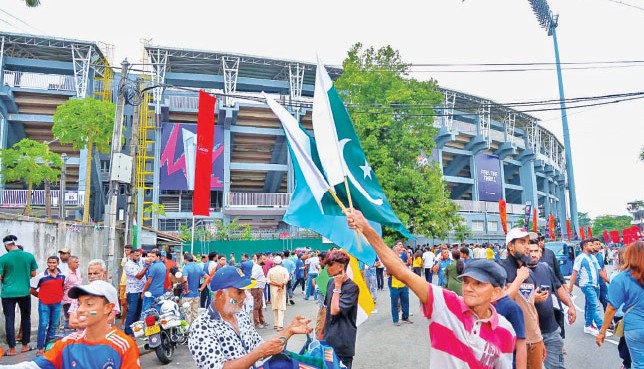

By Camelia Nathaniel/Daily News
Colombo, February 18 – When India and Pakistan met in a high-stakes T20 World Cup clash in Colombo last Sunday (15), the contest was always going to transcend sport. The rivalry between the two nations is among the fiercest in global cricket, often accompanied by intense political undercurrents and passionate fan engagement. Yet, in a remarkable turn, the focus after the match shifted not merely to the cricketing outcome, but to the host nation itself, Sri Lanka.
From seamless logistics and warm hospitality to the celebratory atmosphere that enveloped Colombo, Indian and Pakistani spectators alike expressed admiration for Sri Lanka’s organisational capability. Many described the arrangements as “world class,” praising the welcoming environment that allowed thousands of rival fans to coexist peacefully in a charged sporting context.
The successful staging of this marquee fixture has also drawn attention to behind-the-scenes diplomacy, with President Anura Kumara Dissanayake, playing a mediatory role to ensure that Pakistan agreed to face India on Sri Lankan soil, thereby preserving one of the tournament’s most anticipated encounters.
India–Pakistan matches have historically been fraught with complications over venue agreements, security considerations and political sensitivities. In recent years, bilateral cricket ties between the two countries have remained suspended and neutral venues have become the preferred solution for multilateral tournaments involving both teams.
Colombo’s hosting of the clash was therefore more than a routine scheduling decision. It represented a carefully negotiated compromise: a neutral, secure and culturally welcoming venue capable of accommodating tens of thousands of travelling fans.
The result, according to spectators from both countries, was a model of how high-risk fixtures can be managed with professionalism and grace.
Indian supporters arriving in Colombo reportedly spoke about the ease of airport procedures, efficient transportation links to the stadium and the overall cleanliness and festive ambience of the city. Pakistani fans echoed similar sentiments, noting the friendliness of Sri Lankan volunteers and locals, who they said helped foster a sense of safety and mutual respect among supporters of rival teams.
Effective Security
Several spectators commented that, despite the intense emotions surrounding an India–Pakistan game, the atmosphere in Colombo remained celebratory rather than confrontational, a testament to both effective security planning and Sri Lanka’s tradition of cricket hospitality.Sri Lanka travel
Sri Lanka’s reputation as a welcoming cricketing destination has been built over decades, but last Sunday’s match appeared to elevate that perception further. The influx of Indian and Pakistani supporters transformed Colombo into a vibrant multicultural hub for the weekend. Hotels reported near-full occupancy, restaurants operated extended hours and tourism operators organised special match-day excursions for visiting fans.
Spectators repeatedly highlighted the friendliness of Sri Lankans, from taxi drivers offering directions to stadium ushers assisting foreign visitors. Many noted that the atmosphere extended beyond the stadium gates: Colombo’s streets were decorated with flags of all three nations and fan zones allowed mixed groups to celebrate cricket together.
For Indian fans accustomed to the logistical challenges of large-scale events in metropolitan centres, Colombo’s smooth entry procedures and orderly stadium management came as a pleasant surprise. Pakistani supporters, some of whom had travelled considerable distances due to the rarity of India–Pakistan encounters, described the experience as “memorable” and “well organised,” particularly commending crowd control measures that ensured safety without diminishing enthusiasm.
Tight security at the venue
Such praise underscores an important aspect of Sri Lanka’s soft power, the ability to leverage its cricketing culture and tourism infrastructure to create a hospitable environment that transcends geopolitical tensions.Sri Lanka travel
Beyond the visible success of match-day arrangements lies a deeper narrative of diplomatic engagement. Sri Lanka’s leadership, including President Anura Kumara Dissanayake, played a crucial role in facilitating dialogue to secure Pakistan’s participation in the Colombo fixture against India.
While cricket boards and the International Cricket Council (ICC) officially manage tournament logistics, the geopolitical sensitivities surrounding India–Pakistan encounters often necessitate broader diplomatic assurances. Sri Lanka, with its longstanding cordial relations with both nations, was uniquely positioned to serve as an intermediary that could reassure all stakeholders regarding security, neutrality and organisational capability.
Regional Cooperation
Observers note that President Dissanayake’s administration has emphasised regional cooperation and sports diplomacy as tools to enhance Sri Lanka’s international profile. By supporting the hosting of a high-profile India–Pakistan match, the government signalled confidence in the country’s stability and its ability to act as a neutral bridge in South Asian sporting relations.
Although neither India nor Pakistan publicly detailed the mediation process, the eventual agreement to play in Colombo suggests that quiet diplomatic engagement was instrumental in ensuring the fixture’s success. The match thus became not only a sporting spectacle but also an example of how cricket can serve as a platform for regional cooperation.
Sri Lankan organisers reportedly implemented a multi-layered strategy and while Security personnel were visible,they were unobtrusive, contributing to a sense of reassurance without dampening the celebratory mood.
Spectators praised the orderly entry procedures, efficient ticket scanning, and well-managed seating arrangements. Many also noted the cleanliness of the stadium and surrounding areas, which added to the overall positive impression of Colombo as a host city.
Indo-Pakistan camaraderie at venue.
Importantly, the absence of major crowd disturbances, often a concern in fixtures featuring fierce sporting rivals, underscored the effectiveness of Sri Lanka’s approach. Fans from both sides mingled freely in public spaces, exchanging chants and friendly banter rather than confrontation. Such scenes resonated strongly across social media, where videos and photographs of mixed fan groups celebrating together circulated widely.
The successful hosting of the India–Pakistan match also delivered tangible economic benefits. With thousands of foreign spectators travelling to Sri Lanka, the tourism sector experienced a significant short-term boost. Hotels in Colombo and nearby areas reported high occupancy levels, while local businesses capitalised on increased foot traffic during the match weekend.Sri Lanka travel
Tourism analysts suggest that the positive experiences shared by visiting fans could have long-term promotional value for Sri Lanka’s travel industry. In an era where word-of-mouth and digital testimonials shape destination choices, favourable reactions from Indian and Pakistani visitors, two of the region’s largest outbound travel markets, could translate into sustained tourism growth.
Recovery Efforts
Moreover, the event demonstrated Sri Lanka’s capacity to host large-scale international gatherings despite ongoing economic recovery efforts. By successfully managing such a high-profile fixture, the country reinforced its credentials as a reliable venue for future global sporting events.
Domestically, the successful staging of the India–Pakistan match has generated a sense of pride among Sri Lankans. After a period marked by economic challenges and political transition, the event offered an opportunity to showcase national resilience and organisational competence on the world stage.
Government officials and sporting authorities alike emphasised that the smooth conduct of the fixture was the result of coordinated planning across multiple agencies, including security services, tourism bodies and cricket administrators. The widespread praise from foreign spectators served as validation of these efforts.
For Sri Lanka Cricket (SLC), the event further strengthened its reputation as a capable host for major tournaments. The board has previously organised multi-nation events, but the successful management of a politically sensitive India–Pakistan clash arguably represents one of its most significant achievements in recent years.
The Colombo experience offers valuable lessons for organisers of future high-profile matches. First, effective crowd management and hospitality can significantly reduce the risk of tensions escalating among rival fan bases. Second, proactive diplomatic engagement, as reportedly undertaken by President Anura Kumara Dissanayake’s administration, can help resolve complex scheduling and venue disputes in advance.
This event highlights the importance of integrating tourism promotion with sporting events. By creating a welcoming environment beyond the stadium, Sri Lanka ensured that visiting spectators associated their match experience with the broader appeal of the country as a destination.
While the cricketing result will ultimately be recorded in tournament statistics, the broader legacy of last Sunday’s India–Pakistan T20 match may lie in Sri Lanka’s exemplary hosting. Praise from Indian and Pakistani spectators for the organisation, hospitality, and festive atmosphere reflects not only successful event management but also the deeper cultural ethos of Sri Lankan cricket.
The match illustrated how sport, diplomacy and tourism can intersect to produce outcomes that extend far beyond the boundary ropes. By mediating dialogue to facilitate the fixture and delivering a world-class hosting experience, Sri Lanka demonstrated its capacity to serve as a neutral and trusted venue for one of cricket’s most sensitive rivalries.
In doing so, the island nation achieved something that neither bat nor ball alone could accomplish: it transformed a high-stakes contest between two cricketing giants into a shared regional celebration and in the process, strengthened its own standing as a hub for international sport and diplomacy.
END
