

By Veeragathy Thanabalasingham
Colombo, September 14 – In South Asia, popular uprisings have toppled three governments in three years. First, Sri Lanka’s “Aragalaya” people’s uprising in mid-2022 brought the Gotabaya Rajapaksa regime to an end. Second, in August 2024, the Bangladesh Uprising overthrew the government of Prime Minister Sheikh Hasina. Third, last week a similar popular uprising in Nepal brought down the government led by Prime Minister K.P. Sharma Oli.
President Gotabaya Rajapaksa and Prime Minister Sheikh Hasina fled the country during the uprisings. But Nepal’s prime minister Oli who stepped down last week, sought protection from the military.
While Gotabaya returned to the country in few weeks, Sheikh Hasina is yet to return from exile in India. Bangladesh’s interim government has asked for her extradition to stand trial on various charges, but India is unlikely to comply.
Two years after the popular uprising in Sri Lanka, a peaceful transition of power took place in the national elections with the Janatha Vimukthi Peramuna (JVP) -led National People’s Power (NPP) coming to power with a popular mandate. That change marked the first ‘ ‘achievement’ in Sri Lanka’s political history of a left-wing party taking power through democratic elections.
In Bangladesh, an interim government led by Nobel Peace Prize winner Muhammad Yunus will hold parliamentary elections next year and an interim government has taken over in Nepal.
Of the three popular uprisings the Sri Lankan uprising was largely peaceful compared to the horrendous violence in Bangladesh and Nepal. But Sri Lanka has a historical significance as the first country in the South Asian region to topple an elected government through a popular revolt.
It is natural for students and youth to be at the forefront of struggles. But the participation of young people in last week’s Nepalese uprising was symbolized, in an unprecedented way, as a struggle of a particular generation of youth. For ‘ Generation Z (Gen Z ) as they are called being online is a way of life. They were born between 1997 and 2012 and are between the ages of 13 and 28. The movement called ‘Hami Nepal’ ( We the Nepalis ) demanding wide – ranging reforms led the struggle against the government in behalf of Gen Z.
Protests and agitations are not new to Nepal. For more than a decade in the latter half of the last century, the country suffered great losses and destruction due to the armed revolution led by Maoist Communists. But, why has the younger generation of a certain age took to the streets of Nepal now?
The Communist Party of Nepal (Unified Marxist-Leninist) -led government on August 28 imposed a one-week deadline to register all social media (under the 2023 Social Media Usage Regulation Rules) with the Telecom authority. On September 4, the government banned 26 social media platforms (including Facebook, X, WhatsApp) after none of the major social media platforms took cognizance of the announcement.
The government’s ban on social media was seen by people, especially the younger generation, as censorship and a restriction on access to information. The government did not foresee the consequences of such a ban in a country where more than half the population uses the Internet extensively. It is estimated that among the 30 million Nepal population almost 16.5 million people are active users of internet.
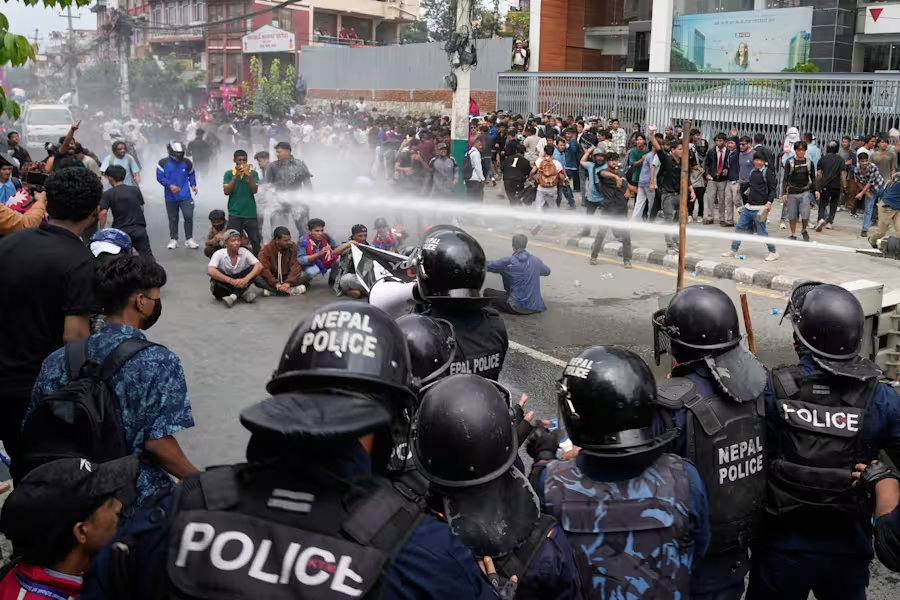
On September 8, 19 people were killed and more than 100 injured in police actions to control the protests. Demonstrations were held not only in the capital Kathmandu but almost all over the country.
Although the government lifted the ban on social media on September 9, the protests did not subside. Last week’s violence in Nepal was the worst in recent years. Political leaders were attacked. Their houses were burnt. Protesters set fire to government buildings, including the parliament, the presidential palace and Supreme Court.
A BBC report says that Gen Z groups which spearheaded the protests distanced themselves from the destruction saying their struggle had been hijacked.
However, the Nepal Army brought the situation under control in a couple of days. It is reported that at least 51 people were killed and hundreds injured in last week’s violence. The wife of a former prime minister was burnt alive.
Communist Party of Nepal (Unified Marxist-Leninist) leader K.P. Sharma Oli, Nepali Congress leader Sher Bahadur Deuba and Communist Party of Nepal (Maoist Centre) leader Prachanda have been accused of serious corruption and malpractices. There were even criticisms that corruption was holding these leaders together, who were largely incompatible in terms of policies.
No one could stop the youth and the people who were boiling over seeing families of the rulers living in obscene luxury. These leaders came to power after the fall of the monarchy but turned democracy into dynastic rule for personal gain.
Nepal’s political leadership had failed to meet the aspirations of the people. The new political system of federal democratic republic introduced by the new constitution passed in 2015 created a lot of expectations among the people. But in the end, the people suffered from political instability, slow economic growth and corruption. There have been 17 governments in Nepal in the last 15 years. The leaders who led the Maoist insurgency and other communist leaders have also served as prime ministers. But still there was a disconnect between the politicians and the people.
There is lesson for the leaders of the Janatha Vimukthi Premuna (JVP) the flagship political party of the National People’s Power (NPP) to be learnt from the failure of communist regimes in Nepali to meet the aspirations of the people.
Like in Bangladesh, the military in Nepal is playing a decisive role in determining the next stage of the political process. Nepal’s former Chief Justice, 73-year-old Sushila Karki was sworn in as head of the interim government on Friday (September 12) after lengthy talks held by President Ram Chandra Poudel with movements representing the younger generation, political parties and the military.
Karki, the first female Chief Justice of Nepal (2016-17), has also become the first woman to head the country’s administration. Her appointment became possible only after the President acceded to the demand of the younger generation movement for the immediate dissolution of Parliament.
It has been announced that members of the ‘Hami Nepal’ movement will not participate in the interim administration. The interim government has to hold parliamentary elections within six months.
The failure of nearly 20 years of democratic experimentation since the end of the monarchy raises disturbing questions about Nepal’s political future. The current crisis has to be understood in the broader context of Nepal’s chaotic democratic transition.
Even after two successful people’s movements (1990 & 2006), a comprehensive constitution drafting process and a federal republican system, Nepal has not undergone meaningful change from the common people’s point of view. There are pro-monarchy forces who are trying to exploit the situation to their advantage.
As for the three popular uprisings in South Asia, it is only in Sri Lanka that interim government was not appointed. After Gotabaya left the country and resigned from the post of President from Singapore, Ranil Wickremesinghe, the leader of the United National Party, was elected as the Executive President by Parliament in accordance with the constitutional provisions. NPP leader Anura Kumara Dissanayake was elected President in the September 2024. The NPP won more than two-thirds of the seats in the 2024 parliamentary elections. Dissanayake will complete one year as president in few days.
Parliamentary elections are due to be held in Bangladesh early next year. The elections are expected to lead to a peaceful transition of power. Nepal’s future political trajectory depends on the approach that the emerging political alternative adopts.
END
(Writer Veeragathy Thanabalasingham is a senior Colombo-based journalist)
