

By Shikha Pandey
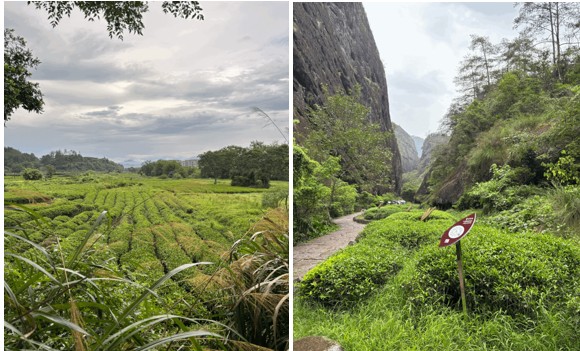
My journey into the cultural intersections between India and China began in the mist-draped cliffs of Wuyishan, a county-level city in southeast China’s Fujian province. At first glance, this region seems like a tranquil sanctuary—home to Taoist temples, ancient tea plantations, and emerald rivers carving through craggy rock faces. But Wuyishan is also a historical epicenter, standing at the crossroads of the land Silk Road that extended through Central Asia and the Maritime Silk Road that connected Chinese ports to the Indian Ocean world.
It is here, amid these ancient cliffs, that China’s legendary rock teas—known as yancha(岩茶)—originated. These teas, grown on mineral-rich cliffs and processed using intricate, centuries-old techniques, carry a deeply meditative aroma and flavor. Yet what surprised me most during my visit was that these very mountains, known for their spiritual and botanical legacy, were also indirectly responsible for shaping one of India’s proudest exports: Darjeeling tea.
Darjeeling’s Hidden Chinese Roots
Today, Darjeeling tea is synonymous with Indian identity, its delicate muscatel flavor sought after across the globe. Yet few realize that the tea plants thriving in Darjeeling’s Himalayan climate were not indigenous. They were brought from China in the 19th century—seeds and saplings of the small-leaf Chinese tea plant (Camellia sinensis var. sinensis), likely sourced from regions like Wuyishan. The British, desperate to break China’s tea monopoly, smuggled both botanical material and tea-making know-how out of China to fuel India’s colonial economy. Thus, India’s tea culture—especially in Darjeeling—was grafted on the roots of Chinese wisdom and cultivation.
This shared heritage in tea is more than just a trade story. In both India and China, tea is woven into the rhythm of daily life, meditation, and social bonding. Whether it is the Chinese gongfu tea ceremony or India’s chai addas, tea embodies patience, reflection, and hospitality—a silent cultural dialogue spoken over steaming cups.
Quanzhou: A Forgotten Indian Footprint
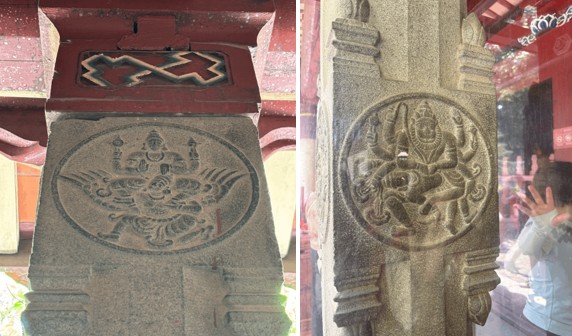
From Wuyishan, my journey continued south to Quanzhou, a coastal city once famed as the world’s busiest seaport during the Song and Yuan dynasties. Here, I encountered an extraordinary and little-known symbol of India-China connection: two granite pillars bearing Hindu carvings, standing quietly behind the Kaiyuan Buddhist Temple, now a UNESCO World Heritage Site.
At first, they seemed like ordinary structural supports. But upon closer inspection, the carvings came alive—depictions of Vishnu, Lakshmi, Krishna, Shiva, and scenes from the Ramayana and Mahabharata. These motifs were unmistakably South Indian in style, reminiscent of Chola-era Tamil temple art. Historical records date the original Hindu temple to 1281 CE, built by Tamil-speaking traders in Quanzhou, likely members of the Ainnurruvar guild—a powerful merchant collective engaged in transoceanic trade. These Indian merchants were not just businessmen; they were cultural ambassadors. Along with spices, textiles, and gems, they carried languages, deities, architectural styles, and devotional practices across the seas. In Quanzhou, their faith found a place to settle and adapt. Stone sculptures of Nandi, Shiva Lingas, and lion-headed gods—many with Chinese stylistic features—still survive in the Quanzhou Maritime Museum.
These hybrid creations reflect something extraordinary: a dialogue between Tamil religious aesthetics and Chinese craftsmanship, a silent testament to cross-cultural collaboration in the 13th century. During a renovation of the Buddhist temple in the 17th century, the original Hindu temple had vanished, but its pillars were repurposed into the new structure—transforming religious memory into shared heritage.
A Civilizational Dialogue Beyond Borders
As I stood beneath those weathered stone pillars—Hindu gods sheltered within a Chinese Buddhist shrine—I felt a deep, unexpected familiarity. This was not history carved by conquest or competition. It was civilizational diplomacy, written in granite and carried across oceans by faith, art, and commerce. These forgotten pillars are not isolated curiosities. All across China, India’s cultural footprints are scattered: Sanskrit inscriptions in Buddhist caves in Dunhuang, references to Nalanda monks in Tang dynasty texts, and relics of Indian astronomy, medicine, and music absorbed into Chinese knowledge systems. Likewise, Chinese influence in India is seen not only in tea but in art, ceramics, martial arts, and architectural ideas transmitted via Tibet and Southeast Asia.
Why Indians Should Visit China Today
In the 21st century, headlines often frame India and China in terms of rivalry and border disputes. But such narratives obscure a far older truth: for millennia, these two civilizations did not collide—they conversed. As Indian travelers, we are often drawn westward in search of history. But perhaps it is time to turn east, to discover how our ancestors once shaped—and were shaped by—the world beyond the Himalayas. Visiting places like Wuyishan, Quanzhou, Xi’an, or Luoyang offers a chance to reconnect with a part of Indian history we rarely learn about. These sites preserve not only China’s past, but India’s cultural echoes—etched in pillars, brewed in teacups, and whispered through old trade winds.
If you ever find yourself in Fujian, take a moment to walk the tea trails of Wuyishan or stroll through the courtyards of Kaiyuan Temple. Behind the grandeur and rituals, you may find something more profound—a quiet affirmation that we, as Indians, have long been part of China’s story. And that story still lives, waiting to be rediscovered.
END
The author holds a PhD in International Chinese Language Education and specializes in India-China cross-cultural studies, with research spanning Chinese language, east-asian studies, and intercultural communication
