

By Camelia Nathaniel/ Daily News
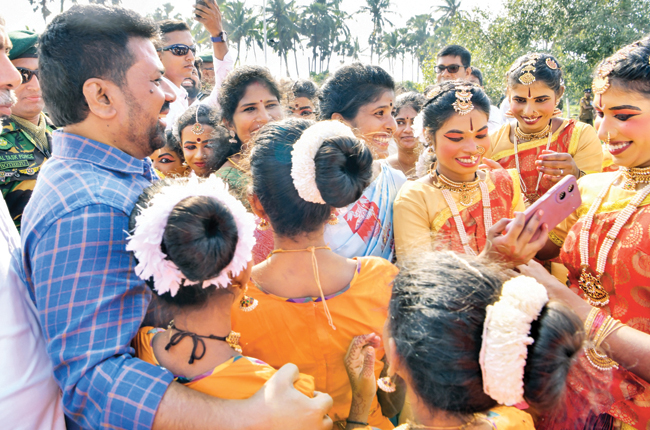
Colombo, January 20 – Sri Lankan President Anura Kumara Dissanayake’s recent visits to Jaffna, coinciding with the Thai Pongal celebrations mark a crucial moment in the Governments’ effort at reconciliation and development of the Northern Province. His remarks at several functions in Jaffna moved between post-war healing, national unity and most controversially, the politics of religion. Taken together, it provides a glimpse into how the new administration intends to frame its governance, its relationship with the North, and its understanding of what Buddhism and nationalism should entail in contemporary Sri Lanka.
A central thread of several speeches delivered at a number of functions was reconciliation and national unity. President Dissanayake repeatedly returned to the idea that Sri Lanka must move beyond suspicion, anger, and ethnic division. He acknowledged that both Sinhalese and Tamil parents had lost children in the war and argued that the only constructive path forward was one based on trust, empathy, and equal opportunity. His assertion that, for the first time, there is a Government accepted by both North and South was a bold political claim, one that will inevitably be tested by events on the ground.
‘I know that many of you here placed your trust in us at the last General Election. For the first time, we won the Jaffna District, which means you have placed your trust in us. I assure you that we will not allow that trust to be betrayed even in the slightest. We will build a country free of racism and rich in national unity, and we will create a better future for your children,’ he noted.
It is within this broader framework of unity that his most contentious remarks must be understood. In a section of the speech that has since sparked debate, the President referred to individuals who travel to Jaffna on Poya days, passing the Jaya Sri Maha Bodhi, to observe religious precepts. He questioned their intentions, suggesting that some of these journeys were not acts of devotion but demonstrations of dominance or provocation. He went further, stating that such groups congregate at a certain temple not for religious purposes but for other reasons, and that intelligence agencies had been instructed to investigate whether they had legitimate claims to land in the area. ‘It is clear that extremist groups, having lost power, are attempting to revive racial divisions in small places. We will not allow any such racist tendencies to rise again in our country,’ he added.
Sensitive Issue
This intervention touched on a deeply sensitive issue in Sri Lanka. In recent years, there have been recurring tensions in parts of the North over the construction or restoration of Buddhist sites, particularly in areas with Tamil historical or religious significance. For many Tamils, these initiatives are seen as part of the imposition of majority will. For some Sinhalese Buddhist groups, they are framed as the rightful restoration of ancient heritage sites. The President’s decision to publicly criticise those who travel north to “prove a point” represents a clear departure from the rhetoric of previous leaders, who often avoided directly challenging such majoritarian activism.
Many have interpreted this as a principled stand in favour of what they call true Buddhist values, particularly ahimsa, humility, and compassion. From this perspective, he is drawing a distinction between genuine spiritual practice and performative religiosity that fuels ethnic tension. By questioning the virtue of passing many temples in the South to observe ‘sil’ in Jaffna, he is, in effect, challenging the idea that piety can be separated from political context.
Critics, however, may distort certain sections of the speech taking them out of context. Others could see it as return to the true values of Buddhism and separate it from the ethno-cultural garb surrounding certain practices.
What is notable is that President Dissanayake did not frame his comments in explicitly anti-Buddhist terms as being distorted on social media. On the contrary, he repeatedly invoked what he described as the “fundamentals of Buddhism,” emphasising non-violence, humility, and inner spirituality. His critique was aimed at ethnic politics. This reflects a broader trend within his political movement, which has long positioned itself as socially progressive while drawing on Buddhist ethical language. This was very much so as the President made it a point to pay a visit to the historic Naga Viharaya international Buddhist centre in Jaffna and call on the Maha Sangha residing there as well. The President thus made it clear that he was referring only to a certain temple that has sparked controversy and not about those that have existed for a long time.
The President during his visit also touched on development, particularly in the Northern Province. By highlighting the allocation of Rs. 5,000 million for rural roads last year, and promising even greater investment this year, the President sought to link reconciliation with material progress. His insistence that local communities must actively participate in how funds are used suggests an attempt to promote participatory governance rather than top-down decision-making. Whether this will translate into tangible improvements in infrastructure and livelihoods remains to be seen.
Implicit Critique
Another significant aspect of the address was its implicit critique of previous Governments. When President Dissanayake spoke of a “Government built for a minimal number of families,” he was clearly referring to Sri Lanka’s entrenched political elite. His claim that both North and South now see the current administration as “their Government” is part of a broader populist narrative that casts his leadership as a break from dynastic and patronage-based politics.
At the same time, the speech contained warnings about “extremist groups that have lost political power” attempting to reignite ethnic divisions. Without naming specific organisations, he suggested that these actors were provoking tensions in isolated areas. This served a dual purpose. Domestically, it positioned his Government as a bulwark against communalism. Politically, it framed any opposition to his policies as potentially dangerous or destabilising.
Another highlight of the visit to Jaffna was the event on the eradication of the narcotic menace. From the outset, President Dissanayake positioned the narcotics trade as an existential threat to the country, describing it as a poison that cuts across ethnicity, class, and geography. He painted a grim picture of a society where parents who once feared for their children because of war now fear for them because of addiction. This framing was clearly intended to resonate in Jaffna, a region still carrying deep psychological scars from decades of conflict.
His rhetoric on drugs was uncompromising. He spoke of criminal networks that have infiltrated the state, of compromised officials in Customs, the Motor Traffic Department, Immigration, and even other parts of the public service. He explicitly warned that there would be no political protection for traffickers under his Government, a pointed contrast to past administrations where links between politicians and organised crime were frequently alleged. In doing so, he sought to present himself as a leader willing to confront entrenched interests, even within the state apparatus.
Yet the President was careful to balance a hardline stance with a rehabilitative one. He repeatedly emphasised that children caught up in the drug trade were not merely criminals but victims of collective societal failure. His commitment to establishing rehabilitation centres and providing vocational training was framed as part of a broader social contract, one in which the state would not simply punish but also restore. This dual approach, punitive against traffickers and compassionate toward addicted youth, is likely designed to appeal to both security-minded voters and more progressive segments of society.
The significance of the President’s approach to the North lies in his recognition of the lived realities of Northern communities, particularly their trauma, grief, and ongoing vulnerability. By centring the drug crisis within that context, the President acknowledged that post-war recovery is not merely about rebuilding infrastructure but also about protecting the social fabric.
Ultimately, the President’s remarks in Jaffna reveal a leader attempting to walk a delicate line. He seeks to be tough on crime yet compassionate to victims, proud of Buddhist heritage yet critical of its politicisation, committed to national unity yet unafraid to confront uncomfortable truths about majority privilege. Whether this balancing act can be sustained in the face of real-world pressures will be one of the defining tests of his presidency.
What is clear is that President Dissanayake did not treat Jaffna as merely another stop on a political tour. He used the platform to articulate a broader vision of Sri Lanka, one that rejects both drug-fuelled decay and ethnoreligious antagonism. In doing so, he invited the country to reflect not only on its policies but also on its values, and on what it truly means to practice virtue in a divided society.
END
