

By P.K.Balachandran/Daily Mirror
Colombo, December 9 – A quick and significant response to humanitarian crises across its borders is today a major ingredient in India’s foreign policy. India is justly proud of its reputation for being the “first responder” during emergencies and natural disasters especially in the neighbourhood.
While the entire world is of interest to it, India’s focus is, understandably, the neighbourhood, given its stated “Neighbourhood First” policy.
The other notable feature of India’s humanitarian work across borders is that it deploys its humanitarian aid mainly through bilateral and sometimes through multilateral channels, rather than through private entities. This is perhaps because such relief works are a key element of its foreign policy.
India’s assistance has included relief in response to natural disasters, during long-term complex emergencies and in post-conflict, post-disaster and pandemic situations.
India’s disaster aid policy is not new. According to www.alternatives-humanitaires.org India supplied relief material to the Peruvian government after the 1970 Ancash earthquake. But India’s assistance budget and bilateral support to partner States started to increase only in the late 1990s after it liberalized its economy and had more dollars in its kitty.
But Rachna Shanbog and Rob Kevlihan point out in their paper in www.alternatives-humanitaires.org that India’s cross border humanitarian assistance really acquired salience during the current regime under Prime Minister Narendra Modi. Modi has been more forthright in promoting the humanitarian work that India is doing abroad because it enhances India’s image as an unconditional giver, in the true spirit of India’s ancient civilization. Modi has popularized the Upanishadic concept of “Vasudhaiva Kutumbakam” (The World is One Family) as a motto of India’s assistance during disasters.
Rachana Shanbog and Rob Kevlihan say that prior to 2020-21 the concept of assistance and disaster relief was used only to describe the Indian armed force’s humanitarian and rescue operations. The subsequent extension of the notion to cover all Indian government humanitarian assistance, together with new institutional arrangements, has signalled an important re-orientation.
Other government agencies involved now are the National Disaster Response Force (NDRF), Food Corporation of India (FCI), National Agricultural Cooperative Marketing Federation of India (NAFED) and Armed Forces while delivering humanitarian support and even State governments (like Tamil Nadu which get involved in Sri Lanka).
India’s humanitarian assistance has largely been provided in three contexts in recent years: conflict/post-conflict, in the immediate aftermath of a natural disaster (such as earthquakes, failure of critical infrastructure, tsunamis and floods), and support in addressing the challenges of Covid-19.
India sent 60 tonnes of humanitarian supplies to Ukraine, including shelter materials, medical supplies, clothing and dignity kits. In January 2021, India extended humanitarian support to Fiji after the island was hit by Cyclone Yasa. Support in conflict situations has also been extended to countries such as Yemen, Syria and Afghanistan. India has also responded to other disasters in Myanmar and Mozambique. As External Affairs Minister S.Jaishankar put it- “ India has become more sensitive to global expectations as a result of its increased capability and is the first responder in many countries, especially in the region.”
In the financial year 2021-22, MEA’s annual report highlighted India’s Covid-19-related support to countries such as Afghanistan, Myanmar and Fiji. In 2020-21 India provided “free drugs, testing kits and Covid-19 protection gear to 82 countries in Asia, Africa and Latin America”. The Rapid Response Medical Teams (from India’s armed forces) conducted Covid 19 relief work under Operation Sanjeevani.
In April 2020, medical training to people from other countries to deal with the pandemic was provided under the Indian Technical & Economic Cooperation (ITEC) programme in 2020-21. All this was done despite the fact that India was severely impacted by COVID-19 losing 2.7 million people during the second wave from April to July 2021.
Between 2018-2022, India supplied food and foodgrains to Bangladesh, Syria, Afghanistan, Comoros, Madagascar, Sudan, South Sudan, Djibouti, Lebanon, and Malawi. It gave medicines, artificial limbs, and medical equipment (including ambulances) to Mozambique, Syria, Yemen, Somalia, Uganda, Tanzania, Madagascar, Swaziland, Kenya, Namibia, El Salvador, Zimbabwe, Comoros, Madagascar, Palestine, Kyrgyzstan, Kazakhstan, and Armenia. Polio vaccines were supplied to Tanzania and Covid-19 vaccines to approx. 51 countries.
Non-food items were sent to Cambodia, Vietnam, Fiji and Democratic Republic of the Congo. India also gave other forms of support such restoring waterworks in war affected Iraq.
“Samudra Maitri” was an operation that helped Indonesians during the October 2018 earthquake and tsunami; “Operation Insaniyat” encompassed India’s support to Rohingya populations during the September 2017 refugee influx in Bangladesh; “Operation Sahayata” included support extended to Mozambique in 2019 after Cyclone Idai, “Operation Vanilla” was undertaken in Madagascar in 2020 after the floods.
India is a signatory to all four Geneva Conventions and participated in the 2016 World Humanitarian Summit. India has been working with UN agencies such as the World Food Programme (WFP) and the United Nations Office for the Coordination of Humanitarian Affairs (UNOCHA) to deliver food and other humanitarian support over the past two decades.
In Sri Lanka
At the end of the civil war in Sri Lanka in 2009, India sent military medical teams to treat the war wounded. When Tsunami struck Sri Lanka in December 2004, India launched “Operation Rainbow” to provide immediate humanitarian assistance. Lasting over two and a half months, this was the largest relief operation undertaken by India outside the country.
Operating from the Indian High Commission in Colombo, a 24×7 Control Room was established the same day as the Tsunami struck. Within hours of Sri Lanka requesting India for assistance, Indian ships and aircraft arrived with relief material and supplies and were the first foreign vessels to reach Trincomalee and Galle.
A total of 14 Indian Navy and Coast Guard ships were pressed into action. Air support was provided by numerous aircraft and helicopters of the Indian Air Force and India Navy for locating and rescuing survivors, retrieving dead bodies, positioning medical teams and supplies, air dropping food and relief supplies and for situation assessment reconnaissance. Indian relief teams were deployed at Galle, Trincomalee, Ampara, Batticaloa, Tangalle, Hambantota, Embilipitiya and Minneriya.
The first Indian medical team reached Sri Lanka the day of the Tsunami, and it assisted the Sri Lankan Army in the safe disposal of dead bodies. In addition to medical teams operating from the Indian ships and from Galle, mobile medial teams were deployed to various relief camps in remote areas and district hospitals. Indian Army’s Field Ambulance set up medical camps in coordination with the local civil and military heath authorities. Preventive medication, vaccination, health lectures, cleaning of drinking water wells, fumigation of refugee camps and living areas by medical teams ensured that no communicable diseases broke out or spread.
Specialized Disaster Relief Teams from the Indian armed forces undertook underwater inspection of 17 railway bridges between Bentota and Matara and assisted in construction of a 350-foot Bailey bridge at Arugam Bay to restore road connectivity. The Indian Navy undertook detailed hydrographic surveys in Galle, Trincomalee, Colombo and Kankesanturai harbours to provide updated charts of these harbours to the Sri Lankan authorities following changes to the topography of the seabed in affected harbours due to the Tsunami.
The Colombo-Matara rail link, which was destroyed by the tsunami, was rebuilt and upgraded by an Indian company IRCON, and locomotives and coaches were provided by another Indian company RITES, under an US $ 167.4 million concessional Line of Credit extended by Government of India.
During the economic crisis in Sri Lanka in 2020, Indian relief aid totalled US$ 4.5 billion helping the island come of the woods.
Operation Sagar Bandhu
When the deadly cyclone “Ditwah” struck Sri Lanka late last month India promptly launched Operation Sagar Bandhu (Friend across the Sea) on November 28. India provided about 58 tonnes relief material including dry rations, tents, tarpaulins, hygiene kits, essential cloths, water purification kits and about 4.5 tonnes medicines and surgical equipment.
Another 60 tonnes of equipment including generators, inflatable rescue boats, Out Board Motors, excavators etc. have also been brought to Sri Lanka. Further, 185 tonnes of Baily Bridge units were airlifted to restore critical connectivity along with 44 engineers. Two columns of National Disaster Response Force (NDRF) comprising 80 experts and K9 units with specially trained dogs assisted with immediate rescue and relief efforts in Sri Lanka.
A fully fledged field hospital with 78 medical personnel was deployed, which is now providing life-saving care, in Mahiyanganaya near Kandy, conducting surgeries, trauma care etc, catering to more than 850 patients so far. Medical centres have also been set up in the badly hit Ja-Ela region and in Negombo.
Naval vessels, INS Vikrant, INS Udaygiri and INS Sukanya, provided immediate rescue and relief assistance. Apart from the two Chetak helicopters deployed from INS Vikrant, two heavy lift, MI 17 helicopters of the Indian Air Force are actively involved in evacuations and airlifting relief material.
On December 6, yet another C-17, the ninth Air Force aircraft arrived with 65 tonnes of load including 55 tonnes of Bailey Bridge units (corresponding to a bridge length of 110 ft), an excavator and other earth moving equipment along with 13 Indian Army Engineers.
Indian Engineer Corps carried out surveys and reconnaissance at multiple sites where bridges have been washed away or damaged, for the construction of Bailey Bridges. Two sites have been identified and work is starting for construction of a Bailey bridges at one of the site in Killinochchi.
A Field Hospital was airlifted to Sri Lanka by an Indian Air Force C-17 aircraft along with a 78-member Indian medical team. As of yesterday (06), the facility has treated a total of 871 patients, carried out 74 minor procedures, and successfully conducted four surgeries.
Indian Air Force Mi-17 helicopter continue life-saving missions. In a sortie yesterday (06), 4 tonnes of relief load was airlifted, 12 survivors were evacuated, and two patients were transported for advanced medical care.
In a significant public–private contribution to recovery and rehabilitation, Lanka Ashok Leyland donated seven essential utility vehicles valued at over LKR 65 million. The initiative was further strengthened by a LKR 2.5 million contribution from employees of Lanka Ashok Leyland.
Relief from Tamil Nadu.
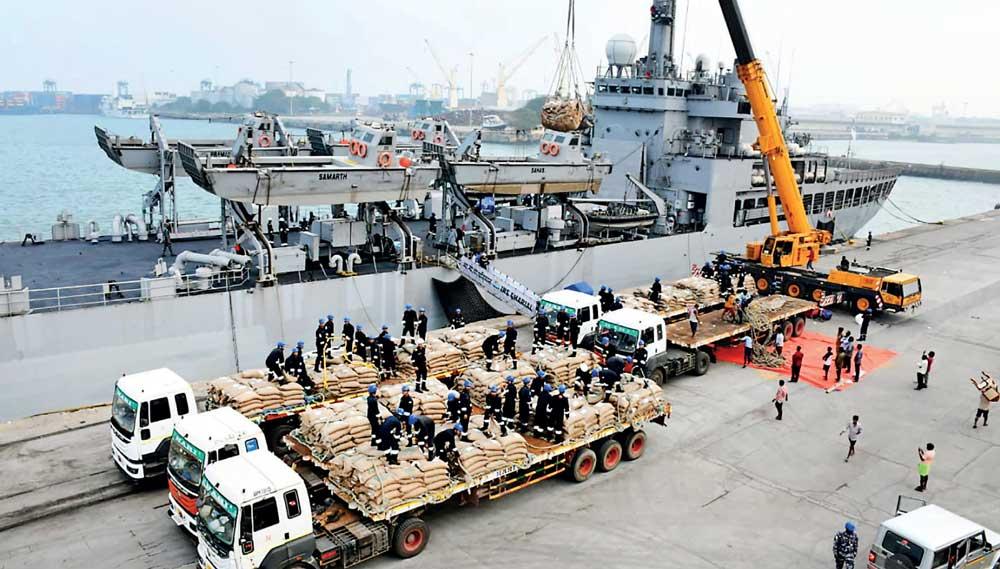
As per the Tamil saying “Yaadhum Oore Yaavarum Kelir” (the world is my town and its people are my kinsmen) the South Indian State of Tamil Nadu also chipped in with 950 tonnes of essentials.
A naval ship which left Chennai carried 300 tonnes of sugar, 300 tonnes of pulse, 25 tonnes of milk powder, 5,000 dhotis, 5,000 sarees, 10,000 towels, 10,000 blankets, and 1,000 tarpaulins. Simultaneously, at the Thoothukudi port, another Navy vessel was dispatched with 150 tonnes of sugar and 150 tonnes of dal.
END
