
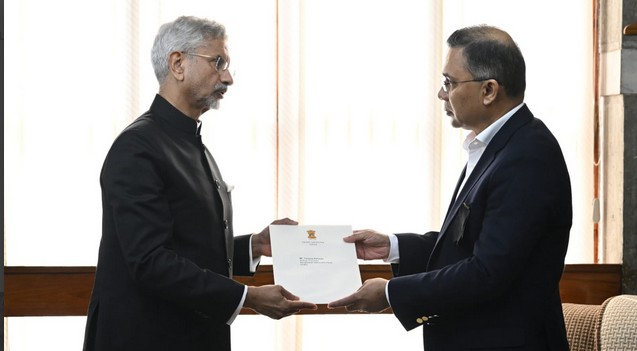

By P. K. Balachandran/Daily News
Colombo, February 17 – The new government of Bangladesh headed by Tarique Rahman of the Bangladesh Nationalist Party (BNP), has a range of issues facing it as it assumes office on Tuesday.
But there is a silver lining – the fraught relations with neighbouring India, which is the regional power with deep economic and security stakes in Bangladesh, have visibly improved. With this it will be curtains down on a number of economic problems and on anxiety about security.
Bangladesh’s economy had suffered since the July 2024 violent movement that overthrew the dictatorial regime of Sheikh Hasina. The Interim government led by Dr.Muhammad Yunus struggled to pick its way through the political and economic mess, partly created by the “July revolution” and partly by a trade war with India.
Today, the Tarique Rahman government has the onerous task of putting the economy back on its feet. And to do that, he will have to bury the hatchet with India and get trade barriers lifted reciprocally. Equally importantly, major issues that have bedevilled bilateral relations for decades such as the sharing of the Ganga and Teesta river waters and the controversies over the supply of power across the border, have to be addressed.
According to The Daily Star, Bangladesh is plagued by three deep-seated vulnerabilities (1) persistently weak tax revenues, (2) the fundamental fragility in the financial sector and (3)high inflation.
In 2024–25, growth slowed to 3.97% from over 7% in 2022. The poverty rate, based on the international $3/day (2021 PPP) threshold, is projected to rise to 8.9% pushing an estimated 1.2 million people into vulnerability. Extreme poverty in Dhaka is forecast to rise to 9.3%, affecting roughly 3 million people.
Non-food inflation rose to 9.13% in October 2025.House rents, transport fares and household essentials have become increasingly unaffordable. The employment rate dropped to 56.7% in 2024, with job losses most visible in the service sector which employs the most.
In March 2025, Moody’s Investors Service downgraded Bangladesh’s banking system outlook from “stable” to “negative”. Bangladesh now holds the highest Non-Performing Loan (NPL) ratio in Asia. According to the Asian Development Bank’s Financial Stability Monitor (2025), NPLs rose to 20.2% of total loans in 2024 and 36% in 2025. Non-banking financial institutions (NBFIs) had bad loans increasing to 33.83%.
Deposits have slowed, and many banks are struggling to meet reserve requirements, further restricting credit flow to the private sector, the daily said.
One of the major causes of the banking crisis is that under the government headed by Sheikh Hasina, several banks and financial institutions were “looted” and the money stashed away abroad by cronies of the regime.
Political Stability Will Help
However, the post-election political situation is conducive for economic development and reform. Over 60% of the people who voted in the referendum on reforms held on February 12 along with the parliamentary elections, said “yes” to the reform package.
The BNP-led coalition is in a commanding position in parliament with a two third majority. The ruling party has 209 seats out of roughly 299 directly elected seats.
The BNP is a right of centre party with a modern vision. The disturbing part is that the radical Islamist, Jamaat-e-Islami and its allies, have grabbed 68 seats (a historic high for Jamaat) to become the official opposition. The student-led National Citizens’ Party (NCP) which spear-headed the violent street-level protests against Sheikh Hasina won six seats. To add to the problem, both the Jamaat and NCP are anti-India and will strain every nerve to prevent the BNP regime from going for a rapprochement with India, which they identify with Hasina’s politics.
Mending Fences with India
A major development which took place this month was the improvement in Bangladesh-India relations, which were the worst in 2024-2025 due to the ouster of the pro-India leader Sheikh Hasina.
A perception about Indian “interference” is thawing. Indian Prime Minister Narendra Modi was the first to congratulate Tarique Rahman on his victory. Modi expressed the hope that the multifaceted relations between the two countries would continue. On his part, Tarique Raman signalled a desire for “mutual respect”, a “reset,” and willingness to address thorny issues like Teesta water sharing, counterterrorism cooperation, and Hindu minority protection—points that align with Indian concerns.
Mutual Suspicions
However, mending ties with India would still face substantial challenges. There are entrenched mutual suspicions and attitudinal barriers. Indian leaders and opinion-makers often view Bangladesh’s outreach to Pakistan and China with suspicion, fearing marginalization, encirclement or threats to strategic interests. Indians fear that Bangladesh, China and Pakistan might collude to threaten the “Siliguri Corridor” or the “Chicken Neck” which is the only land link between mainland India and its North Easters States such as Assam, Meghalaya, Arunachal Pradesh, Nagaland, Mizoram and Tripura.
On the other hand, Bangladeshis perceive India as hegemonic, imposing dominance through economic leverage, insensitive border policing and a blind support for the ousted Premier Sheikh Hasina even now, after her ouster.
To the chagrin of those who led the revolution, India has given Hasina shelter. Hasina’s extradition was sought by the Interim Government. But it was not granted. India is likely to use a principle that if the charges are politically motivated, the fugitive need not be handed over. Political motivation is clear in Hasina’s case. The Bangladeshi tribunal which sentenced her to death blamed her personally for the death of 1400 people during the July 2024 agitation. She was not allowed to use a lawyer to defend her at the trial.
A change of stance on the part of India indicating a desire for mutual accommodation and an acknowledgement of Bangladesh’s desire for strategic autonomy will greatly help reduce the psychological distance between Dhaka and New Delhi.
Amplification in the Indian media of violent incidents against the Hindu minority in Bangladesh since the exit of Hasina, had exacerbated public anxiety in India and made some even call for military action against Bangladesh. Therefore, media restraint is needed to cement the goodwill that now marks relations between Narendra Modi and Tarique Rahman.
Farakka Barrage Issue
Water-sharing disputes remain the core irritant in bilateral relations, with 54 shared rivers. Disputes are over water flow rates, barrages, and unimplemented treaties. Commissioned by India in 1975, the Farakka Barrage was meant to divert water from the Ganges into the Hooghly River in West Bengal.
But for Bangladesh, this unilateral action had catastrophic downstream consequences. During the critical dry season, from January to May, the drastically reduced flow of the Ganges (known as the Padma in Bangladesh) has had a devastating impact. It has accelerated desertification in northern Bangladesh, increased salinity in the southwestern regions, and crippled the delicate ecosystem of the Sundarbans, the world’s largest mangrove forest. Livelihoods of millions who depend on the river’s bounty, from farmers to fisherfolk, have been eroded.
During the rule of Gen. Ziaur Rahman (father of Tarique Rahman), Bangladesh began to oppose the barrage. In 1976, the issue was taken to the United Nations, compelling India to return to the negotiating table. For the next two decades, water sharing was managed through ad-hoc agreements until the landmark 30-year Ganges Water Treaty was signed in 1996.
However, its implementation has been fraught with controversy and accusations of non-transparency. Bangladesh has repeatedly alleged that it does not receive the guaranteed quantum of water, particularly in years of low flow. A core reason for this mistrust is the treaty’s lack of a joint monitoring mechanism. The water flow data used for the sharing formula is collected solely by India at Farakka, with no provision for Bangladeshi participation.
With the treaty set to expire in 2026, the issue is bound to confront the new government in Dhaka. As the deadline approaches, India has reportedly expressed interest in renegotiating the terms. New Delhi argues that climate change, reduced river flow, and rising domestic demand necessitate a revision of the original allocations. But this shift has sparked anxiety in Bangladesh.
Teesta Waters
Bangladeshi anxiety is compounded by the unresolved dispute over the Teesta River waters, a crucial artery for agriculture in northern Bangladesh’s “food basket.” A negotiated water-sharing agreement has not come about for over a decade, thanks to India’s federal system. The government of West Bengal, an Indian State bordering Bangladesh, has steadfastly refused to approve the treaty, arguing that it would create water shortages in its own northern districts.
While India’s central government has expressed its commitment, its inability to bring the West Bengal State government on board has left Bangladeshi farmers at the mercy of a river whose flow is now heavily controlled by upstream dams and irrigation canals in India.
Cross-border Economic Barriers
After the overthrow of Sheikh Hasina, India banned the import of all types of Ready Made Garments (RMG) from Bangladesh via the land route, allowing trade only through Kolkata and Mumbai seaports. The Interim Government in Bangladesh scrapped several India-linked projects and sought to review energy and transit agreements.
However, despite the political standoff and economic/trade barriers Bangladesh-India trade has surged, says Saqlain Rizve in The Diplomat. He quotes the Export Promotion Bureau of Bangladesh to say that during fiscal year (FY) 2024-25 the amount of goods exported to India went up by 12.4%, reaching a total of $1.76 billion.
Bangladesh’s export of footwear to India increased by 43% and that of Ready-Made Garments (RMG) rose by 17.38%. Fish exports also increased by 42.04% compared to the previous fiscal year.
Factors Sustaining Trade
There are several reasons why trade with India remains robust, Rizve points out. Geography and the transportation system make India a necessary trade partner of Bangladesh. Bangladesh is surrounded by India on three sides and the two countries share a roughly 4,000-kilometer-long border. Border ports like Benapole-Petrapole keep the cost of transport of bulk goods and raw materials low.
For the production of garments, leather, and agro-processing industries, Bangladeshi factories need to import Indian intermediate goods such as machinery, packaging materials, and chemicals.
Business leaders point out that even the ban on trade in RMG products through land routes had had little impact. Although sea transport raises some costs, duty-free access to India keeps Bangladeshi garments competitive in the Indian market, they said.
The connection between the two economies has been strengthened by energy and infrastructure links. During seasonal shortages, India supplies electricity and fuel to Bangladesh, while Indian-made construction materials and capital goods support industrial expansion in Bangladesh. Bangladesh had recently increased electricity imports from India.
END
