

C
By P.M.Amza
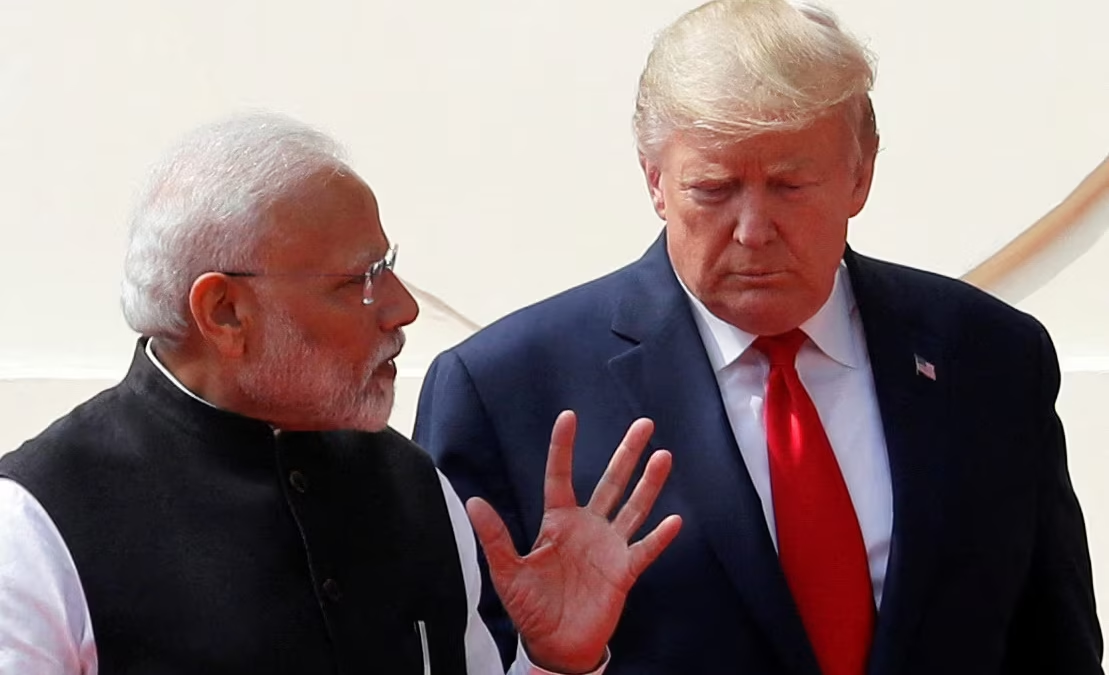
olombo, January 16 -The recent observation by the United States Commerce Secretary Howard Lutnick that President Donald Trump “expected a call” from Indian Prime Minister Narendra Modi to conclude the long-pending US–India trade agreement has triggered an unusually public exchange of narratives between Washington and New Delhi.
At first glance, the remark appears anecdotal, even trivial. Yet in diplomacy, expectations conveyed publicly often reveal deeper assumptions about power, process, and political hierarchy.
The comment invites a more serious question: is the impasse the product of a personality mismatch between two strong leaders, or does it reflect deeper structural and political realities that cannot be resolved by leader-level symbolism alone? The answer matters not only for the trajectory of US–India economic relations, but also for how trade diplomacy is increasingly practiced in an era of personalized power and strategic competition.
Politics of Expectation
In early January 2026, US Commerce Secretary Howard Lutnick publicly attributed the failure to conclude the trade deal to the absence of a decisive leader-to-leader intervention. According to Lutnick, negotiations had reached an advanced stage, but required a final personal call from Prime Minister Modi to President Trump to close the agreement. When that call did not materialize within a narrow time window, Washington, he suggested, moved on to prioritize deals with other partners.
This framing reflects a distinctly leader-centric conception of trade diplomacy, one in which personal authority and symbolic gestures are treated as catalysts capable of cutting through institutional complexity. It is a style consistent with President Trump’s broader approach to international negotiations, where deals are often portrayed as the outcome of presidential resolve rather than bureaucratic process.
New Delhi’s Rebuttal
India’s response was swift and firm. New Delhi rejected the suggestion that negotiations faltered because of a missed call, noting that Prime Minister Modi had engaged President Trump on multiple occasions during 2025. More fundamentally, Indian officials emphasized that trade negotiations of this scale cannot be reduced to a single personal interaction.
For India, the characterization of the impasse as a failure of personal diplomacy was problematic on two counts. First, it trivialized substantive disagreements on tariffs, digital governance, industrial policy, and market access. Second, it implied an asymmetry of agency—suggesting that India’s role was merely to respond to presidential cues rather than to negotiate on the basis of domestic economic and political constraints.
Structural Fault Lines
Stripped of its personal drama, the US–India trade impasse rests on long-standing policy differences. India has been reluctant to lower tariffs in sensitive sectors such as agriculture and medical devices, where livelihoods and public health concerns carry significant political weight. It has also defended data localization and regulatory autonomy as essential to digital sovereignty and developmental strategy.
The United States, by contrast, has pressed for broader market access, freer data flows, and constraints on industrial subsidies—demands that align with its own commercial and technological interests. These are not marginal issues. They cut to the heart of how India conceives economic development and how the US views the rules of the global trading system.
No amount of personal rapport can easily reconcile these positions without domestic political cost on both sides.
Strategic Convergence vs Economic Convergence
The paradox is that US–India strategic relations have rarely been stronger. Cooperation in the Indo-Pacific, defense technology, intelligence sharing, and geopolitical signaling vis-à-vis China has deepened steadily. Yet this strategic convergence has not translated into economic convergence.
For India, preserving policy space is itself a strategic objective. For the United States—particularly under Trump—trade agreements serve as visible markers of geopolitical influence and leadership effectiveness. When these priorities collide, even strong strategic alignment struggles to overcome economic disagreement.
Trump’s India–Pakistan Claims
An additional, often overlooked, source of friction lies in President Trump’s repeated public claims that he personally helped “resolve” or defuse tensions between India and Pakistan—one of several global conflicts he has listed among problems he believes he solved. New Delhi has consistently and unequivocally rejected this narrative, insisting that any de-escalation occurred through bilateral military channels and that third-party mediation is neither accepted nor politically permissible.
While this disagreement is not directly about trade, it matters profoundly for diplomatic trust. India–Pakistan relations occupy a uniquely sensitive place in Indian strategic culture. External mediation is not merely unwelcome; it is domestically radioactive. When conflict resolution claims are publicly linked—explicitly or implicitly—to leverage and deal-making, they risk reinforcing Indian resistance to transactional diplomacy rather than encouraging cooperation.
This context helps explain why expectations framed around personal intervention can backfire. What is presented in Washington as decisive leadership may be interpreted in New Delhi as an encroachment on sovereignty.
Energy and Tariffs
A similar dynamic has unfolded around India’s continued purchase of discounted oil, justified by New Delhi on energy security grounds. Washington’s growing frustration with these imports—particularly in the context of broader geopolitical tensions—has increasingly spilled into the trade domain through tariff threats and rhetorical pressure.
From the US perspective, energy choices have become an extension of strategic alignment. From India’s standpoint, they remain sovereign economic decisions insulated from trade bargaining. The attempt to conflate these spheres has hardened India’s negotiating posture and reinforced skepticism toward a transactional approach that links unrelated policy domains.
Misaligned Grammars
At its core, the impasse reveals a clash of diplomatic grammars. The US approach, as articulated by its Commerce Secretary, privileges immediacy, visibility, and leader-level intervention. The Indian approach prioritizes institutional negotiation, domestic consensus, and strategic autonomy.
Neither approach is inherently illegitimate. But when expectations are misaligned, disappointment becomes inevitable—and narratives of personal failure obscure structural reality.
Sri Lankan Perspective
For smaller and medium-sized economies such as Sri Lanka, the US–India trade impasse offers several sobering lessons.
First, strategic goodwill does not guarantee economic concessions. Even between major partners, trade outcomes are shaped by domestic politics, not diplomatic warmth.
Second, over-reliance on leader-level engagement is risky. While personal diplomacy can open doors, sustainable outcomes depend on institutional capacity, technical preparation, and policy coherence.
Third, trade is increasingly entangled with geopolitics. Energy choices, conflict narratives, and strategic alignments now bleed into trade negotiations, often to the disadvantage of smaller states with limited bargaining power.
For Sri Lanka, navigating this environment requires diversification of markets, clarity about national priorities, and resistance to assuming that geopolitical alignment alone will deliver economic benefit.
So, has personality derailed the US–India trade deal? The evidence suggests not. What we are witnessing is a collision of governing philosophies and strategic priorities, amplified by personalized narratives but rooted in structural disagreement
If and when a trade agreement emerges, it will not be because a phone call was finally made or received. It will be because both sides conclude that their economic and political priorities can be reconciled without compromising domestic legitimacy. In today’s fractured global economy, policy space—not personality—remains the decisive currency of trade diplomacy.
If and when a trade agreement emerges, it will not be because a phone call was finally made or received. It will be because both sides conclude that their economic and political priorities can be reconciled without compromising domestic legitimacy. In today’s fractured global economy, policy space—not personality—remains the decisive currency of trade diplomacy.
END
