

By Sagina Walyat
The strategic expansion of China’s influence—through railways, highways, and energy projects in Nepal, has raised alarms in New Delhi and Washington. India faces mounting challenges in its neighbourhood, while the US is recalibrating its Nepal approach to counter Beijing’s growing presence.
Nepal’s deepening engagement with China under the Belt and Road Initiative (BRI) is reshaping South Asia’s geopolitical landscape. Prime Minister K.P. Sharma Oli’s prioritization of Beijing signals a shift from Nepal’s traditional “India-first” policy, balancing its economic aspirations between China’s infrastructure investments and India’s historical ties.
As Nepal navigates its foreign policy amid internal political instability, it remains a key player in the region’s evolving power dynamics.
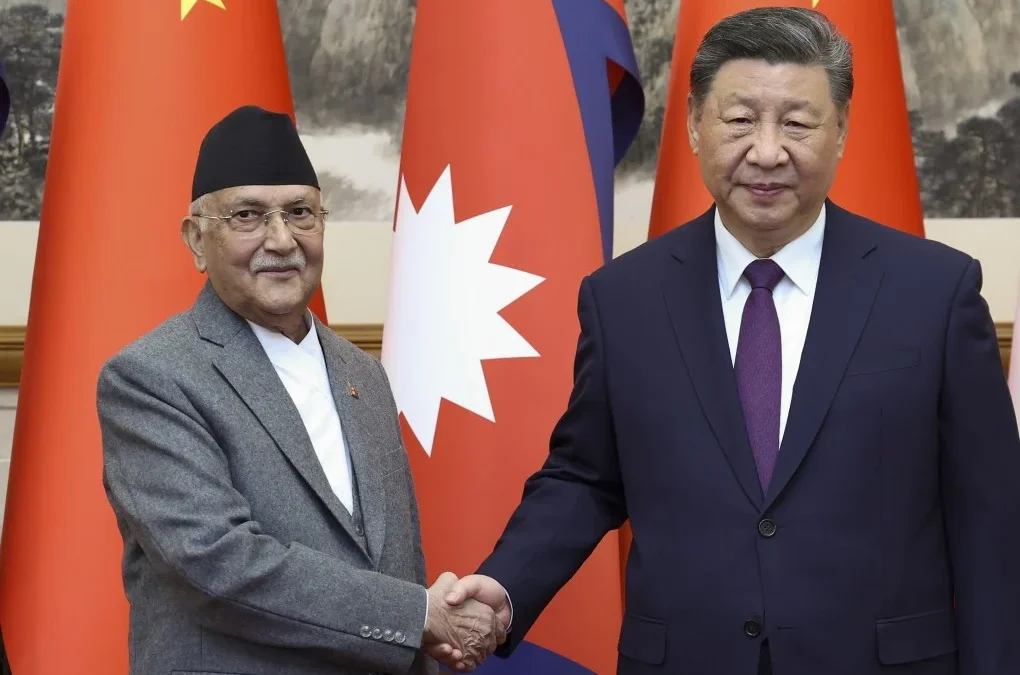
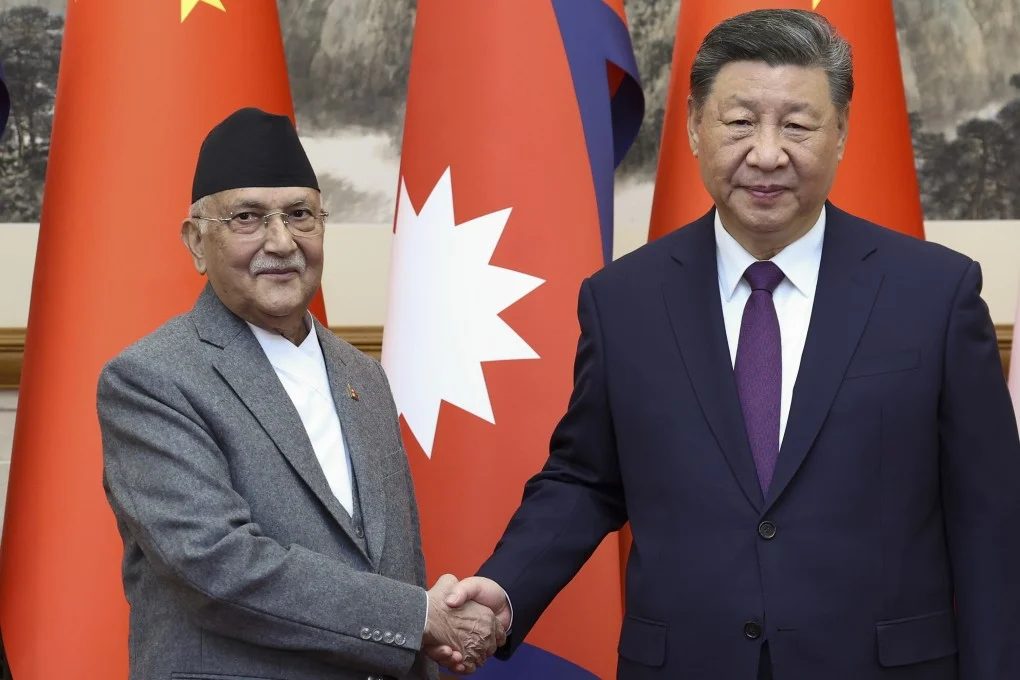
South Asia is undergoing yet another geopolitical transformation, this time driven by China’s Belt and Road Initiative (BRI) advance in Nepal. Nepal’s Prime Minister, K.P. Sharma Oli, visited China in December last, marking a significant milestone by formally integrating Nepal into the BRI framework through the signing of nine Memoranda of Understanding (MoUs).
China’s deepening ties with Nepal through BRI framework agreements after 2017, represent a strategic extension of its influence, solidifying its foothold in the Himalayan nation—a move forward in China’s ‘peripheral diplomacy’.
By prioritizing China for his first official visit after assuming office, Prime Minister Oli signalled a departure from Nepal’s traditional ‘India-first’ approach. This shift symbolizes Nepal’s reorientation in its foreign policy, seeking to balance its immediate neighbour, India, with the growing allure of Chinese investments and infrastructure projects.
By strategically addressing Nepal’s concerns regarding financial arrangements, China agreed to shift from ‘grant financing’ to ‘aid financing’ after bilateral deliberations. This change came in response to Nepal’s apprehension about a potential backlash within the coalition government and the opposition.
Nepal is a significant partner in China’s neighbourhood policy, and in the recent advancements in the BRI framework centred on the Trans-Himalayan Multi-Dimensional Connectivity Network. Sino-Nepal cooperation aims to transform Nepal from a landlocked country into a regional hub for trade and connectivity, particularly in the highways, railways, and energy sectors.
India’s Strategic Lag in Its Backyard
China’s inroads into Nepal come at a time when India faces multiple challenges in its neighbourhood. Notably, after China built the Pokhara airport— a crucial infrastructure near the Indian border— its railway projects in Nepal, connecting Nepal with Tibet/Xizang while traversing several important regions within Nepal, raises concerns for New Delhi. Sino-Nepalese moves are slowly replacing the cultural and traditional people-to-people connections between India and Nepal.
It undermines India’s entire security architecture, with China appearing at the top of India’s states of Bihar and Uttar Pradesh in addition to the Line of Actual Control (LAC). This has been achieved by China’s increasing soft power amongst Nepalese.
New Delhi is very concerned and apprehensive about Beijing’s influence creeping closer to its borders, particularly following setbacks in neighbouring Bangladesh and Myanmar.
While India remains the largest economy in South Asia and is a historically significant player, challenges in the neighbourhood add complexities to its regional policy.
BIMSTEC (Bay of Bengal Initiative for Multi-Sectoral Technical and Economic Cooperation), is viewed by some as a counter to China’s BRI in South Asia. But comparing BIMSTEC with the BRI is futile. Since 2004, BIMSTEC has held only six summits and had lacked the ambitious vision and swift project implementation that characterize the BRI.
India views the Nepal-China collaboration as part of Beijing’s broader strategy to expand its influence in South Asia, from the Himalayas to the Indian Ocean. China’s heavy investments across the region, Bangladesh, Sri Lanka, and including its “all-weather friend” Pakistan, increases worries for India. New Delhi’s analysts see this strategy as a attempt to keep India occupied on a continental scale front, and also counter India’s active advancement in its ‘Act East policy’ and the US-led ‘Ring of Fire’ strategy in the Pacific Ocean.
Nepal’s Domestic Politics and Foreign Policy
Nepal’s foreign policy manoeuvrings reflect its aspiration to maintain its sovereignty while benefiting from both Indian and Chinese investments. While Nepal’s government expressed solidarity with China on sensitive issues like Taiwan and Tibet during Oli’s recent meeting with Xi, it has also sought to keep India engaged with it. This is evident from Nepal’s foreign minister’s visit to New Delhi in August, prior to the Nepalese Prime Minister’s trip to Beijing.
However, Kathmandu’s domestic political instability adds another layer of complexity to its foreign ties. Since its constitutional change in 2008, Nepal has recorded 11 changes in government. The current coalition government, led by Prime Minister Oli and including the major pro-India and pro-US Nepali Congress, faces significant pressure to balance national interests with external expectations.
The internal instability complicates Nepal’s ability to maintain equilibrium between India and China. Analyzing Nepal’s domestic political realities, even China passed over Nepal’s request to waive a US$ 216 million loan for the Pokhara Airport, highlighting domestic complexities.
New Delhi, on the other hand, may prefer a “wait and watch” approach as the political situation in Nepal unfolds under the “power-sharing agreement” in the coalition government. Oli and the Nepali Congress leader Sher Bahadur Deuba will alternatively share the Premiership until 2027.
Kathmandu’s trade with India remains significantly higher than its trade with China, underpinned by a currency system pegged to the Indian rupee and further rooted in civilizational, religious, cultural ties.
However, Beijing’s strategic investments in infrastructure not only present an attractive alternative for Nepal’s economic aspirations but its increased diplomatic courtship continues to appeal to sections of Nepal’s political leadership and the general population.
The US-India Strategic Nexus in Nepal
The evolution of Sino-Nepal relationship has drawn the attention of the United States. In proportion to China, the US does not have heavy investments in infrastructure and diplomacy in Nepal. However, Washington, like India, views Nepal as a critical partner and a key player in the regional balance of power. The US’s discomfort with China’s growing influence in Nepal has led to proactive engagements.
The former US Assistant Secretary of State Donald Lu undertook a three-day visit to Nepal, shortly after K.P. Sharma Oli’s trip to Beijing, in the same month. During his visit, Lu met with former prime ministers Sher Bahadur Deuba and Pushpa Kamal Dahal—now an opposition leader—as well as with civil society and young leaders. It is highly likely that the US, along with India, will recalibrate its approach to counter China’s growing and concerning presence in Nepal.
Nepal often finds itself at the intersection of US-China rivalry and India’s regional ambitions, with America aiming to supplement India’s regional leadership through Washington’s Indo-Pacific strategy and strategic economic projects like the Millennium Challenge Corporation (MCC).
During Donald Trump’s first Presidency (2017–2021), Nepal-US ties faced strains due to controversies over the MCC, which many in Nepal saw as alignment with the US Indo-Pacific strategy (USIPS) of containing China. It was only after repeated US clarifications that the MCC was not linked to broader strategic initiatives that tensions eased.
Kathmandu also rejected United States Institute of Peace and the State Partnership Program, reflecting its cautious approach to foreign alignments. Environmentally vulnerable Nepal’s calls for climate change compensation seems to find no traction under Trump’s second Presidency, given his withdrawal from the Paris climate pact.
Kathmandu’s policymakers anticipate that the evolving ties between the US, China and India will shape Washington’s actual policy towards Nepal and argue that Trump’s second term with regard to South Asia will be guided more by his close personal bond with Indian Prime Minister Modi. This further entangles Nepal in the broader geopolitical contest between powers.
While India and the US share the objective of countering China in Nepal, both need to acknowledge that China’s presence in the Himalayan nation now cannot be entirely reversed. Instead, they might work on limiting Beijing’s influence and ensuring that Nepal continues to act as a geographic and strategic buffer state. This objective should reflect an understanding that halting China’s entry is not feasible.
The Bigger Picture: A Rapidly Changing Region
The advanced Nepal-China engagement cannot be viewed in isolation. It aligns with a series of developments that highlight the shifting dynamics in South Asia. China’s has effected a rapprochement with Bhutan on territorial matters and has strong strategic footholds in Bangladesh and Sri Lanka. Similarly, China’s strategic investments in Nepal under the BRI umbrella, with nine recent agreements, signal Beijing’s determination to further solidify its presence in South Asia.
The deepening Nepal-China partnership presents an undeniable win-win scenario for Beijing. However, for India, Nepal’s evolving stance serves as another call to intensify efforts under its ‘Neighbourhood First’ policy. India, with its revised Trade and Transit Treaty in 2023 and the extension of long-term power trade cooperation in 2024, has also signed several additional hydropower projects.
These efforts aim to support Kathmandu’s economic stability and bridge the trust deficit amongst Nepalese that India has faced in recent years as a result of blockades it had imposed in the past.
In this unfolding narrative, China emerges as a third strategic player, raising the stakes for traditional players involved. The strategic competition between India and China, coupled with U.S. involvement, will continue to shape South Asia’s future. Consequently, the interplay between India’s historical dominance, China’s growing influence, and U.S. strategic interests has turned Nepal into a microcosm of South Asia’s broader geopolitical challenges.
The stakes are high. As Nepal navigates this complex web of alliances and rivalries, its choices will not only determine its own future but also influence the trajectory of regional and global geopolitics.
Sagina Walyat is a Geo-political analyst and Visiting professor in Internatignal laws & Relations in RCL, Panjab University. She’s a (MOFA) Ministry of Foreign Affairs Visiting fellow at National Chengchi University, Taiwan and AsiaGlobal fellow, The University of Hongkong and also a delegate of Australia- India Yourh Dialogue. She contributes to National and International media including- South China Morning Post, The EU Today, The Australia Today, The outlook India, The Wire, Telegraph etc.
END
