

By P.K.Balachandran/Daily News
Colombo, January 19 – Political confusion is the order of the day in Nepal, ahead of parliamentary elections earmarked for March 5.
The violent Gen Z revolution, which overthrew K.P. Oli’s United Marxist-Leninist government and brought in an Interim Government led by retired Chief Justice Sushila Karki in September 2025, has failed to secure the desired results. The Karki regime has been dragging its feet on key issues, such as corruption.
Conventional political parties, which suffered a shock in 2025, are in a state of ennui. And the Nepali Congress (NC), the country’s oldest and most successful party historically, is now split down the middle. Its vote bank is in confusion. This is significant because there have been seven NC Prime Ministers, and the party has been in government fourteen times in Nepal.
Thus, uncertainty is writ large over Nepal’s political landscape.
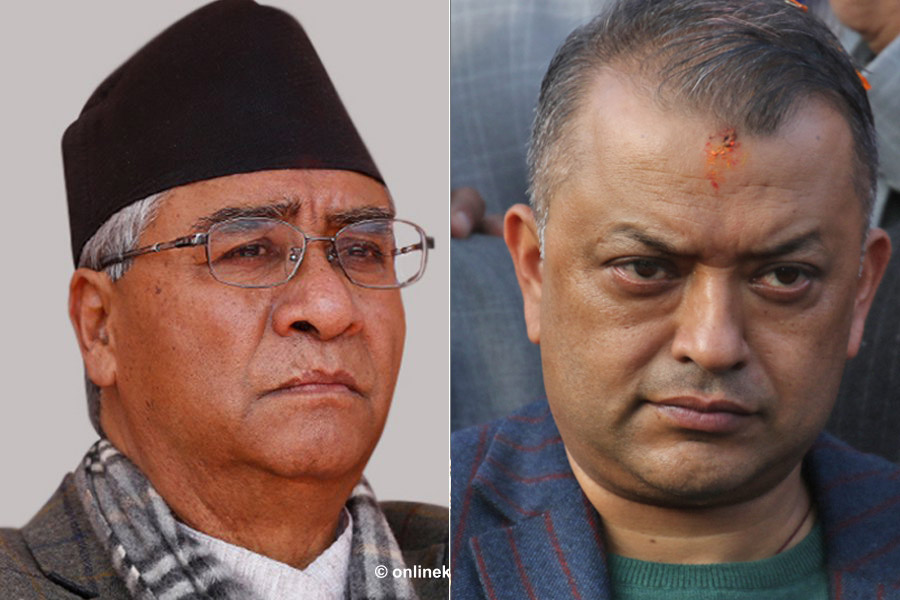
The split in the Nepali Congress (NC) may have significant consequences due to the size of its vote bank. In the NC, it is a fight for legitimacy between two factions, one led by senior leader Sher Bahadur Deuba and another led by the new and younger leader Gagan Thapa, who was elected party President by the “Special General Convention” on Tuesday.
The Deuba faction claimed before the Election Commission (EC) that no such convention had been officially called. The Deuba faction also stated that a majority of the Central Working Committee (CWC) had sacked Gagan Thapa, General Secretary, and Bishwa Prakash Sharma, Deputy General Secretary, as well as Farmullah Mansoor.
The special convention of the NC was called by 54% of the convention’s representatives. Clause 17(2) of the party statute states that 40% of representatives can call such a convention. Though the statute does not specify what percentage of convention representatives can elect new leadership, legal experts say a majority has the authority to do so. The organisers claim that over 60% of representatives participated in the special convention.
Gopal Krishna Ghimire, former president of the Nepal Bar Association, told “Kathmandu Post” that because every decision had been taken by the majority of the party’s supreme body—general convention—its decisions are legitimate. However, others pointed out that Art 255 of the Political Parties Act did not recognise a special convention at all. Article 255 mandates a general convention every five years, and the central committee of the Nepali Congress had already announced the convention for April. There is thus no room for a special general convention it is argued.
In case of a dispute, Section 44 of the Act is invoked. It states that the faction which holds a majority among the office-bearers and members of the Central Working Committee shall be recognised as the party. And the Deuba faction has a majority in the committee.
Sections 43, 44, 45, and 46 of the Political Parties Act don’t recognise the leadership elected through a special general convention. Such a faction cannot get recognition as a political party, nor can it claim the party’s name and election symbol.
Section 43 of the Act authorises the EC to settle disputes between two or more parties, or between two or more factions of the same party, regarding the party’s name, seal, statute, flag, symbol, office bearers, central committee, or the authenticity of decisions of the central committee.
The Election Commission had on Friday granted legal recognition to the new central committee led by Thapa, elected through a special general convention held in Kathmandu between December 11 and 14. The Deuba-led faction has moved the Supreme Court, seeking to overturn the Election Commission’s recognition of the Gagan Thapa-led central committee. The petition argues that the special general convention, which elected Thapa’s committee, was unconstitutional and in violation of party statutes.
That faction of the NC which fails to gain legitimacy through the EC and the Supreme Court can form a new party, but that will not be allowed to participate in the election. Therefore, the vote bank of the NC could split, affecting its electoral prospects in March.
Significance of the Nepali Congress
NC is Nepal’s oldest party that is also known for ushering in democracy in Nepal. It was formed in exile in India in 1946 to raise political consciousness in Nepal and overthrow the Rana family’s feudal rule. The Ranas were the hereditary Prime Ministers of Nepal who overshadowed the King.
The NC has been in the forefront of political struggles in the cause of democracy, pluralism, human rights and rule of law. The NC has gone through several ups and downs, trials and tribulations.
In 1950, the NC began an armed struggle, which resulted in the formation of a Rana family -NC coalition government on a parity basis. Rana Mohan Shumshere became Prime Minister. An Interim Constitution was enacted in 1951. It created a Supreme Court and an independent Public Service Commission.
Subsequently, Matrika Prasad Koirala of the NC was nominated by the King as the Prime Minister. He was thus the first commoner Prime Minister under a democratic setup. But in July 1952, Matrika Prasad Koirala was expelled by the Nepali Congress for violating the Constitution. His actions had resulted in transferring people’s political power into the hands of the King.
In 1957, the NC launched a Civil Disobedience Movement for the formation of an elected government. King Mahendra held an election, and a multi-party caretaker government was formed in 1958.
Elections were held in 1959, and the NC secured a two-thirds majority. B.P.Koirala became Prime Minister. The NC government moved towards the implementation of agrarian reform, and the establishment of an independent judicial system, a National Planning Board, an Industrial Development Corporation and a system of village governance.
In December 1960, King Mahendra and the army staged a coup against the B.P. Koirala government and democracy was extinguished. The leadership of the NC took refuge in India to carry on their struggle. An armed revolt began in December 1961, but the Chinese attack on India in 1962 ended it.
In 1972, B.P. Koirala resumed the armed struggle. In 1975, B.P.Koirala was sentenced to death in absentia. K.P. Bhattarai was nominated as Acting President of the NC. In 1976, B.P. Koirala returned from exile in India following an understanding with the then King Birendra. In a Referendum on the form of government, 45% of the votes were in favour of a multi-party system.
In 1985, NC organised a nationwide Civil Disobedience Movement against the Panchayat System established by the King. In 1990, the Panchayat System fell, and a multi-party system was established. An Interim Government was formed under the Prime Ministership of NC’s acting President Krishna Prasad Bhattarai. The King, NC and the Communists jointly enacted a new constitution in 1990 which made Nepal a Constitutional Monarchy assisted by an elected multi-party legislature.
In the 1991 elections, the NC secured a majority. An NC government under Girija Prasad (G.P.) Koirala was formed. But after the 1994 mid-term elections, the Communist Party of Nepal (United Marxist Leninist)-led coalition government was formed. In the 1999 elections, the NC secured a majority. In 2000, K.P. Bhattarai resigned from the post of Prime Minister to be succeeded by G.P. Koirala.
In 2002, Prime Minister Sher Bahadur Deuba of the NC dissolved the House of Representatives without consulting the party. When Deuba was suspended from the NC he formed the rebel Nepali Congress (Democratic).
The King sacked Deuba and took over power but only to face an all-party agitation. In 2005, the King declared an Emergency and took full charge. But this triggered a movement for the abolition of the Constitutional Monarchy itself. In 2006, unable to contain the movement, the King announced the restoration of the House of Representatives and handed over power to the agitating seven-party front, which chose G.P. Koirala as the Prime Minister. On May 18, 2006, the House of Representatives stripped the King of all powers.
Royalists Attempt Come Back
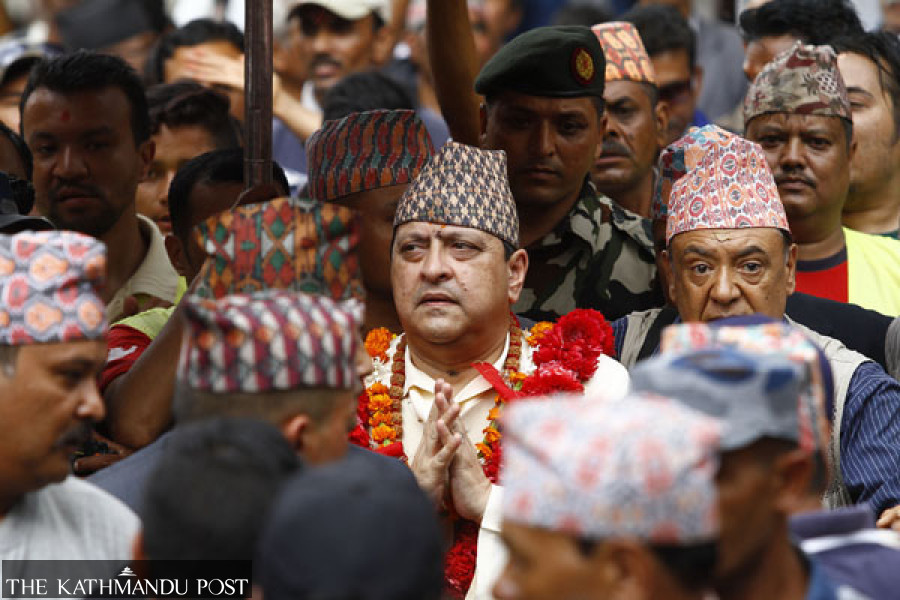
Since 2025, Nepalese royalists have been trying to come to the fore again. This is gaining traction again in 2026, with elections due in March. Recently, thousands of Nepalese rallied in Kathmandu demanding the restoration of the deposed monarchy ahead of the elections. The protest took place near the statue of King Prithvi Narayan Shah, the founder of present-day Nepal.
The rally marked the first significant display of royalist sentiment following GenZ-led protests in September 2025, which resulted in the establishment of an interim government and the appointment of Sushila Karki as PM.
The Gen Z-led revolution was against corruption, unemployment, limited opportunities and poor governance. But since taking office, Karki and the interim government have faced mounting criticism from GenZ who expected swifter action on corruption and other key issues.
A story in the international media quoted a participant in the Royalist rally as saying, “The last and only alternative for this country is the king and the monarchy. In the present context and the path our country has taken after the Gen Z movement, there needs to be a monarchy restored to manage the situation.”
King Gyanendra was the last Shah king of Nepal as the nation transitioned to a republic in 2008. Lately, there has been a persistent public expression of loyalty toward ex-King Gyanendra, especially during his birthday, signalling frustration with the current political climate and a desire for a return to monarchical rule.
Amid chants of “We love our king. Bring back the king,” protesters circled the statue of King Prithvi Narayan Shah, the first monarch of unified Nepal. The rally coincided with King Prithvi Narayan Shah’s birth anniversary.
Royalism is promoted by the Rashtriya Prajatantra Party (RPP) the fifth largest party in Nepal. It seeks the return of constitutional monarchy with parliamentary elections based on proportional representation. It is also against provinces enjoying devolved power. Overall, it seeks a national constitution based on the Hindu Sanatana Dharma with full freedom to practice other faiths.
END
