
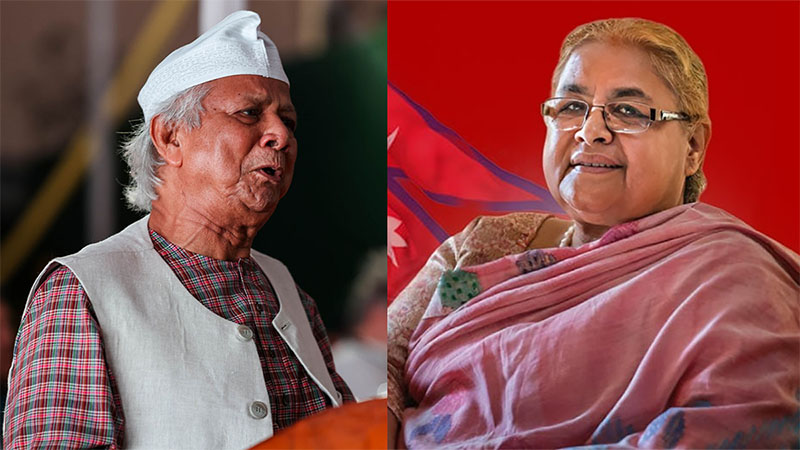

By P.K.Balachandran/Daily News
Colombo, September 16 – Many Nepal watchers wonder if post-revolutionary Nepal will be a mirror image of post-revolutionary Bangladesh because both saw mayhem marked by an unbridled destruction of property and shocking denigration of past leaders.
But there are reasons to believe that Nepal is unlikely to resemble Bangladesh. The difference is essentially in the personality of the two Interim Heads, Sushila Karki, the Prime Minister of Nepal, and Dr.Muhammad Yunus, the Chief Advisor of Bangladesh. While Karki is decisive, with strong convictions, Dr. Yunus appears to lack conviction and the will to act decisively.
The contrast is reflected in the post-revolutionary law and order situation in the two countries. While order was restored in Nepal within days albeit the cost of 72 lives, confusion and lawlessness continue to plague Bangladesh even a year after the August 2024 revolution.
Yunus looked on benignly and almost approvingly, as the anti-Hasina agitators burnt Father of the Nation Sheikh Mujibur Rahman’s house and turned his statues into rubble. Subsequently, Yunus took no steps to curb vigilante violence and mob justice against Hasina’s supporters.
Karki, on the contrary, unequivocally condemned the vandalism that occurred during the Gen Z protest as “criminal acts against the country”. The violence “was executed in a planned way, raising questions of a conspiracy,” she added. Karki declared that the government would investigate the vandalism targeting Singha Durbar, Parliament building, Supreme Court, business complexes, and private property and said that those responsible would be punished.
Karki is said to be tough as nails as her record as a Supreme Court Chief Justice shows. She is also expected to shore up the battered Nepalese administration and economy in the six months she has pledged to serve as PM. And unlike Yunus, she announced a date for fresh parliamentary elections – March 5, 2026. Yunus took months to declare that elections would be held in February 2026, giving the impression that he wanted to be in power indefinitely.
While Yunus was in the NGO sector giving loans to the rural needy, Karki began as a pro-democracy agitator even courting arrest in 1990. Growing up in Biratnagar, Karki was close to the family of B. P. Koirala, Nepal’s first elected Prime Minister in 1960. Her husband, Durga Subedi, was part of a group of underground Nepali Congress activists who hijacked a Royal Nepal Airlines plane in 1973 and flew it to India. The group snatched cash belonging to the Nepal Rashtra Bank from the plane’s cargo hold. The money was used for the party’s pro-democracy campaign.
As Chief Justice of Nepal, in 2016, Karki was behind a ruling to impeach the powerful head of Nepal’s anti-graft body. In another case, a bench, including Karki, ruled against granting amnesty to former Maoist lawmaker and convicted murderer, Bal Krishna Dhungel. Earlier, in 2012, Karki was one of the two judges on a bench that convicted the sitting Minister for Information and Communication, Jaya Prakash Gupta, for corruption.
On April 30, 2017, the Maoist Centre and Nepali Congress filed an impeachment motion against Karki after the Supreme Court annulled the government’s appointment of Jaya Bahadur Chand as police chief. The motion was later withdrawn following strong public opposition and a Supreme Court order.
Rebuilding the Economy
Bangladesh’s economy is still struggling due to poor governance, lack of political direction and lawlessness, not to speak of Trump’s tariffs and conflicts with India. But Karki has called upon all stakeholders to put their heads to device ways to rebuild the battered Nepalese economy.
The task is humongous. Economists estimate the collateral damage inflicted by the Gen Z stir is NPR 3 trillion (USD 21 billion) or half of Nepal’s GDP. Economic growth this fiscal year will be under 1 percent, said economist Chandra Mani Adhikari. The Hotel Association of Nepal said its members suffered damage worth NPR 25 billion (USD 117 million) and Auto dealers estimated their losses at around NPR 15 billion (USD106.2 million).
Army’s Role
While the Bangladesh army is yet to take action against rampant lawlessness in the country, the Nepalese army stepped in fairly quickly to stop rampant vandalism. Unlike the Bangladesh army which had intervened and seized power in the 1970s and 1980s upto 1990, supplying two dictators, the Nepalese army has confined itself to the barracks, coming out only to fight the Maoists during the insurgency.
The army served Nepal well during national disasters like earthquakes. During the latest Gen Z uprising, it was army chief Gen. Ashok Raj Sigdel who started talks with the Gen Z protesters, political party leaders and the President of Nepal, Ram Chandra Poudel, to set up an interim government. It had a huge role in getting Sushila Karki to accept to be the Interim PM.
Hami Nepal Movement
A redeeming feature of the Nepalese Gen Z agitation was the role of the NGO “Hami Nepal”. Though part of the Gen Z movement, Hami Nepal opted out of the violent phase and initiated talks with the army.
Hami Nepal had emerged from the rubble of the 2015 earthquake. It is a non-profit organization dedicated to supporting communities and individuals in need, guided by its motto ‘For the People, By the People’. Hami Nepal now has hundreds of thousands of members, and growing by the day.
Hami Nepal donated more than 400 blankets to Bir Hospital’s Covid unit in 2022, created a plasma and oxygen bank during the pandemic, and distributed school jackets to rural children. More recently, it mounted a relief effort in response to the 2023 Jajarkot earthquake, reaching over 13,000 families with shelter, food, and medical support. It even sent aid to Turkey after its 2023 earthquake. After the Kavre floods last year, Hami Nepal donated solar lamps.
Funding for Hami Nepal comes directly from public donations. It has a policy of channelling 100% of received funds for aid distribution. Volunteers self-finance administrative costs, and the group publishes detailed expenditure figures, regularly sharing updates and transparency reports through its social media and website.
Tackling Gen Z’s High Demands
The Gen Z, being Gen Z, had pitched its demands very high. One of the demands was that parliament should be dissolved immediately and changes in the constitution should be made first before holding elections. The movement also demanded a ban on all who had been in power earlier and had failed to deliver.
Experienced Nepal watchers warn that changing the Constitution will mean another shaky rigmarole like in the 2008-2015 period. They point to Bangladesh to show the consequences of pitching demands too high. Nothing will get done. The commissions which Chief Advisor Yunus up to draft reforms for Bangladesh have not made their recommendations yet. A new election system is yet to be announced while political parties are still divided on every key issue.
The Bangladesh Nationalist Party (BNP) insists that a new constitution should be framed only by a freshly elected parliament. It is also against adopting the Proportional Representation System. But the students’ party, the National Citizens’ Party (NCP), and the Jamaat I Islami want a new constitution before the elections. The also want Proportional Representation. The Jamaat wants Islamic principles incorporated but others are seeking a secular constitution. The NCP is unclear, but it is in alliance with the Jamaat.
In Nepal on the contrary, such fundamental differences do not exist. All except the Royalist Rashtriya Prajatantra Party (RPP) are left or Centre- left. But RPP is only the fourth in the pecking order of parties. And though there is strong leftism in Nepalese politics, Nepal is a country which encourages private enterprise.
So far, developments in Nepal suggest there is no desire to upset the existing system. But what is expected is the establishment of a strong anti-corruption and accountability mechanism and a system that would prevent arbitrariness in framing policy and in governmental action, thus addressing the basic issues highlighted by the Gen Z movement. And Prime Minister Sushila Karki has the wherewithal to deliver these.
END
,
