
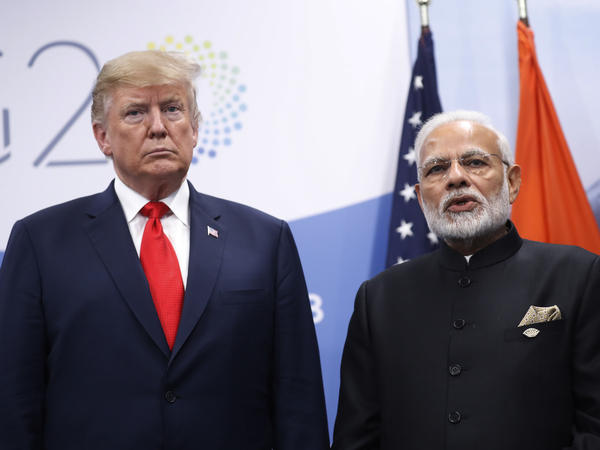

By P.K.Balachandran/Daily Mirror
Colombo, May 27 – Indian Prime Minister Narendra Modi finds himself in a difficult position as he has to navigate the demands of US President Trump, who prefers trade with Pakistan, because of the alluring Rare earth mineral deposit they possess
Since the US seeks to break China’s unrivalled domination over crucial rare earth minerals, they seek to tap into Pakistan’s estimated value, which as per estimates of the Pakistani Government, stands at $50 trillion in value
Regardless of the outcome of the India-US conflicting points over the May 2025 war, they hope to have more productive talks regarding trade and tariffs
To the Indians’ dismay, the US equated India and Pakistan during the three-day air war over a terror attack in Kashmir
During the May 7-10 India-Pakistan war, US President Donald Trump did four things which dismayed and shocked Indians. Though it was the US that had unleashed the Global War on Terror, Trump failed to condemn in strong terms, Pakistan’s terrorism at Pahalgam in which 26 Indians were killed. He did not hold Pakistan to account as the Indians expected.
Trump jumped the gun and unilaterally announced a ceasefire between India and Pakistan, putting New Delhi in an embarrassing position vis-à-vis the Indian public. He announced that India and Pakistan would have talks in a neutral place and declared that he would mediate on the Kashmir issue, though India’s consistent policy has been to deal with Pakistan only bilaterally as per the 1971 Simla agreement.
And to press home his point, Trump said that he wants to trade with both India and Pakistan but won’t with either if they continued to fight.
Taken aback, Indian officials denied that the US had any role in bringing about a ceasefire and insisted that it was brought about by the Directors General of Military Operations (DGMO) after the Pakistani DGMO mooted the idea. India also declared that there could be no talks with Pakistan on any matter unless it stopped cross-border terrorism. It also stressed that all problems with Pakistan would be sorted out only bilaterally, thus summarily rejecting an offer of mediation.
Anti-US rhetoric went viral in the Indian media, regardless of its consequences for the very critical Indo-US defence tie-ups against Chinese expansionism. The US, however, turned a deaf ear to the adverse rhetoric. It was eyeing the lucrative prospect of exploiting the mineral wealth of Pakistan, set to be worth US$ 6 trillion.
The US is seeking to break China’s global domination of the critical rare earths industry. Well before the April 22 Pahalgam terror attack, the US had decided to go soft on Pakistan. There was a growing awareness that Pakistan was sitting on minerals (including rare earths) of an estimated value of anything up to US$ 50 trillion, according to the Pakistan government.
To be sure, Pakistan is nowhere in the world rare earths extraction business today, but if it cleans up its political, bureaucratic and security stables, invites foreign investors and supports them to the hilt, it could be a major producer of minerals and rare earths.
International Minerals Forum
On April 8 and 9, Pakistan held a two-day Pakistan Minerals Investment Forum 2025 (PMIF25) in Islamabad. Prime Minister Shebaz Sharif told the forum that the government would present Pakistan’s mineral-rich terrain, covering 600,000 sq km, to international investors.
The attendees included 300 representatives from overseas, including delegations from Azerbaijan, Saudi Arabia, China, the US State Department, the US Exim Bank, the Asian Development Bank (ADB), and CEOs of mining companies from Denmark, Kenya, Finland, and the UK.
The United States was represented by Eric Meyer, a senior official at the Bureau of South and Central Asian Affairs, to advance US interests in the mineral sector. He had a meeting with army chief Gen. (now Field Marshal) Asim Munir, the most consequential man in Pakistan.
However, Pakistan will face the problem of balancing relations between the US and China, since both are interested in mining in that country. Right now, China has the upper hand because of its help to Pakistan in the May 2025 war with India. But commentators point out that Pakistan has for long had good relations with the US too and that is so even today. By not being doctrinaire, Islamabad has managed to be friendly and relevant to both Washington and Beijing.
US Search Global
The US interest in Pakistan’s minerals is part of its global search for minerals and rare earths. According to the website “US Critical Minerals”, US imports most of its rare earths from China, which has a near monopoly on the processing of rare earths.
The U.S. Department of Defence (DoD) uses rare earth elements for a variety of purposes in its weapon systems—in radars, guidance systems, precision-guided munitions, lasers, satellites, and equipment, including night vision goggles. And yet, it depends on China for its supply. According to the DoD, “Continued U.S. reliance on foreign sources for rare earth products poses a risk to national security”.
Rare earths are also essential for the production of a full range of industrial and consumer goods, including batteries, mobile phones, laptops, hard drives, lasers, electric vehicles, semiconductors, computer chips, 5G technology, solar panels, wind turbines and medical diagnostic devices.
China has recently begun to weaponise its control of rare earths and rare earth processing. In the past year, China has limited the export of gallium, germanium, and antimony to the US. In response to tariffs imposed by Washington, China began ordering restrictions on the exports of seven rare earth minerals—most of which are known as “heavy” rare earths, that are crucial to the defence sector. These are less common and are harder to process than “light” rare earths, which also makes them more valuable.
According to the Centre for Strategic and International Studies (CSIS), this leaves the US particularly vulnerable, as there is no capacity outside China to process heavy rare earths.
Ukraine and Greenland
Trump’s efforts to bring about a ceasefire in the Russo-Ukraine war was motivated by the desire to have a deal with Ukraine over its minerals. His efforts to take away Greenland from Denmark was also because he was eyeing Greenland’s minerals.
About 5% of all the world’s ‘critical raw materials’ are located in Ukraine. Ukraine is a real treasure trove of lithium. Lithium, due to its efficient energy storage per unit weight, has become virtually indispensable in producing Electric Vehicle (EV) batteries. The reserves of this mineral, which is so important from the point of view of renewable energy sources, amounted to about 500 thousand tons, according to a report by the National Academy of Sciences of Ukraine.
Greenland too has great untapped potential for 25 of the 34 minerals identified as critical.
The Greenland government irritated the US by courting Chinese investment in its minerals sector. Greenland’s foreign minister, Vivian Motzfeldt, reportedly identified closer cooperation with China as a priority, and even touted the possibility of a free trade agreement between Greenland and China.
According to a report in The Diplomat, Motzfeldt’s actions were ”largely driven by the belief…that a mining boom, fuelled by Chinese investment, was the most realistic path toward independence from Denmark—a goal shared by most Greenlandic parties.”
The world is therefore likely to see strange relationships being struck in the search for minerals and rare earths. The current US lurch towards Pakistan, loosening its ties with India, is but a manifestation of this quest.
Indo-US Trade Talks
It is hoped that Indo-US differences over the May 2025 war will not affect the on-going talks on trade and tariffs, as these are a different ballgame. India is considering lowering tariffs on US products like bourbon, motorcycles, and certain agricultural goods. The US seeks greater access for its industrial and agricultural exports. Discussions include market access for US farm products such as apples, tree nuts, and alfalfa hay. India aims to boost exports of shrimp, textiles, and other labour-intensive goods.
Both countries are exploring cooperation in critical sectors like semiconductors, pharmaceuticals, and critical minerals to build resilient supply chains.
According to Trump, India is a difficult country to trade with, given the barriers it puts up. India has a trade surplus with the US. The US goods trade deficit with India was US$ 45.7 billion in 2024, a 5.4% increase over 2023.
END
