
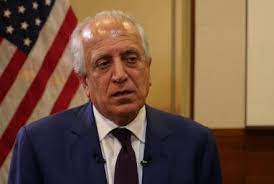

Kabul, September 18 (TOLO News) – In response to the suspension of fiber optic services in several provinces, Zalmay Khalilzad US Special envoy for Afghanistan, said this decision harms not only the economy but also the overall future outlook of the country.
The Kunduz governor’s office had earlier stated: “Based on the decree of the esteemed Amir al-Mu’minin Sheikh Sahib, may Allah protect him, the Kunduz zone provinces (Kunduz, Baghlan, Takhar, and Badakhshan) have been completely stopped, and from now on internet via cable will no longer exist. This action has been taken to prevent immoralities, and alternative means inside the country will be provided to meet essential needs.”
Abdul Zuhor Mudaber, an economic affairs expert, added: “The world is moving toward digitalization. One of the factors that helps us better reach this goal is standardization of internet services and facilities, as these naturally have social and economic impacts. In the production process, they can increase accuracy, speed, and transparency.”
In addition to these provinces, it is reported that fiber optic services have also been suspended in Laghman, Kandahar, and Helmand. However, the Islamic Emirate has not officially commented on this matter.
On the other hand, some economic experts consider the provision of high-speed internet services vital in various sectors.
Khan Jan Alokozai, a former board member of the Chamber of Commerce and Investment, expressed this view: “Just as airplanes, cars, and transportation are important today, the internet is equally important, and communications hold great significance.”
Meanwhile, the Minister of Higher Education, during the graduation program of Kabul University students, emphasized that although the internet and social networks have brought many advancements and conveniences to society, on the other hand, the corruption of social networks, the internet, and smartphones is also significant.
Neda Mohammad Nadim, the Minister of Higher Education, said: “Closeness, contacts, and the conveniences of the internet and mobile phones are an advancement, but on the other hand, the problems and corruptions of social networks, the internet, and mobile phones are very high.”
The suspension of Afghan Telecom’s fiber optic internet services in some provinces comes while the company provides more than sixty percent of the country’s fiber optic services.
According to the Afghanistan Telecom Regulatory Authority (ATRA), the other forty percent of fiber optic services are provided by five private companies.
Zalmay Khalilzad condemns
The former U.S. Special Envoy for Afghan Peace Zalmay Khalilzad wrote: “It will damage not only the province’s economy but the country’s prospects as a whole. This decision will undermine investment and development.”
Janat Faheem Chakari, former head of Afghan Telecom, said: “We have spent hundreds of millions of dollars on fiber optics. Through this network, we are connected to the entire world. Fiber optic has unlimited capacity, and its internet is both cheap and fast.”
Some experts believe fiber optics could serve as a key infrastructure for the growth of Afghanistan’s digital economy.
Its major uses include: Online trade, electronic banking, and virtual education; Creating job opportunities in the technology sector; Reducing internet costs and expanding digital services to rural areas
Shakir Yaqubi, an economic analyst, said: “Fiber optic services played a vital role in facilitating commercial communications. In operational management, especially in banking, it was a key enabler. It also provided many conveniences in education, as many people were engaged in online learning through these services.”
Afghanistan’s fiber optic network is connected to regional networks through seven points, and by November 2024, more than 9,000 kilometers of cable had been installed across the country.
The project, launched in 2007, was designed to improve high-speed internet services, expand telephone communications, reduce costs, and increase regional connectivity.
END
