

By P.K.Balachandran
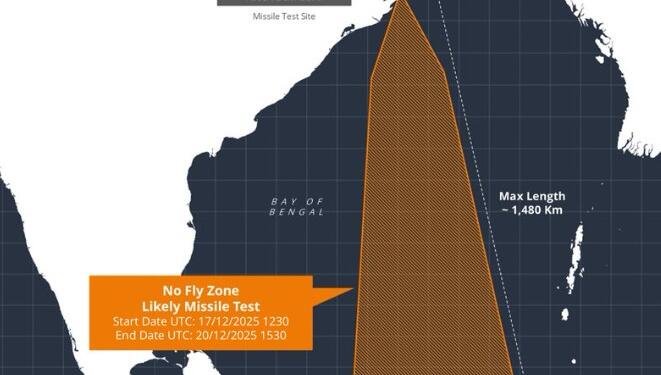
Colombo, December 17 – India has cancelled a Notice to Airmen (NOTA) issued on December 12 about a naval missile testing exercise in the Bay of Bengal over a 3500 sq.km area to be held from 12.30 AM on December 17 to 3.30 PM on December 20.
According to https://idrw.org/category/afi/, the website of the Indian Defence Research Wing (IDRW), no reason was given as in the case of earlier cancellations.
However, other open sources said that the cancellation was either due to the possibility of cyclonic storms over the Bay of Bengal (at the end of November, the cyclone Ditwah had hit parts of South East India and Sri Lanka), or it was a tactical decision to tease and study the responses of Chinese research cum spy vessels which prowl in the Indian Ocean snooping on Indian missile and naval activity.
The IDRW said that this was the second such revocation in quick succession in December. Earlier NOTAMS for December 1 to 4 and December 6 to 8 were also cancelled.
The cancellations have driven observers to question whether the NOTAMS were genuine preparations for a breakthrough in missile technology or were a calculated exercise to gauge the response times of Chinese “research” vessels frequently deployed in the Indian Ocean Region (IOR).
The NOTAM, issued by the Directorate General of Civil Aviation on December 12, represented one of the largest safety corridors ever notified for an Indian missile test, stretching eastward from launch points near Chandipur in Odisha and Visakhapatnam’s Eastern Naval Command.
Towards Agni-1 ISBM or K-15 SLBM
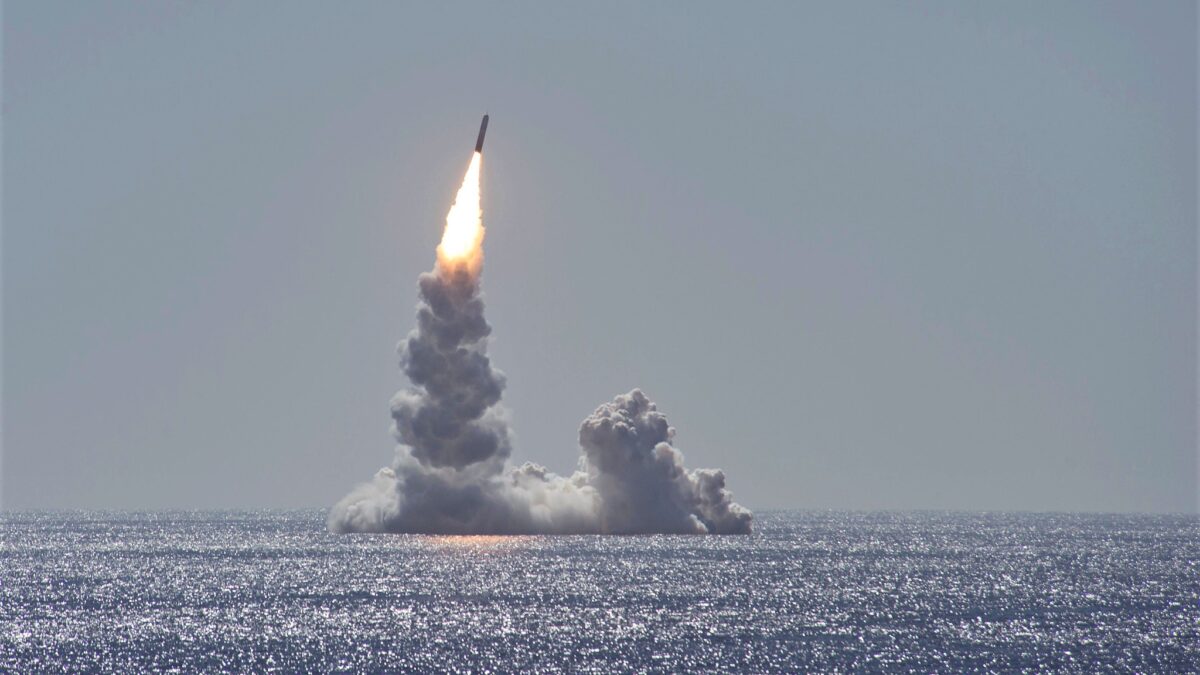
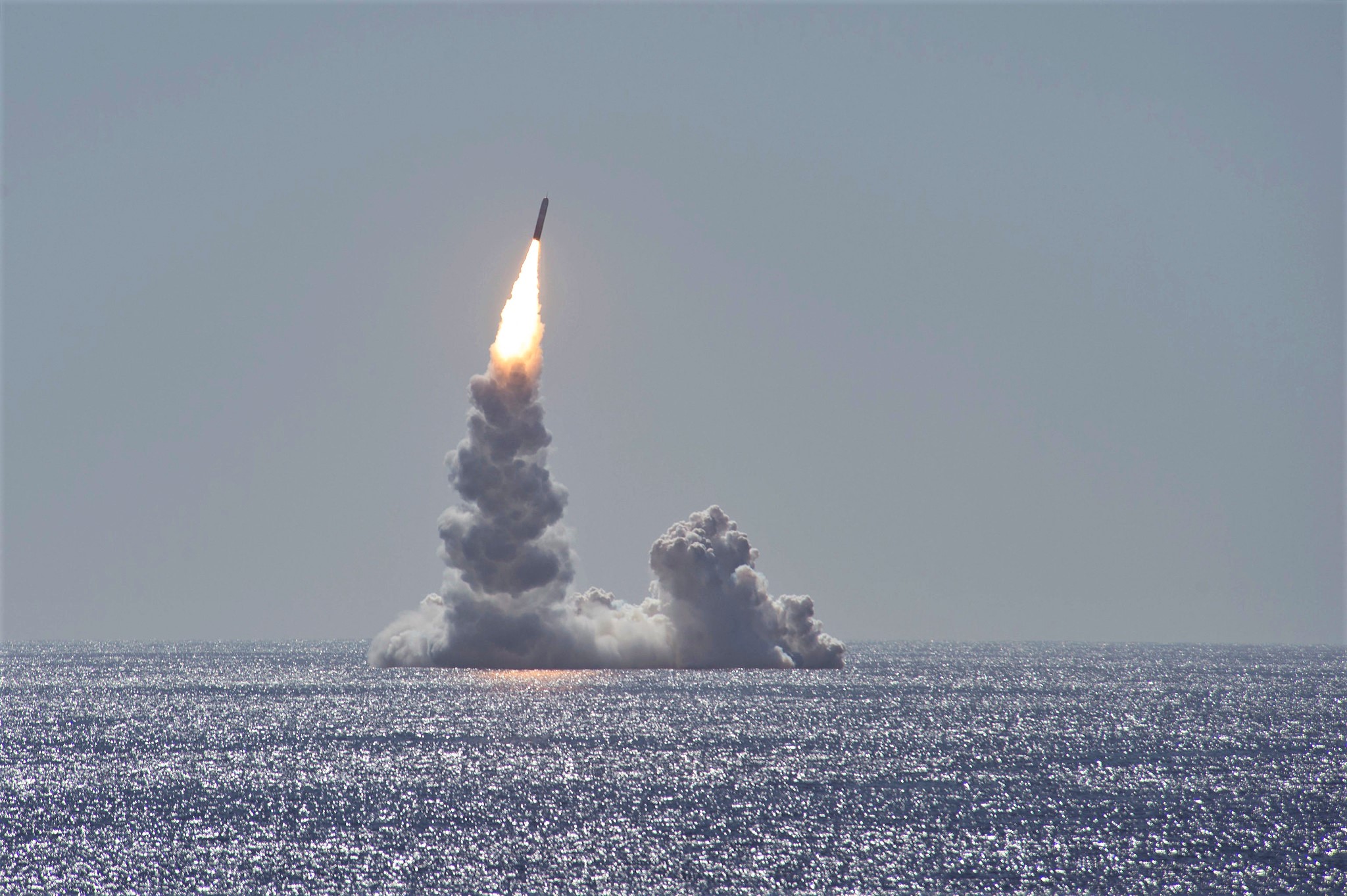
Such an expansive zone—far surpassing the 1,480 km buffer from a prior alert—hinted at the evaluation of an advanced long-range system, potentially the Agni-1 Intercontinental Ballistic Missile or the K-15 Submarine-Launched Ballistic Missile (SLBM), both capable of exceeding 1500 km and central to India’s nuclear deterrence triad.
Yet, as with the two preceding alerts withdrawn earlier this month, this one too was scrubbed without explanation, echoing a pattern observed throughout 2025, IDRW points out. In October and November, similar NOTAMs—ranging from 1,480 km to 3,545 km—were pulled back amid heightened maritime activity, prompting accusations of “foreign interference”.
Dual Purpose
Speculation has mounted about the idea behind India’s repeated issuances and abrupt cancellations, whether they serve a dual purpose: not just missile validation, but also a low-cost intelligence operation to measure Beijing’s surveillance agility.
Reports indicate that as soon as NOTAMs are published, Chinese vessels like the “Xiang Yang Hong” series, “Lan Hai 101”, and “Shi Yan 6” reposition into optimal tracking positions, often within days, covering vast swathes of the Bay of Bengal and Andaman Sea.
By revoking alerts at the eleventh hour, New Delhi may be forcing these ships to burn fuel on false alarms, revealing deployment patterns, sensor ranges, and coordination with PLA Navy assets—insights invaluable for countering espionage in contested waters, IDRW says.
Message to Chinese?
A prevailing interpretation is that India may be denying intelligence windfalls to adversaries. If Chinese “research” or surveillance vessels are actively monitoring missile test corridors in the Indian Ocean, withdrawing or rescheduling NOTAMs could be a deliberate move to prevent the collection of sensitive telemetry, radar signatures, or trajectory data.
In this reading, postponement does not signal hesitation or technological uncertainty. Rather, it reflects a mature strategic calculus—India will test its systems on its own terms and timetable, not when adversaries are optimally positioned to observe. The NOTAM, in this sense, becomes more than a procedural aviation notice; it becomes a signal of capability without disclosure of intent, IDRW says.
A second interpretation views the repeated issue-and-cancel cycle as a form of psychological or strategic play. By demonstrating the ability to repeatedly activate and deactivate test windows, India signals clear awareness of foreign surveillance and its own capacity to control tempo and escalation.
A third and equally compelling explanation is that NOTAMs are now serving as multi-layered messaging tools. Domestically, they reassure audiences of India’s preparedness and technological readiness. Regionally, they reinforce deterrence—particularly toward China and Pakistan—by underlining India’s long-range strike capabilities.
Internationally, they signal to allies and strategic partners that New Delhi is an active and calculating player in the Indo-Pacific security landscape. Viewed through this prism, the issuance and withdrawal of NOTAMs appear less random and more like part of a broader strategic communication ecosystem.
Navy Chief’s Denial
Commenting on the previous postponements, India’s Chief of Naval Staff, Admiral Dinesh K Tripathi, had dismissed the idea that missile tests were postponed because of Chinese spy vessels as “a figment of imagination”.
He acknowledged that India monitors foreign vessels but stressed that such activity is normal maritime practice and not a trigger for test postponement
India’s Naval Build Up
Given the threat to it from China in the Bay of Bengal and the Indian Ocean at large, New Delhi is strengthening its naval presence here in terms of submarines as well as missiles. It is acquiring new vessels and longer ranger missiles and conducting tests, giving Notice to Airmen (NOTAM) about firing or the launching of missiles over specified areas.
The K-4 submarine-launched SLBM is India’s advanced solid-fuelled system derived from the Agni series. The K-4 program develops a nuclear-capable Submarine-Launched Ballistic Missile (SLBM) to bolster the sea leg of its nuclear triad.
Led by Defence Research and Development Laboratory (DRDL), the solid-fuelled missile draws from Agni-III technology for enhanced survivability and second-strike capability. Development began post-2009 INS Arihant launch to enable credible minimum deterrence.
Submarine Integration and Status
INS Arihant (commissioned 2016) and INS Arighat (2024) are submarines which carry 4 K-4 missiles each and S4/S4 boats (2025 onward) doubled to 8. By mid-2025, K-4 achieved full operational status on Arihant-class submarines.
The December 17-20, 2025, Bay of Bengal NOTAM (2520-3550 km zone) was expected to validate K-4 maturity. Its range is 3,500 km, enabling strikes across regional threats from submerged platforms. It is 12m long, weighs 17 tons; and is nuclear-capable with MIRV tech for multiple independent warheads. It is fired from 20-30m depths on SSBNs like INS Arihant or Arihant-class successors.
It bolsters India’s sea-based nuclear triad, enhancing second-strike deterrence against adversaries like China or Pakistan.
K-4’s November 2024 trials used 2000 km area and the December 17-20 escalation was meant to show maturity in deployment.
India is pushing for indigenous SLBMs under the Nuclear Command Authority. The K-4 equips Arihant-class boats to counter China’s Type 096 SSBNs and JL-3 missiles. Success could accelerate K-5 (5000+ km) development, tying into AUKUS dynamics and Quad maritime security.
Third Nuclear Submarine
India’s Navy Chief Adm. Tripathi said on December 2, that INS Aridhaman, India’s third indigenously built nuclear-powered submarine, is set to be commissioned soon and It in the final stages of its trial.He was speaking at the annual pre-Navy Day press conference.
Equipped to carry longer-range missiles, INS Aridhaman significantly strengthens India’s sea-based nuclear deterrence by enhancing both strike capability and survivability in line with the country’s nuclear doctrine.
INS Aridhaman will join INS Arihant and INS Arighaat, forming a trio of Arihant-class nuclear-powered Ballistic Missile Submarines (SSBNs). The second submarine in the class, INS Arighaat, was commissioned on August 29, 2024, in Visakhapatnam after an extensive construction process involving advanced design and manufacturing technologies, specialised materials, and complex engineering.
Admiral Tripathi also provided updates on recent naval inductions, noting that INS Vaghsheer was commissioned by the Prime Minister on January 15 during the Tri-ship commissioning event. Since the last Navy Day, the Navy has commissioned 12 warships, including INS Uday Giri, the 100th indigenously designed warship developed by the Navy’s Warship Design Bureau.
END
