

By P K Balachandran/Daily News
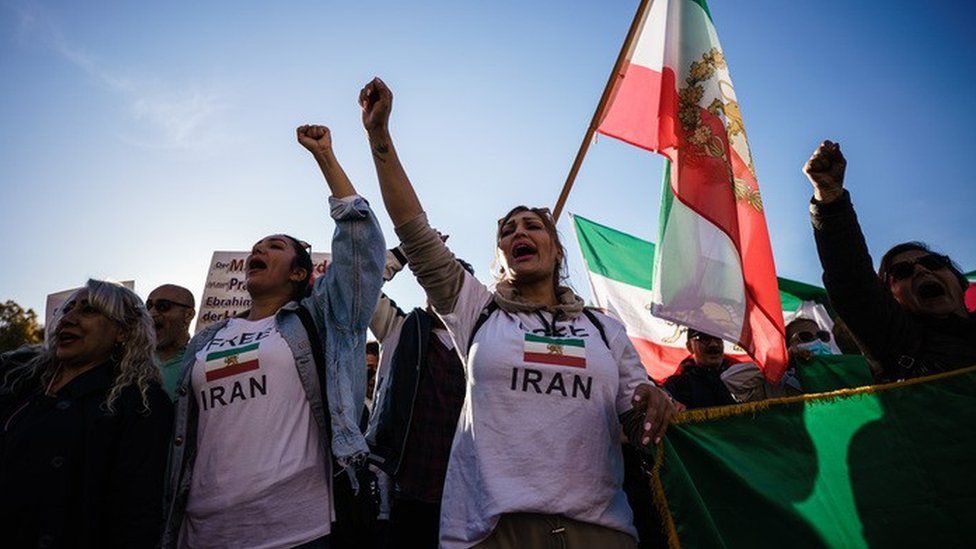
Colombo, January 13 – Iran is on the boil, with the masses across cities protesting an unprecedented 42% inflation. An average Iranian would need US$ 500 dollars a month to make both ends meet, but he has only US$ 125. Iran’s currency had lost more than half its value last year rendering imported goods out of reach for the common man.
There is now no support for the regime’s policy of financially supporting Islamic resistance groups abroad such as the Hamas, Hezbollah and the Houthis, all which have been neutralized by Israeli and the US military action.
Export of Islamic Terrorism
The government denies that domestic tax revenue is being spent on supporting its regional military allies such as the ones mentioned here. But leaked reports of Iran’s financial assistance to regional groups such as Hezbollah in Lebanon indicate Iran’s largesse. Hezbollah has been expanding its network of interest-free loan funds, using Iranian support to provide financial relief to its followers.
Iran recently allocated over US$ 10,000 per family to Lebanese households affected by the most recent conflict with Israel. The funds were distributed among Shia families aligned with Hezbollah. Naim Qassem, Hezbollah’s newly appointed secretary-general, had described the payments as a “gift from the Islamic Republic (of Iran).”
True, the rule of the Ayotollahs had survived similar large-scale demonstrations several times in the past, as in 2017, 2018, 2019, 2022 and 2023, and had come out unscathed. But the million dollar question is, would it be able to repeat the success this time round?
The answer is no, according to Karim Sadjadpour of the Carnegie Endowment for International Peace. He is quoted as saying, “ The Islamic Republic is today a zombie regime. Its legitimacy, ideology, economy and leader are dead or dying. What keeps it alive is lethal force. It kills to live and lives to kill. Brutality can delay the regime’s funeral, but it can’t restore the pulse.”
Be that as it may, Ayatollah Ali Khamenei, the supreme leader, gave a defiant speech on Friday, claiming that the protesters were “a bunch of vandals” trying to please US President Donald Trump. But this time round, he appears to be in deep trouble due to a combination of internal and external factors.
Stinging Sanctions
Iran is currently facing the open hostility of the UN and Europe, in addition to the US and Israel. In 2025, the UN Security Council (UNSC) reimposed harsh sanctions on Iran over its nuclear program after the failure of a diplomatic marathon on the sidelines of the General Assembly session. UN sanctions are more sweeping than the American sanctions against Iran.
UN sanctions stem from a dispute over adherence to the 2015 Nuclear Accord between the world powers and Iran. Iran’s decision to bar international inspectors from its nuclear sites after strikes by Israel and the US in June 2025 was also a contributory factor.
European countries accused Tehran of violating the 2015 agreement by enriching uranium up to 60% from 3.5 % and accumulating a stockpile of 400 kilograms of highly enriched uranium, which could allow Iran to build several nuclear bombs if it chose to weaponize its program.
But Iranian officials maintained that their nuclear program was for peaceful purposes. They said that they accelerated uranium enrichment only because the US, under Donald Trump, unilaterally exited from the Nuclear Accord in 2018 calling it “a horrible one-sided deal,” even though Iran was in full compliance.
The UN froze Iranians assets and banned travel for a range of Iranian entities and individuals, and authorized countries to stop and inspect cargo traveling from Iran by air or sea on Iranian government vessels, including oil tankers. The sanctions prohibited Iran from enriching uranium “at any level”, launching ballistic missiles with nuclear warhead capability and transferring technical knowledge of its ballistic missiles. The sanctions also reinstated an arms embargo.
In June 2025 the US emphatically signalled its opposition to Iran’s nuclear weapons program by bombing three of its nuclear facilities.
The UNSC sanctions hit Iran at a particularly difficult time when it was grappling with an acute energy and water crisis, leading to mandatory cuts in power and water supplies in many cities. European countries complicated matters by stopping trade with Iran.
This week’s protests had spread to every Iranian region and ethnic group, but they have not reached the intensity of the 2022-2023 revolt over the death in custody of Mahsa Amini, who was arrested for refusing to wear a hijab or headscarf.
The ensuing crackdown resulted in 551 deaths and more than 22,000 arrests, according to human rights reports. Security forces killed 104 people on what was called “Bloody Friday” in September 2022.
Despite this violent suppression of the 2022-2023 rebellion, a rebellion erupted in 2026. As of last Monday, protests were reported in more than 340 places in all 31 Iranian provinces, according to “Iran Wire””, an online news service. But this year’s revolt is driven more by anger over Iran’s economic failures than the mullah’s repressive Islamic rules.
The question is whether the regime’s hard-liners have lost their marbles. There is also speculation that perhaps some members of the Supreme Council are thinking about making peaceful progress like the Gulf States and Saudi Arabia, abandoning war and the export of an Islamic revolution.
Russia and China
Russia and China, Iran’s two main allies and permanent members of the Security Council, have not come to the aid of the hard-pressed Iranian regime. Russia and Iran have close military ties, with Iran selling Russia drones it uses in the war in Ukraine. China is the main client for Iran’s oil sales, helping the government stay economically afloat. But even friends like them, have taken note of Iran’s tanking economy and reoriented their Iran policy.
Brushes With US
US President Donal Trump, who bombed Iran last June, warned Tehran on Friday, saying: “You better not start shooting because we’ll start shooting too.”
Iran has had many brushes with Iran since 1951-53. In 1951, the Iranian parliament, led by nationalist Prime Minister Mohammad Mossadeq, voted to nationalize the British-owned oil industry. A power struggle between the Shah and Mossadeq resulted in a coup engineered by US and British intelligence in 1953. Mossadeq was overthrown, and the Shah, Mohammad Reza Pahlavi, returned from temporary exile to consolidate his autocratic rule with US backing.
The Shah modernized Iran but this alienated the Islamic clergy who in 1979, overthrew the Shah and set up the Islamic Republic led by Ayatollah Ruhollah Khomeini. In 1979, Islamic militants seized the US embassy in Tehran, taking 52 Americans hostage for 444 days. The crisis led to the US severing diplomatic relations. Ayotollah Ruholla Khomeini’s death in 1989 led to Ayotollah Ali Khamenei’s ascension.
In the early 2000s, international scrutiny increased over Iran’s nuclear activities. This led to a series of UN and U.S. sanctions. In 2015 there was a Nuclear Deal to limit Iranian nuclear activity in exchange for lifting international sanctions. But in 2018, President Trump withdrawal from Nuclear Deal unilaterally reimposed sanctions, leading to tension.
In 1984, the US dubbed Iran a “State Sponsor of Terrorism” as it backing Hizbollah, Palestinian terrorist groups in Gaza, and various terrorist and militant groups in Iraq, Syria, Bahrain, and throughout the Middle East.
Iran used the Islamic Revolutionary Guard Corps-Qods Force (IRGC-QF) to provide support to terrorist organizations. In 2019, the US designated the IRGC, including IRGC-QF, as a Foreign Terrorist Organization.
Iran supported various Iran-aligned militia groups in Iraq including the US-designated terrorist groups Kata’ib Hizballah (KH), Harakat al-Nujaba, and Asa’ib Ahl al-Haq, with sophisticated weapons including lethal Unmanned Aerial Systems (UAS). These groups conducted roughly two dozen rocket and UAS attacks on US and coalition facilities in Iraq in 2021. The Bashar Assad regime in Syria was a crucial ally of Iran. Iran-aligned forces conducted an attack on US forces at Al-Tanf, Syria.
In Bahrain, Iran has continued to provide weapons, support, and training to local Shia militant groups, including the al-Ashtar Brigades and Saraya al-Mukhtar, both U.S.-designated terrorist groups. In Yemen, Iran has provided a wide range of weapons, training, advanced equipment such as unmanned aerial systems, and other support to Houthi militants, who engaged in hundreds of attacks against regional targets in Saudi Arabia.
Again in 2021, Iranian forces attacked several commercial ships in the Gulf of Oman, including an April 13 attack on the Hyperion Ray and a July 29 UAS attack on the Mercer Street vessel. Iran supported terrorist attacks against Israeli targets in 2021, including a thwarted January plot to attack an Israeli embassy in East Africa and a January bomb attack outside the Israeli embassy in New Delhi. The Indian government said the IRGC-QF was responsible.
In recent years, Albania, Belgium, and the Netherlands have all either arrested or expelled Iranian government officials implicated in various terrorist plots in their respective territories. Denmark similarly recalled its ambassador from Tehran after learning of an Iran-backed plot to kill an Iranian dissident in Denmark. In 2021, the US disrupted an Iranian intelligence network plot to kidnap Masih Alinejad, an Iranian American journalist and human rights advocate living in Brooklyn, New York.
The survival of the Islamic regime is in question especially in light of the US intervention in Venezuela
END
