

By Tang Lu
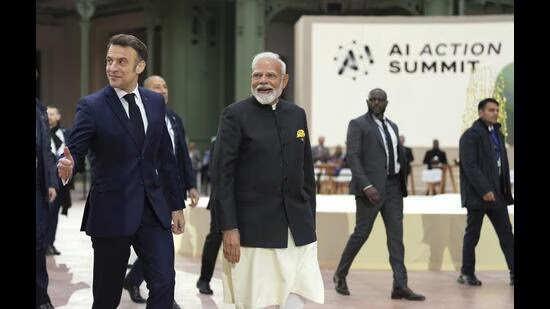
In February 2026, the India AI Impact Summit 2026, hosted by the Government of India under its national AI Mission, took place in New Delhi, making it one of the largest AI gatherings ever held in the Global South.
Prior to the summit, a widespread expectation was that India would showcase its “computing muscle.” However, when Minister of Electronics and Information Technology Ashwini Vaishnaw took the stage, he did not unveil any 1T (trillion-parameter) mega-models designed to turn Silicon Valley heads.
Instead, he delivered a statement that momentarily silenced the audience. “95% of global AI workloads can be handled by small models. In India, models with fewer than 10B (10 billion) to tens of billions of parameters are sufficient to address the majority of enterprise needs. India is no longer chasing the vanity of scale; it is pioneering the reality of substance.”
This declaration signalled India’s strategic pivot—stepping away from the exhausting race defined by the United States and China, and instead carving out a distinct “third track” for the Global South, one that New Delhi views as the essential path to AI leadership for the developing world.
The DeepSeek Impact
To understand India’s composure in 2026, one must first revisit the turbulent early months of 2025. At that time, news of China’s DeepSeek model achieving top-tier performance at minimal cost cast a long shadow over Delhi. For India, long championing “Jugaad” innovation, the news brought not just technical pressure but a stinging challenge. If a neighbour could build a frontier foundational model in 18 months with just over US$ 5 million and a team of 200, what excuse could India—a global IT powerhouse—possibly have for failing to deliver its own breakthrough?
“Saving face” became a near-universal conversation topic. Driven by this sentiment, Minister Vaishnaw made a bold pledge. India’s own large language model (LLM) would be unveiled within 10 months. Under the India AI Mission framework, the government swiftly assembled a “National AI Team” comprising 12 leading enterprises and research institutions. Star start-up Sarvam AI received substantial funding, targeting large-parameter, cutting-edge models. The logic was straightforward, to build sovereign AI, one must build the largest. Only then could India prove its capabilities to the world.
This fervour ignited a profound “sovereignty definition debate.” One faction insisted India must start from scratch, from the first line of code and the initial stage of data cleaning, completely breaking free from Silicon Valley’s open-source foundations (such as Meta’s Llama) to build a genuine “Indian brain.” Any development based on external frameworks, this faction argued, would amount to only “second-class sovereignty.”
The Ceiling of Computing Power
By early 2026, India’s AI Mission had deployed 38,000 GPUs (graphics processing units), double the 18,000 units from a year prior, an unprecedented achievement on the Indian subcontinent.
Yet on the global stage, this figure appears modest. OpenAI’s computing pool alone numbers in the hundreds of thousands, while leading US tech companies maintain inventories in the millions. Even under external restrictions, China’s computational scale remains in a different league.
This gap collided with reality in mid-2025, shattering the “full-stack sovereignty” blueprint.
In July, BharatGen—the first sovereign large model project to carry high hopes, was released. The technical limitations accumulated through insisting on “purely homegrown development” became glaringly apparent. The model with only 2B (2 billion) parameters, exhibited numerous logical reasoning flaws, and appeared fragile in an era of trillion-parameter competition.
Meanwhile, Sarvam AI, the flagship of the “national team,” faced its own embarrassment during closed beta testing.Early versions fell short on scale and suffered severe breakdowns when processing complex mixed Indian-language inputs.
These setbacks thrust a sharp question into the spotlight. Is sovereignty achieved by clinging to a bug-ridden “purely domestic foundation,” or by leveraging the world’s most powerful tools to solve the real-world problems of 1.4 billion people?
Nandan Nilekani’s “Electrical Appliance Theory“
In this debate over strategic direction, entrepreneur Nandan Nilekani—the architect of India’s Aadhaar national identity system and the Unified Payments Interface (UPI)—has played a pivotal role.
While the government remained entangled in the vortex of computing power and parameter races, Nilekani offered a comparison that was coolly logical, almost accounting-like.
“If someone in the world has already spent tens of billions of dollars to build the best ‘generator’ and is willing to sell us ‘electricity’ at an extremely low price, why should India go bankrupt building its own nuclear power plants? What we should do is use this cheap electricity to invent the world’s most abundant ‘appliances.’ Sovereignty lies not in who built the engine, but in who holds the steering wheel.”
He then articulated the core logic of small language models (SLMs).
“We don’t need a large model that can write Shakespearean sonnets. We need small models that can help farmers calculate loan interest or assist village doctors in diagnosing heart murmurs. Large models are expensive fireworks in the lab; small models are India’s daily sustenance. Rather than depleting the treasury to build a trillion-parameter monument to abstraction, we should build a ‘use-case capital’ composed of countless precise, affordable small models. Only small models can truly run on the inexpensive smartphones used by most Indians.”
The setbacks India experienced in the latter half of 2025 validated exactly this logic.
The Davos Prelude
The strategic pivot at the 2026 New Delhi summit was foreshadowed a month earlier at the World Economic Forum in Davos. Responding to the IMF’s classification of India as an AI “observer” rather than a “creator,” Minister Vaishnaw delivered a firm yet pragmatic rebuttal on the “AI Power Play” panel. He made clear that India has no intention of joining Silicon Valley’s parameter arms race.
“Return on investment doesn’t come from building a hyper-massive model; 95% of the work can be done with a 20B (20-billion) or 50B (50-billion) parameter model,” Vaishnaw told Fortune India.
“If you have a 5B (5-billion) or 3B (3-billion) parameter model, you don’t even need expensive GPUs to deploy it. This ‘bouquet of models’ is where the real economic value lies.”
In a subsequent NDTV interview, World Bank President Ajay Banga—an Indian-American—expressed strong endorsement for India’s approach, succinctly summarising this strategy as “Small AI” and identifying it as India’s “secret weapon” in global competition:
“Most discussions about AI today focus on generative LLMs, but that requires massive computing power, electricity, and data… If AI conversations remain fixated on Western large-scale systems, we risk losing the trust of emerging markets,” Banga said.
He emphasised that India’s approach—enhancing productivity through small models tailored to specific use cases—is key to avoiding being left behind in the technological wave.
“This isn’t just about growth; it’s about social equity.”
India’s AI narrative has thus completed a logical full circle. This is not a story of failing to catch up in a trillion-dollar race, but a strategic pivot grounded in cost and national circumstances—shifting from pursuing absolute computational supremacy to achieving “AI for All” through deep deployment.
Portrait of Small Models at India’s AI Summit
At the 2026 New Delhi summit, the excitement no longer revolved around parameter counts. Though Sarvam AI—with its 105B(105-billion-parameter) model and polished corporate image—occupied the most prominent booth as India’s flagship showcase, the real buzz came from several models rooted in the soil, some carrying the faint scent of cattle sheds.
Gnani.ai’s Inya VoiceOS
This compact model with 5B (5 billion parameters)boasts the most sensitive ears. Its most striking capability was not text recognition, but voice cloning—within 10 seconds, it could replicate the warm, local accent of a village clerk. In Andhra Pradesh’s areas without 4G coverage, illiterate rural women need only speak a phrase in Telugu into a worn-out handset. The AI understands commands like “Send Kumar next door some feed money.”
In India, AI doesn’t need to write Shakespeare—it just needs to understand the neighbours.
BharatGen’s Param 2
With 17B (17 billion parameters), it is modest in scale yet ambitious in scope. Like an ascetic carrying a dictionary, it breaks down the “cultural firewall” separating 22 native languages through a Mixture of Experts (MoE) architecture.
Shodh AI’s Project Skanda
The summit’s most celebrated non-frontier model, it doesn’t converse with humans—it deals solely with atoms. As an energy-focused foundational model, it relentlessly simulates material science scenarios. Its sole KPI: charting a sodium-ion battery pathway for India that bypasses dependence on lithium-exporting nations.
To many Indians, this is the AI that delivers the most tangible value.
Amul’s Sarlaben App: Nicknamed the “Cow Shed AI,” this project is Nilekani’s most memorable response to Prime Minister Narendra Modi’s offhand question; “Can AI diagnose a cow’s illness?”
It is not code residing in the cloud, but a “digital veterinarian” in the pockets of India’s dairy farmers. In just 34 days, this AI agent learned to monitor the health of 40 million cows in real time using a single recorded moo and a photo of a cow’s eye.
While Silicon Valley debates whether AI will one day dominate humanity, India has already deployed AI to help dairy farmers diagnose ailing cattle.
It is noteworthy that applications like Skanda and Sarlaben both favor adopting 1.3B (1.3-billion parameter) micro-model architectures at their core. This choice is far from coincidental—1.3B is currently recognized as the computational sweet spot capable of bridging the “last mile” on low-end hardware.
As Minister Vaishnaw stated, India is not pursuing trillion-parameter behemoth. Instead, it is squeezing the purest sovereign productivity from these 1.3B “tactical-grade models.”
Three Cracks Beneath the Small Model Narrative
Yet beneath the success narrative of small models lie several unavoidable fault lines.
The first – the risk of innovation silos. Betting heavily on small models essentially means forfeiting a seat at the frontier of artificial general intelligence (AGI). While the world’s top researchers race to master the Scaling Law—the belief that sufficiently large amounts of computing power and data will eventually forge superintelligence—India has turned its focus inward, concentrating on engineering optimisations for small-parameter models. If this trend persists, India risks becoming merely a “high-end application lab” within the global AI ecosystem rather than a source of foundational algorithms, with its influence in shaping global standards gradually eroding.
The second – identity anxiety. This anxiety is most pointedly expressed by Pratyush Kumar, co-founder of Sarvam AI. In a closed-door summit session, he stated bluntly: “Don’t define India as a ‘small model nation’ just because we’re optimising for our national context. This label is toxic—it risks making us forfeit the ability to compete for global leadership while chasing local optima. If the world perceives India as incapable of playing in the big leagues, how do we retain top talent?”
The third – the spectre of secondary dependency. Many researchers note that the underlying weights of India’s so-called sovereign small models often trace back to Meta’s Llama or China’s DeepSeek.
If algorithmic origins remain anchored in Silicon Valley or Beijing, even the most precise dialect models in India are merely dancing within boundaries others have drawn. This absence of “algorithmic sovereignty” is the deepest concern lurking beneath the small-model success narrative.
Modi’s Three Symbolic Moments
During the summit, Prime Minister Modi visited numerous exhibition booths. His interactions at three revealed the underlying themes of India’s AI strategy.
At the Sarvam AI booth, he tried on the Sarvam Kaze—India’s first domestically developed AI smart glasses. Modi used the moment to signal India’s ambition to compete across the full technology stack, stressing: “Technology must serve humanity, not replace it.”
At the BharatGen booth, his focus turned to multilingual inclusion. Watching AI transform dry data into the warm dialect of Assam, Modi remarked that AI should serve as “a medium of inclusion and empowerment,” realising his vision of a civilisation where everyone benefits and everyone thrives.
At the Project Skanda booth, he underscored the backbone of deep technology. Modi explicitly stated that India needs not just “chatty models,” but also hardcore science capable of tackling materials science challenges and securing national energy independence—”because India is not prepared to rent someone else’s intellect.”
In New Delhi in 2026, India stands at a delicate balancing point. seeking “asymmetric competition” through small models, yet constantly wary of being consigned to a second-class seat in the global technology race.
The moment Modi donned those AI glasses may have been the most authentic reflection of this internal tension—even while bending over the most mundane details of people’s daily lives, he sought to frame his cosmic ambitions for global influence within the lenses of algorithms.
This is the ‘Third Track’ India has paved for the Global South. While the world is awed by the brute force of trillion-parameter models, New Delhi has delivered a survival manual through its 1.3B (1.3-billion) ‘subtraction philosophy.’ It tells nations without GPU clusters or stable power, sovereignty isn’t about the height of your Tower of Babel, but whether you hold the ‘digital golden shovel’ to dig into your own soil.
From Scale to Substance
This strategic breakthrough is as much about dignity as it is about technology. In the AI era, true independence isn’t rented; it is rooted in the precision of those 1.3 billion neurons.
END
(Ms. Tang Lu has served in India, Sri Lanka and Maldives as a journalist for many years)
