

By Veeragathy Thanabalasingham
Colombo, January 4 – The people of Sri Lanka have entered the New Year in a precarious condition, facing enormous challenges in rebuilding the country from the ravages of cyclone Ditwah.
The cyclone stalled the progress made in the restructuring programme to stabilize the economy after the worst economic downturn in its history in 2022.
The National People’s Power government (NPP) led by President Anura Kumara Dissanayake, which came to power amidst great expectations, has passed through the first year of its term but faces a formidable task as a result of the natural disaster.
The failure to take the necessary precautionary measures to mitigate the effects of the cyclone in advance despite warnings, and the flaws in the post-disaster relief and reconstruction activities, have been pointed out by the opposition parties. They attribute the flaws to the inexperience and incompetence of the leaders of the NPP in governance.
But it is unfortunate that Sri Lanka is deeply rooted in a disgusting culture in which political forces do not come forward with a sense of responsibility to rebuild the country through an inclusive approach during national calamities, whether they be political and economic but only pick holes.
When former President Ranil Wickremesinghe was arrested in August 2024, opposition politicians were talking about the urgency to work together against the government’s alleged vindictiveness, but they were unable to put forward credible allegations against the regime acceptable to the people. Similarly, they once again wrongly believed that the crisis resulting from the cyclone could be used as an opportunity to turn the people against the government.
At the same time, it must be pointed out the government is not keen in taking forward the work of rescuing people from disaster by involving all parties. The Presidential Task Force appointed to carry forward the work of rebuilding the country clearly exposes a serious flaw in the government’s approach. There has been criticism from civil society organizations that not all non-governmental members of the task force are known to have experience or expertise in disaster management or dealing with the needs of affected populations.
Despite being a left-wing coalition, the NPP government is very cautious in its interactions with civil society organizations. It is only after various criticisms that the government came forward to include at least one representative from civil society in the Presidential Task Force.
The NPP is not prepared to learn any lessons from the miseries that the country has suffered as a result of past ways of governance that systematically ignored the participation of a wide range of stakeholders in the policy-making process, especially the ethnic and religious minority communities.
But the NPP government has been very prudent in ensuring that it does not face crises like those that had arisen as a result of the approaches adopted by previous governments in dealing with the international community. It maintains a balanced relationship between the Western powers and the powerful countries of Asia.
The disaster munificence of countries from the East and the West, like India, China, Japan and Pakistan, in response to the devastation caused by unprecedented flooding and landslides is a testament to this.
In particular, the government has handled relations with India and China very tactfully. Given the Janatha Vimukthi Peramuna’s (JVP) long-standing close political ties with the Chinese Communist Party ( CCP) and its virulent anti-India stance of the past, it was widely anticipated that relations with Beijing under its leadership would be a source of irritation for New Delhi.
But, President Dissanayake’s government has been maintaining very close ties with India, defying all expectations. During the tenure of President Chandrika Kumaratunga, the then foreign Minister Lakshman Kadirgamar described relationship between India and Sri Lanka as ‘ irreversible excellence.’ It appears that President Dissanayake has reaffirmed it.
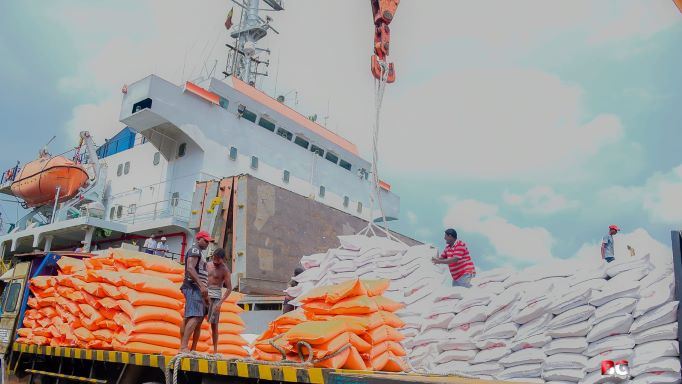
The rush of powerful countries to provide humanitarian assistance and rescue missions to Sri Lanka can be said to be an indirect ‘showcase’ of geopolitical interest in the Indian Ocean. There is no gainsaying that providing disaster relief assistance is not only a goodwill gesture but also a diplomacy in motion. Powerful nations use the opportunity to provide relief aid to strengthen ties with Colombo.
As the first responder to disasters in Sri Lanka, India has shown a special interest this time too. External Affairs Minister S. Jaishankar arrived in Colombo as a special envoy of Prime Minister Narendra Modi and announced a package of assistance for the rebuilding of Sri Lanka.
In his letter to President Dissanayake, Modi said, ‘ Sri Lanka will always find India by its side’. Dissanayake in a subsequent statement hailed ‘ a new era in Indo- Sri Lanka relations.’
On the heels of Jaishankar’s visit, a high- profile delegation from China led by Wang Junsheng, a member of the 20th Central Committee of the CCP, arrived in Sri Lanka and held wide ranging talks with Sri Lankan leaders. Overall, powerful nations seized the opportunity to reassert their influence in a strategically contested region.
It is important that countries at the risk of frequent natural disasters such as Sri Lanka, need to maintain good relations with all countries particularly with the world powers. But as Sri Lanka’s foreign aid dependency increases, the chances of the country becoming a playground for geopolitical activity would increase.
Maintaining a balance in relations with important countries while receiving aid is a complex issue. Sri Lanka, which is already dependent on the international community to recover from the economic crisis, may not be able to avoid being caught up in the geopolitical interests of the superpowers. Only time will tell whether President Dissanayake and his government will be able to maintain the balance.
In the meantime, will there be enough time for the government to focus on bringing political reforms as promised to the countrymen?
END
