

By Veeragathy Thanabalasingham
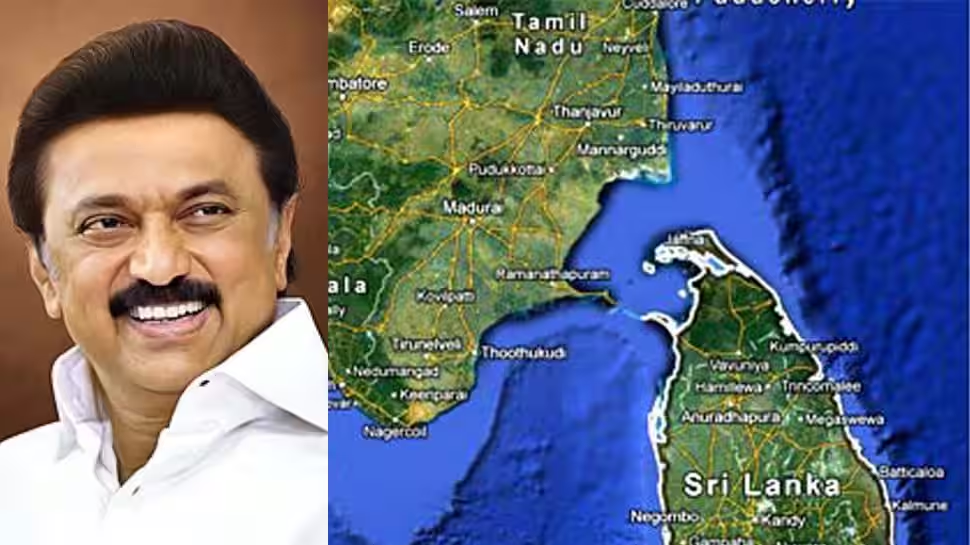
Colombo, January 17 – Within a month of his meeting with a delegation of the Tamil National Council ( TNC ) led by Member of Parliament Gajendra Kumar Ponnambalam, Tamil Nadu Chief Minister Muthuvel Karunanidhi Stalin wrote to Indian Prime Minister Narendra Modi urging him to engage diplomatically with Sri Lanka to press for a constitutional change that genuinely addresses the Tamils’ grievances.
Noting that the Sri Lankan Tamil political leaders who met him recently had pointed out the ‘grave dangers’ that the constitutional reforms currently underway in their country would pose to the Tamils, the Chief Minister said India should press for the inclusion of federal arrangements that devolve powers to the provinces, protect the ethnic minority rights and uphold the principles of pluralism and equality.
He emphasized that such an approach, if adopted by New Delhi, would not only honour India’s role as a guarantor of regional peace, but also align with the Indian constitutional values of federalism and protection of linguistic and ethnic minorities, consistent with India’s constitutional values of federalism and protection of linguistic and ethnic minorities, adding that the government led by President Anura Kumara Dissanayake is accelerating efforts to introduce a new constitution under the guise of resolving ethnic issues and that the proposed structure appeared to reinforce the unitary (Ekkiyarajya) model, which threatens to further marginalise the Tamils by ignoring their legitimate aspirations for by ignoring the Tamils’ aspirations for political autonomy.
“Pointing out to Prime Minister Modi that the Tamil leaders who met him had asserted that the ‘Thimbhu Principles’ put forward by the Tamil representatives in the peace talks organised in Bhutan in August 1985 between the then Sri Lankan Government and the Tamil parties and armed struggle movements, under the auspices of India, continued to be relevant in the present context, the Chief Minister asserted that any new Constitution brought without incorporating the elements in those principles risks perpetuating the cycle of injustice and instability continue to perpetuate injustice and instability leading to a renewed conflict and humanitarian crisis.
‘ India, as a regional power with a longstanding commitment to peace and justice in Sri Lanka – evidenced by historical involvement, including the Indo – Lanka Accord of 1987 – has a moral and strategic imperative to act, Stalin further stated.
It seems that TNC regards Stalin’s letter as an initial remarkable improvement in its efforts to use pressure from Tamil Nadu on the Indian central government to find a solution to the Sri Lankan Tamil issue. Gajendra Kumar’s speech at a political seminar organised by the Tamil National Green Movement in Jaffna last week is a clear indication of this.
Gajendra Kumar, who seems to be confident that there will be a wave of support for their Tamil nationalist stance in Tamil Nadu, says it is imperative to take these efforts forward by bringing together Ilankai Thamizharsu Katchi ( ITAK ) and the Democratic Tamil National Alliance ( DTNA). His position is that the two parties are indispensable forces in securing Tamil Nadu’s support for the Tamil nationalist stance for the duration of the current Parliament.
It is his belief that if the TNC with a single MP, is able to make such progress through talks with Tamil Nadu political parties, it can make a big leap in creating a wave of support in the state, if it works together with MPs from other Tamil parties with the same Tamil nationalist stance.
One is at a loss to understand why Gajendra Kumar, who said this after visiting Tamil Nadu and meeting political parties there, did not think it fit to take a collective stand in consultation with the ITAK and DTNA in advance. His behaviour in this regard, has to be seen as a continuation of the usual practice of Tamil nationalist parties expecting other parties to work with them after they have taken a stand on their own without consulting others.
The expectation of the Tamil people that the Tamil parties should take a unified stand on the political solution to the national question seems to be forever a mirage.
It is noteworthy that the Chief Minister of Tamil Nadu has used the term ‘Ekkiyarajya’ in his letter. In the interim report submitted after the constitution drafting process carried out by the then Sri Lankan government during 2015-2019, it was stated that the character of the Sri Lankan state would be ‘Ekariyaraja’.
Based on Anura Kumara Dissanayake’s promise in the 2024 presidential election manifesto that the stalled constitutional process will be revived and the national problem e solved, Gajendra Kumar seems to believe that the ‘Ekkiyarajya’ constitution will be brought by the National People’s Power ( NPP) government.
President Dissanayake, who mentioned it in the election manifesto, has not spoken about the constitution for more than a year now. The NPP government, which initially said that constitutional reforms would be carried out after three years, is now almost silent on it.
Responding to a question raised by the Leader of the Opposition Sajith Premadasa in Parliament recently on the abolition of the executive presidential system, Prime Minister Harini Amarasuriya said that the presidential system would be abolished only through the new constitution. She, however, did not specify any time frame.
While the situation in Sri Lanka is such, Chief Minister Stalin has said hat the process of introducing a new Constitution in Sri Lanka is being expedited. Thus, doubts are being raised about Stalin’s understanding of the political developments in the island nation.
In any case, it is welcome that he has once again begun to show concern for the Sri Lankan Tamil ssue. At the same time, as the Tamil Nadu Assembly elections are approaching, there is criticism that Stalin has written to PM Modi in an attempt to pre-empt political rivals in extending solidarity with Sri Lankan Tamils.
Despite having more than a two-thirds majority in Parliament, there is a growing perception in the public domain that the NPP government is squandering the opportunity to push through constitutional reforms.
Civil society organisations are of the view that the Janata Vimukthi Peramuna (JVP) -led NPP which has a long history of campaigning for the abolition of the executive presidency, should have pushed through constitutional reforms without delay. The first year of a government’s term is the safest time for a new constitution to gain popular approval in a referendum.
The lukewarm response from the government to changing the constitution has already led to criticism from the opposition that it is moving in the direction of establishing a constitutional or one-party dictatorship.
Professor Jayadeva Uyangoda, one of Sri Lanka’s leading political scientists, in a recent analysis on the one-year rule of the NPP government, has said the following about this constitutional change issue: ” All indications at present suggest that politics in Sri Lanka in the new year and after most likely be highly contentious and tense. That indeed is not very good news for any major constitutional reform. However, delaying promised constitutional reforms will also not bode well for the NPP’s own agenda and, more crucially, its credibility.
” If the NPP fails to abolish the executive presidential system and to bring parliamentary democracy, with safeguards necessary to prevent parliamentary- cabinet authoritarianism, the future of Sri Lanka’ s democracy under a post-authoritarian constitution might require another citizens’ uprising.”
END
