

By P.K.Balachandran/Daily Mirror
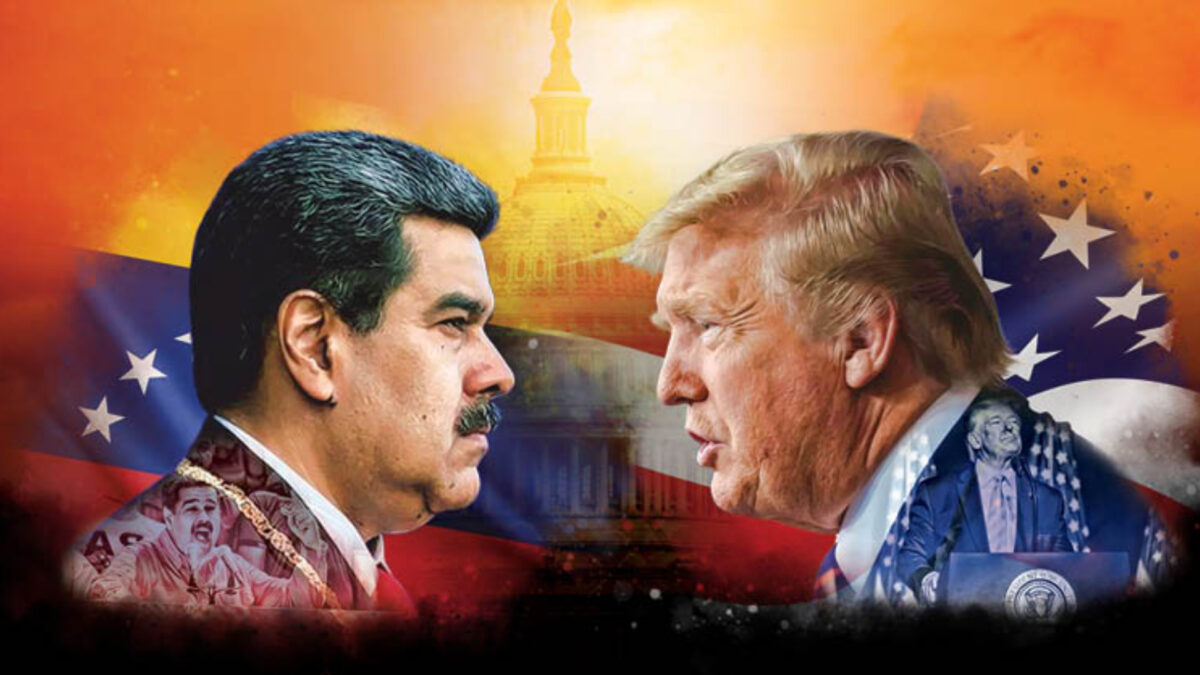
Colombo, January 6 — The United States’ invasion of Venezuela in early January 2026, culminating in the overthrow of President Nicolás Maduro’s left-wing government, was driven by four interlocking objectives:
(1) installing a compliant regime in Caracas;
(2) forcefully reasserting American primacy in the Western Hemisphere under a revived Monroe Doctrine;
(3) preventing Venezuela from abandoning the US dollar in favor of the Chinese yuan and other currencies for international trade; and
(4) securing strategic influence over Venezuela’s vast oil resources.
Nicolás Maduro rose to national prominence under President Hugo Chávez, the charismatic architect of Venezuela’s “Bolivarian Revolution.” A former bus driver and trade-union leader, Maduro succeeded Chávez after his death in 2013. Over the 26 years that Chávez and Maduro ruled, their United Socialist Party of Venezuela consolidated power over key state institutions, including the National Assembly, large sections of the judiciary, and the National Electoral Council.
Maduro was declared the winner of the 2024 presidential election, despite widespread allegations of fraud and claims that opposition candidate Edmundo González had won by a large margin. González entered the race only after María Corina Machado, the opposition’s most popular leader, was barred from contesting the election by the Maduro government.
In October 2025, Machado was awarded the Nobel Peace Prize for what the Nobel Committee described as her “struggle to achieve a just and peaceful transition from dictatorship to democracy.” Defying a travel ban, she traveled to Oslo to receive the award in December. In her acceptance speech, Machado pledged to return to Venezuela with international — particularly American — support and to replace socialist policies with free-market reforms.
Trump’s Case Against Maduro
US President Donald Trump blamed Maduro for the arrival of nearly eight million Venezuelans in the United States since 2013, arguing that economic collapse and layering repression had triggered one of the world’s largest migration crises. Trump went further, accusing Maduro — without presenting evidence — of deliberately emptying prisons and mental health institutions and pushing their inmates toward the US.
Trump also alleged that Maduro bore responsibility for the flow of narcotics, particularly fentanyl and cocaine, into the United States. He claimed this constituted a form of asymmetric warfare against America and even placed a bounty on Maduro’s capture.
However, counter-narcotics experts dispute these claims. Venezuela is widely regarded as a secondary transit country in global drug trafficking, not a major producer. Cocaine is overwhelmingly produced in neighboring Colombia, the world’s largest supplier, and most trafficking routes bypass Venezuela altogether. Moreover, fentanyl — the principal driver of opioid overdose deaths in the US — is produced mainly in Mexico using precursor chemicals sourced from Asia and enters the US almost entirely via land routes across the southern border. Venezuela is not identified as a fentanyl source in the US Drug Enforcement Administration’s 2025 National Drug Threat Assessment.
Maduro, for his part, argued that the drugs narrative was a pretext. He accused Washington of using the fentanyl crisis to justify regime change and seize control of Venezuela’s oil wealth.
Covert and Overt Operations
In October 2025, President Trump authorized the CIA to conduct covert operations inside Venezuela. On December 15, he signed an executive order designating fentanyl a “Weapon of Mass Destruction,” arguing that its lethality made it comparable to a chemical weapon.
By September 2025, US naval forces had begun targeting vessels accused of carrying narcotics from South America. At least 30 strikes were carried out in the Caribbean and Pacific regions, resulting in more than 110 deaths. Despite international objections, Trump subsequently declared a “total naval blockade” on sanctioned oil tankers entering or leaving Venezuela.
The United States deployed approximately 15,000 troops to the Caribbean, supported by aircraft carriers, guided-missile destroyers, and amphibious assault ships. The blockade proved devastating for Venezuela, whose economy depends overwhelmingly on oil exports — the government’s primary source of foreign exchange.
The Oil Factor Reconsidered
Venezuela possesses the world’s largest proven crude oil reserves, and revenues from the sector have historically financed more than half of the state budget. Years of US sanctions pushed Caracas closer to China, Russia, and Iran, resulting in a series of energy and mining agreements. For Beijing, Venezuela offered both an energy supplier and a strategic foothold in the Western Hemisphere.
Yet many analysts argue that the oil factor is often overstated. According to the US Energy Information Administration, Venezuela accounted for only about 0.8 percent of global crude production in 2023, exporting roughly 900,000 barrels per day. China is the single largest buyer — a fact that has particularly irritated Washington.
Another long-standing grievance has been Venezuela’s nationalization of its oil industry under Chávez. While US companies such as ExxonMobil and ConocoPhillips lost assets, Caracas paid more than US$1 billion in compensation. Even so, US sanctions steadily crippled Venezuela’s production capacity.
Restoring the oil industry to its former output levels would require tens of billions of dollars and at least a decade of sustained investment. Today, Venezuela produces roughly 860,000 barrels per day — barely a third of its output a decade ago and less than 1 percent of global consumption.
Leftism as the Deeper Issue
More than oil, it was Venezuela’s left-wing orientation that antagonized Washington. Hugo Chávez swept to power in 1998 by channeling public anger over corruption, inequality, and elite domination. He promised sweeping constitutional reforms and a redistribution of wealth.
In April 2002, Chávez survived a short-lived coup attempt, widely believed in Venezuela to have had tacit US backing. Although he returned to power within days following mass protests, Chávez emerged more suspicious and authoritarian. He cracked down on political opponents and openly accused the George W. Bush administration of plotting his removal.
Chávez reasserted state control over the oil sector, reversing privatization and forcing foreign firms into minority stakes under the state oil company. When US oil majors refused, their assets were seized. After Chávez’s death in 2013, Maduro continued these policies, deepening Venezuela’s isolation and driving it closer to Russia, China, and Cuba — all strategic rivals of the United States.
The Monroe Doctrine Reborn
The ideological justification for Trump’s intervention lay in a revived Monroe Doctrine. Originally articulated in 1823, the doctrine warned European powers against interference in the Western Hemisphere.
Trump’s 2025 National Security Strategy introduced what he called a “Trump Corollary” — aimed not at Europe, but at China and Russia. Although Venezuela was not named explicitly, the document warned against Beijing’s growing influence through “like-minded leaders” and pledged to deny rival powers access to strategic assets such as ports, energy resources, minerals, and communications infrastructure.
Under this doctrine, the US committed to an expanded military presence in Latin America, ostensibly to combat drug trafficking, secure sea lanes, and counter Chinese influence.
Exploiting Venezuela’s Divisions
Washington also capitalized on Venezuela’s internal political fractures. María Corina Machado actively courted US investors, promising that a post-Maduro government would privatize oil, gas, and infrastructure assets. She claimed American companies could gain access to opportunities worth US$1.7 trillion.
While firms like Chevron remained marginally active in Venezuela, sanctions sharply curtailed their operations. The objective was clear: deprive Maduro of revenue while positioning US interests for a post-regime transition.
Enforcing Dollar Dominance
Perhaps the most significant — and least discussed — motive behind the invasion was the defense of the US dollar’s global dominance.
In 2018, Venezuela announced it would conduct oil trade in currencies other than the dollar, including the yuan, euro, and ruble. It sought membership in BRICS, explored alternatives to the SWIFT payment system, and deepened financial integration with China. Washington feared that Venezuela could become a test case for broader de-dollarization in global energy markets.
Since the 1970s, US power has rested heavily on the “petrodollar” system, under which oil is priced globally in dollars. Any sustained challenge to this arrangement threatens America’s ability to finance deficits and project power.
Leaders who attempted such challenges in the past — notably Iraq’s Saddam Hussein and Libya’s Muammar Gaddafi — met violent ends following Western military interventions.
With oil reserves exceeding those of Iraq and Libya combined, Venezuela represented a particularly dangerous precedent.
On January 3, 2026, US commandos captured Nicolás Maduro in a swift operation. He was flown to the United States and taken into custody. His life was spared, but his government — and Venezuela’s experiment in defying US financial and geopolitical dominance — had come to an abrupt end.
END
