

By P.K.Balachandran/Sunday Observer
Colombo, September 21 – An archaeological excavation project at Keeladi in Tamil Nadu, that ought to have been an intellectually stimulating and rewarding work primarily, has developed into a North India vs South India slanging match.
The quarrel is over the antiquity of Tamil civilization vis-à-vis North Indian civilization. Passions have been whipped up in Tamil Nadu over the stunning discoveries in Keeladi and their alleged denigration by the powers-that-be in New Delhi who are allegedly interested in imposing a single all-India historical narrative at the expense of the diverse regional narratives.
In New Delhi, the national power centre and headquarters of the Archaeological Survey of India (ASI), the belief is that the Tamils are using the issue for whipping up sub-nationalistic passions over an issue which ought to be treated purely technically and as per established archaeological principles.
Tamil archaeologists and Tamil Nadu politicians allege an anti-Tamil bias in New Delhi. North Indian politicians and bureaucrats are seen to be deliberately debunking the Tamils’ claim that the findings in Keeladi establish the existence of an advanced urban civilization in Tamil Nadu in the Sixth century BCE. The Tamil’s claim challenges the hitherto accepted theory that it was from the Indus Valley in North West India that Indian civilization spread to other parts of India including the Tamil country in the deep South.
Excavations in Keeladi
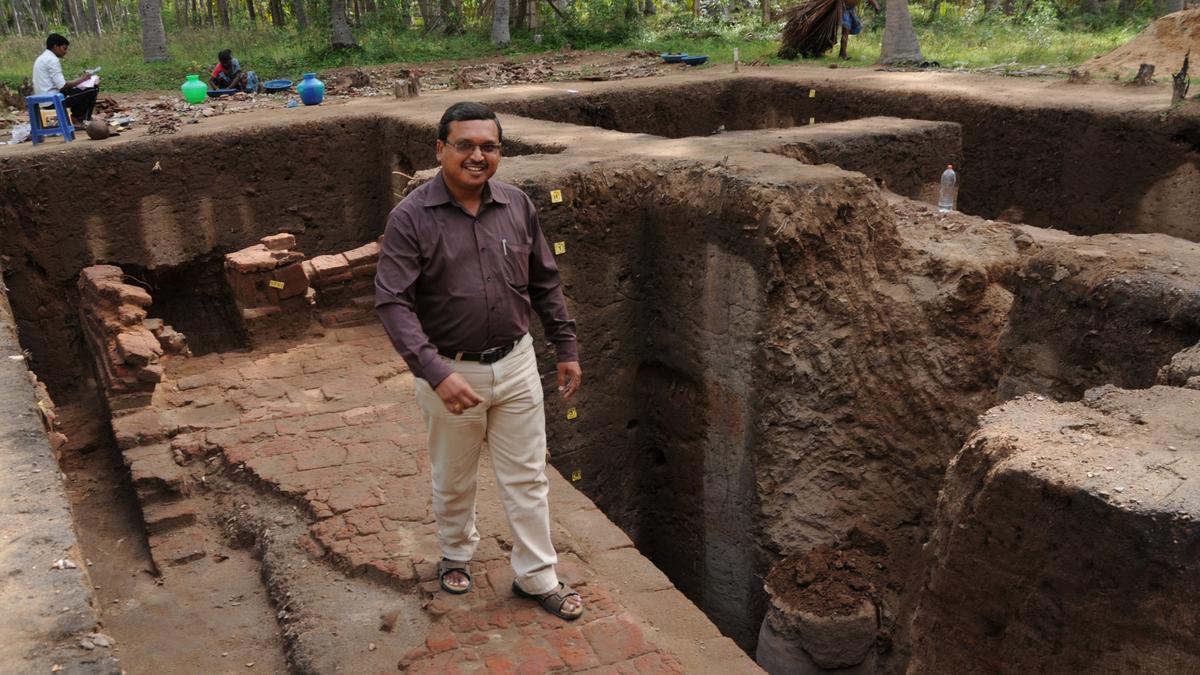
ASI Archaeologist K. Amarnath Ramakrishna, who led the Keeladi excavations in Sivaganga area of Tamil Nadu from 2014, released his 984-page report it in 2023. The report brought out the existence of a stunningly advanced urban civilization in Tamil Nadu going as far back as Sixth Century BCE.
According to a BBC report, since 2014, 10 excavation rounds at Keeladi had uncovered over 15,000 artefacts – burial urns, coins, beads, terracotta pipes and more from just four of the 100 marked acres. There are elaborate brick structures and water systems – evidence of a 2,500-year-old urban settlement.
“Since the Indus Valley Civilisation’s discovery in the early 1900s, most efforts to trace civilisation’s origins in the subcontinent have focused on northern and central India. Therefore, the Keeladi findings have sparked excitement across Tamil Nadu,” BBC said.
But Ramakrishna’s bosses in the ASI in New Delhi refused to endorse and release his report, saying that accurate dating was needed and that further excavations and proof were required. The Union Minister for culture and tourism Gajendra Singh Shekawat said Ramakrishna’s reports were not technically well-supported. The Minister wanted the Accelerator Mass Spectrometry (AMS) dating done. Government wanted Ramakrishna to excavate further and resubmit the report.
But Ramakrishna pointed out that an enormous amount of material had already been collected and that dating had been done by reputed institutions in the US. Radiocarbon dating and stratigraphic evidence had indicated that the material could be placed as belonging to 600 BCE, 300 years before the Ashokan era.
According to a 2019 report of the Tamil Nadu State Department of Archaeology, one of the six samples sent to the United States for carbon testing was placed at circa 580 BCE.
As Ramakrishna refused to oblige his bosses, he was transferred out of Tamil Nadu. Amarnath’s successor, P.S. Sriraman, excavated just 400 square metres, and declared that there was no continuity in the brick structures earlier uncovered. He stopped excavating. Many viewed Sriraman’s claims as an attempt to downplay Keeladi’s importance.
By then, the issue had taken a Delhi vs Tamil Nadu character with the Tamil Nadu government and archaeologists of the State backing Ramakrishna. The matter was taken to the Madurai bench of the Madras High Court which ordered continuance of the excavations and asked the ASI to involve the Tamil Nadu Archaeology Department in the excavations.
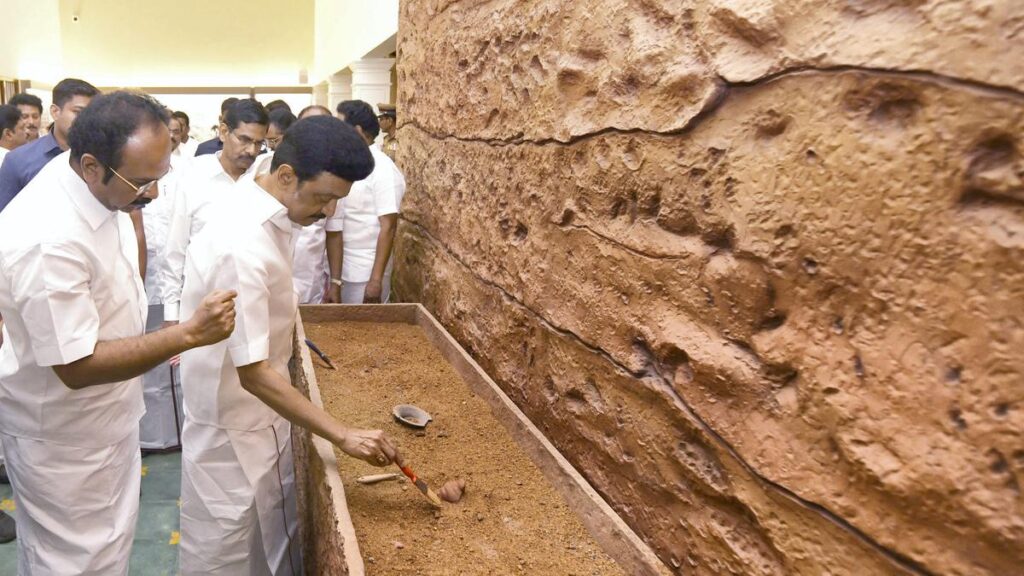
The DMK government in Tamil Nadu plunged into the task with gusto, giving full support to its archaeologists. It set up an impressive museum near the excavation site, which became a huge draw.
Chief Minister M.K. Stalin used the social media to say – “How many obstacles do Tamils have to face? We have been fighting against all of them for thousands of years, and with the help of science, we have been establishing the antiquity of our race. Yet, some minds refuse to accept it. It’s not the statements that need to be corrected; it’s some minds.”
Tamil Nadu Finance Minister, Thangam Thennarasu, said that the Centra l government was treating Tamils as “second-class citizens”.
A story by Kavitha Muralidharan in India Today quoted a political analyst as saying – “This is about who gets to write India’s history. When the state selectively obstructs certain findings, it sends a message that history must serve ideology. In this case, it seems Tamil Nadu is being punished for asserting a past that does not fit the official narrative.”
A noted archaeologist told the magazine – “Keeladi has emerged as one of the most important sites in reconstructing the cultural and urban history of early South India. The findings deserve open debate—not suppression.”
Another commentator said -“The excavation trenches at Keeladi are turning into battlegrounds—not only over potsherds and carbon dates, but over who is at the centre of India’s civilisational story.”
Kavitha Ramakrishnan said that the institutional sidelining and political persecution of Ramakrishna and his transfer to Assam in 2017, just as the excavation in Keeladi was gaining national attention, “was the first clear signal of an attempt to derail the narrative he was helping construct, “a narrative that unearthed evidence of a sophisticated, secular, urban Tamil civilisation from the Sangam era.”
The Sangam era stretches from 3rd century BCE to the 3rd century CE.
Antiquity of Tamil Brahmi Script
Running parallel to the controversies over discovering in Keeladi, there is a linguistic dispute as to whether the Tamil Brahmi script predates the Ashokan script or not. Some archaeologists and epigraphists say that Tamil Brahmi is older than the Ashokan Brahmi by at least 300 years (the Ashokan Brahmi script is dated as 3rd century BCE.) But others hold the contrary view that the Tamil Brahmin came after the Ashokan script.
A cist-burial site excavated in 2009 at Porunthal village, on the foothills of the Western Ghats, 12 km from Palani in Tamil Nadu, kicked off this debate. Prof. K.Rajan of Pondicherry University found an inscription on paddy in the Tamil Brahmi script. The Accelerator Mass Spectrometry (AMS) dating of the paddy done by Beta Analysis Inc., Miami, US, assigned the paddy to 490 BCE.
“Since all the goods kept in the grave including the paddy and the ring-stands with the Tamil-Brahmi script are single-time deposits, the date given to the paddy is applicable to the Tamil-Brahmi script also,” Dr. Rajan told T.S.Subramanian of The Hindu. . It was the first time an AMS dating was done for a grave in Tamil Nadu, he added.
Rajanwent on to say that Tamil-Brahmi could be dated 200 years before Ashoka and that this was of a great significance for Tamil Nadu’s history. K.V. Ramesh, retired Director of Epigraphy, at the ASI, also said that Tamil Brahmi was pre-Ashokan.
T.S. Subramanian also quoted Dilip K. Chakrabarti, Emeritus Professor, Department of Archaeology, University of Cambridge, who said that the Porunthal Tamil-Brahmi script was “an epoch-making discovery in the archaeology of Tamil Nadu” and that there was no doubt that Tamil-Brahmi belonged to the pre-Asokan period. In two of his books — “An Oxford Companion to Indian Archaeology” and “India, an Archaeological History” — he had written that the evolution of Tamil-Brahmi should go back to circa 500 BCE.
But Iravatham Mahadevan, a leading authority on the Tamil-Brahmi and Indus scripts, and Dr. Subbarayalu, Head, Department of Indology, French Institute of Pondicherry, argued that it was difficult to reach a conclusion on the basis of a single scientific dating.
Mahadevan told The Hindu that the earliest evidence of the Tamil Brahmi script was found in Tissamaharama in southern Sri Lanka and that was dated as 200 BCE. The Ashokan Brahmi is dated to 250 BCE. There is no inscription of the pre-Asoka period available, Mahadevan said and contended that Tamil-Brahmi is post-Asokan saying that it is “ based on concrete archaeological as well as palaeographical grounds.”
END
Excavations in Keeladi, Dates Tamil civilization to sixth century BCE, India government challenges findings, Archeologist Amarnath Ramakrishna, North India-South India divide, Controversial claim of Tamil Brahmin being older than Asokan Brahmi,
