

By Milinda Moragoda/Daily Mirror
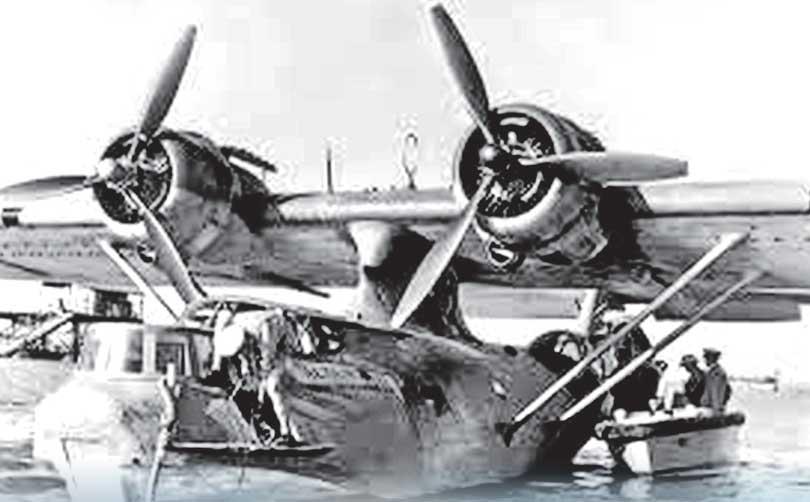
Colombo, April 3 – Eighty-five years ago, the skies over the Indian Ocean bore witness to a feat of aviation so daring it felt more like science fiction than wartime logistics. Between 1943 and 1945, the “Double Sunrise” flights—the longest non-stop commercial journeys of their era—tethered Western Australia to the southern shores of Ceylon. In a world fractured by conflict, these Consolidated PBY Catalina flying boats became a vital umbilical cord, navigating 5,500 kilometres of open water in radio silence. Today, this extraordinary chapter of shared history between Australia and Sri Lanka remains a hidden gem of human ingenuity and geostrategic grit.
In July 2028, the 85th anniversary of the “Double Sunrise” flights offers an opportunity to recall a remarkable chapter of shared history between Australia and Sri Lanka. From July 1943 to July 1945, Consolidated PBY Catalina flying boats connected Perth in Western Australia with Koggala on the southern coast of Ceylon, operating the longest non-stop commercial flights of the era—over 5,500 kilometres in journeys lasting 27 to 33 hours.
What made the operation extraordinary was not only distance, but the technical and logistical challenge. Payloads were strictly limited, fuel management had to be precise, navigation relied on basic tools across open ocean, and crews endured extreme fatigue in confined conditions. Flights were conducted under radio silence, making every calculation and decision critical. Each journey was a careful balance of endurance, planning, and skill.
Central to the story was Koggala, whose location enabled a direct air link across the Indian Ocean when conventional routes were blocked. Sri Lanka’s geographic position along the main east–west corridors made the operation possible—demonstrating, in practical terms, the island’s geo-strategic importance at a critical time.
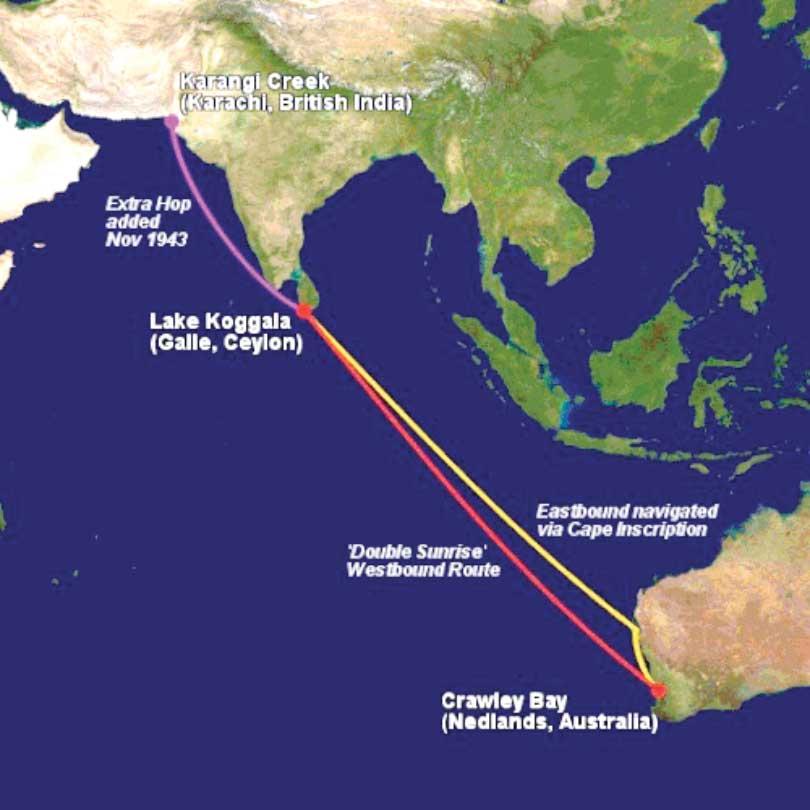
Despite the achievement, the Double Sunrise flights remain little known in either country today. The 85th anniversary provides a chance to change that through a joint commemoration, ideally at Koggala itself. A modest interpretive pavilion could convey the story: the route, the aircraft, the operational challenges, and the human experience of those involved. The goal would be a concise, accessible experience that highlights both technical achievement and strategic significance.
This shared history also reflects broader Australian–Sri Lankan ties, marking nearly eight decades of formal relations. Recognising the Double Sunrise flights in a joint initiative would not only honour a remarkable aviation feat, but also reinforce enduring connections in the Indian Ocean region.
The flights illustrate how geography, technical skill, and cooperation intersected to overcome extraordinary challenges.
As we approach the 85th anniversary, there is an opportunity to commemorate this milestone in a way that educates, inspires, and reminds Australians and Sri Lankans alike of a shared moment of ingenuity and endurance.
END
The author Milinda Moragoda is the Founder of the Pathfinder Foundation. He is also the Founder of the MMBL-Pathfinder Group, which is a joint venture partner with John Keells Holdings PLC and Phoenix Ventures Ltd in Saffron Aviation (Pvt) Ltd, owner of Cinnamon Air, Sri Lanka’s pioneering private amphibian aircraft operator.
Consolidated PBY Catalina
During World War II, the Consolidated PBY Catalina became an indispensable icon of Australian maritime aviation. Operated primarily by the Royal Australian Air Force (RAAF), which acquired 168 of the aircraft, the Catalina was the only platform capable of conducting the grueling long-range patrols required to protect the nation’s vast coastline. Most famously known as the “Black Cats,” these aircraft were painted matte black for daring nocturnal mine-laying missions deep into enemy waters. Beyond combat, the Catalina achieved legendary status through Qantas’s “Double Sunrise” service, maintaining a vital, non-stop 30-hour link between Perth and Sri Lanka—the longest regular commercial flight ever attempted.
These versatile flying boats were not manufactured locally; instead, they were supplied by North American firms. The majority were built by the Consolidated Aircraft Corporation in the United States, while others were produced by Boeing Aircraft of Canada and Canadian Vickers, ensuring the RAAF remained equipped for its most distant and dangerous assignments.
The author Milinda Moragoda is the Founder of the Pathfinder Foundation. He is also the Founder of the MMBL-Pathfinder Group, which is a joint venture partner with John Keells Holdings PLC and Phoenix Ventures Ltd in Saffron Aviation (Pvt) Ltd, owner of Cinnamon Air, Sri Lanka’s pioneering private amphibian aircraft operator.
END
