
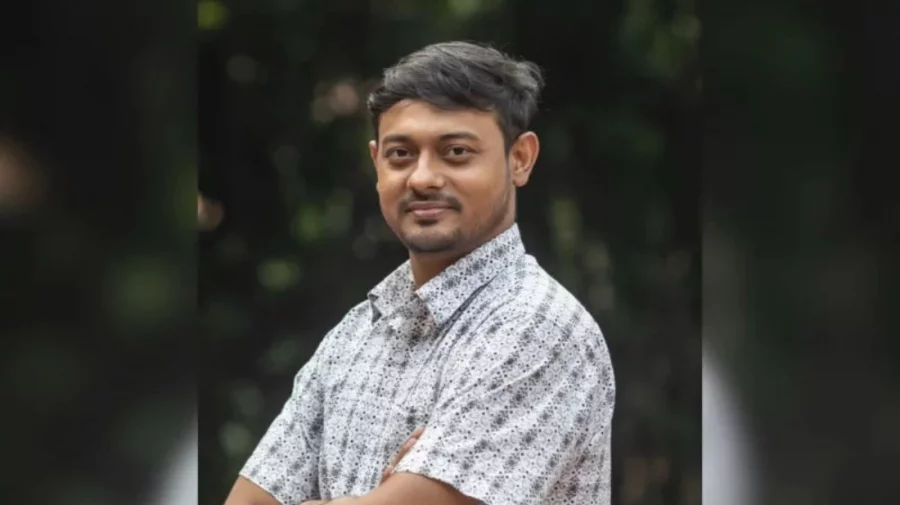

Dhaka, March 23 (Dhaka Tribune) – Sarjis Alam, the chief organizer (Northern Region) of the National Citizen Party (NCP), has posted on Facebook providing clarification about a recent post by Hasnat Abdullah, the party’s chief organizer for the southern region, regarding the military.
On Sunday, he shared this post from his verified Facebook account.
In his post, Sarjis wrote: “On March 11, Hasnat and I went to meet the army chief. Another key member of our team was also supposed to accompany us. However, due to personal reasons at the last moment, he could not join.”
He clarified that they were not summoned to the cantonment but had been exchanging messages with the army chief’s military adviser whenever necessary.
Referring to the army chief’s speech on the anniversary of the Pilkhana massacre, Sarjis said: “The army chief gave a rather strong statement on the Pilkhana massacre anniversary and said, ‘enough is enough.’ I asked his military adviser whether they perceived anything undesirable. The army chief’s speech seemed relatively straightforward and harsh. He asked me, ‘Do you want to talk about this directly?’ I replied, ‘It can be discussed.’ After that, we had our meeting with the army chief.
“Inside the Sena Bhaban, in that room, there were only three of us—the army chief, Hasnat, and me,” Sarjis added.
Regarding the army chief’s statement, Sarjis said: “As individuals, people observe and interpret someone’s opinions in different ways. Hasnat perceived and received the army chief’s remarks in a certain way and wrote about it on Facebook. However, I somewhat disagree with his interpretation. From my perspective, I do not see that day’s statement as a direct proposal but rather as a direct expression of opinion.”
He noted a distinction between expressing an opinion and making a proposal, adding that, compared to previous interactions, the army chief was much more straightforward that day.
He further clarified that while Hasnat’s post suggested that pressure was being exerted to form a “refined Awami League,” he did not interpret it that way.
“Regarding the claim of pressure for a refined Awami League, I did not get the impression that there was actual pressure. Rather, the army chief said with great confidence that if a refined Awami League did not emerge, there would be long-term issues in the country’s political landscape,” Sarjis said.
He acknowledged that their discussion covered topics such as a refined Awami League, Saber Hossain, Shirin Sharmin Chaudhury, and Sohel Taj.
“There were discussions about whether Awami League would return, what would happen if they participated in this election or if they did not when they could return if they sat out, or whether they would return at all. The potential impact on the country, the levels of stability or instability—these issues were discussed,” he said.
However, Sarjis believed that Hasnat’s Facebook post exaggerated the tone of the conversation, making it appear more extreme than it was.
“While it was undoubtedly more straightforward and self-confident than other discussions, it was not as extreme as the post suggested. The direct opinion was that the participation of a refined Awami League in the election was necessary for national stability,” Sarjis added.
Regarding a particular exchange highlighted by Hasnat—where Hasnat questioned how a party that had neither apologized nor admitted its wrongdoings could be forgiven and received an angry response from the army chief—Sarjis acknowledged that the conversation did take place.
“However, it occurred not inside the room where we were seated, but rather when the army chief was leaving the room. As he walked out, we continued talking, and just before we left in our car, during the farewell moment, this exchange took place.”
However, Sarjis said that the army chief’s response was not given in anger but rather in the tone of a senior addressing juniors with the weight of experience.
Sarjis emphasized that it was not appropriate to frame the situation as a confrontation between the army and the National Citizen Party or the general public.
He said: “I do not support the Hasnat vs Waker narrative or slogan. Hasnat has his own position, and General Waker-Uz-Zaman, has his own. It is neither relevant nor appropriate to pit the Bangladesh Army against the National Citizen Party, other political groups, or the public.”
He also dismissed speculation about the army chief’s resignation, clarifying that their party had not raised such a demand.
Expressing his personal opinion, Sarjis remarked: “During the tenure of an interim government, various political parties maintain some level of communication with the Bangladesh Army, and this privacy is upheld. Even if we strongly disagreed with what the army chief said, we could have discussed it extensively in our party forum, made a decision, and executed our program accordingly. We could have engaged in joint discussions with other political parties to reach a consensus and then taken to the streets against any version of Awami League.
“But the way these matters were posted on Facebook did not seem appropriate to me. This could lead to a trust deficit in our future discussions with any stakeholder,” he added.
Acknowledging his disagreement with Hasnat, Sarjis said: “In my statement, I have disagreed with Hasnat’s position in several areas. Some may criticize me for this. However, I firmly believe that our principles have never been about simply going with the flow. It is because of this principle that we stood in front of Hasina’s regime’s guns.
“Even today, if someone points a gun at Hasnat, we remain committed to standing in front of him. But when I feel the need to critically examine a comrade’s position, I will do so,” Sarjis said.
Sarjis concluded: “It is this conscience that made us stand in the front row on June 6 at Shaheed Minar when a handful of people first protested against the quota system. I believe that this sense of conscience will keep us on the right path. It is this mentality of self-criticism that will lead us to our desired destination.
“Our struggle against the return of any version of Awami League—the perpetrators of the July genocide, the BDR massacre, and the Shapla Chattar killings—in Bangladesh’s politics will continue.”
END
Nasiruddin clarifies army meeting was not on NCP’s behalf
‘NCP only learned about the meeting between the army and Hasnat and Sarjis after it happened’
National Citizen Party (NCP) Chief Coordinator Nasiruddin Patwari clarified that the meeting between Bangladesh Army Chief General Waker-Uz-Zaman and NCP leaders Hasnat Abdullah and Sarjis Alam was not held on behalf of the party.
NCP learned about the meeting between the army and Hasnat and Sarjis after it happened,” he said while speaking at a press conference at the NCP office in Dhaka’s Banglamotor on Sunday.
The clarification follows a Facebook post earlier on Sunday by Sarjis, NCP’s chief organizer (North), in which he expressed some disagreements with comments made by Hasnat, the NCP chief organizer (South), about their March 11 meeting with General Waker-uz-Zaman.
In his post last Friday, Hasnat claimed that during the meeting at the Dhaka Cantonment, he and two other NCP leaders were presented with a plan to rehabilitate the ousted Awami League.
He alleged that they were offered seat sharing in exchange for accepting a proposal to bring back a “refined Awami League,” which he claimed was “entirely India’s plan.”
Sarjis, however, disputed this interpretation, saying that the “Refined Awami League” was merely an opinion, not a proposal from the army chief.
“The way Hasnat observed and received the army chief’s statement that day and wrote about it on Facebook differs somewhat from my perspective,” Sarjis said.
He added: “The way Hasnat’s Facebook post portrayed the tone, I personally feel that the conversation was not that extreme.”
Nasiruddin responded to the controversy, saying: “Such remarks made without the consent of the other party are unwelcome. That meeting did not take place on behalf of the National Citizen Party.”
He further confirmed that while the party was informed about the meeting afterward, no official discussion had taken place at the party level yet. “An official statement will be issued by the party after our discussion on Sunday night,” he added.
Nasiruddin urged the public to show forgiveness for the mistakes made by the party’s leaders and assured saying: “No division or discord within the NCP has developed over this incident.”
He also emphasized that the leaders’ involvement in politics is separate from their previous activism. “The students who led the mass uprising are now transitioning from activism to politics. Therefore, we urge the nation to view the mistakes during this period with tolerance and understanding,” he said.
On the issue of the NCP’s reputation, Nasiruddin added: “People have high expectations of the NCP, and we will continue to work to meet those expectations.”
This comes after a report by Netra News in which the Bangladesh Army denied Hasnat’s allegations. The army clarified that while General Waker did meet Hasnat and Sarjis on March 11, they dismissed Hasnat’s claims as “hilarious and an immature array of stories.”
The army further described Hasnat’s post as “nothing but a complete political stunt.”
https://www.dhakatribune.com/377043
END
