
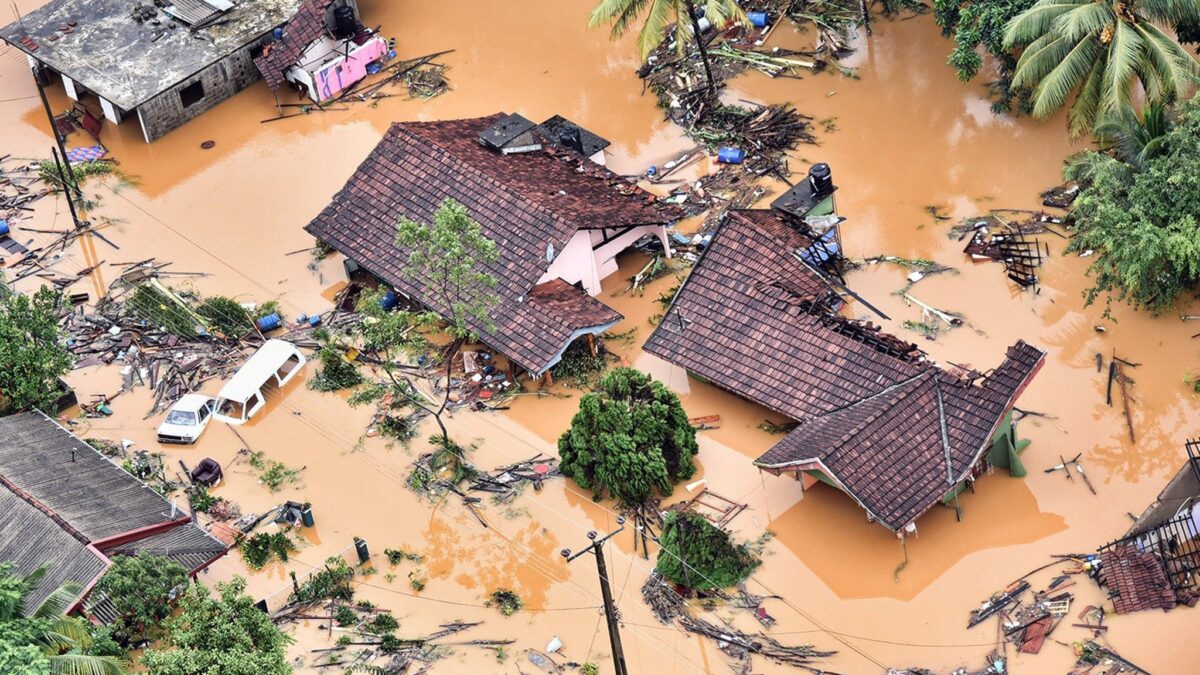


By P.K.Balachandran/Daily Mirror
Colombo, December 18 – The devastation caused by Cyclone “Ditwah” in Sri Lanka cannot be understood in its entirety unless it is seen in the light of economic inequality in the country and indeed in the comity of nations.
Over half of the people in the flooded areas were living in households already facing multiple vulnerabilities before the cyclone, including unstable income, high debt, and limited ability to cope with disasters, UNDP said in a report.
Hydrologists estimate that nearly 13 billion cubic metres of water fell on a single day on November 28, equivalent to about 10% of Sri Lanka’s annual rainfall. Floodwaters from the cyclone inundated more than 1.1 million hectares – almost 20% of the country’s land area. Over 576,626 families and 2,054,535 individuals were affected, with 627 deaths and 190 missing persons reported.
More than 4,517 houses were destroyed, and 76,066 were partially damaged. About 956 relief centres were set up, to shelter 27,663 families and 89,857 individuals. Over 16,000 km of roads, enough to circle the island’s coastline more than twelve times, were flooded as were 278 km of railway tracks.
The devastation caused by climate change is closely linked to economic inequality, says World Inequality Lab (WIL) in its latest report. The cumulative consequences of extreme climate events are becoming increasingly visible, affecting livelihoods, infrastructure, and economic stability worldwide. And the climate crisis is unfolding in a world marked by profound economic inequality and highly concentrated wealth, the report points out. And climate change is advancing at a pace that far exceeds early projections. Funds for climate change mitigation are drying up.
Inequality as a Factor
Global emissions cause climate change triggering disasters like cyclones. The WIL report points out that wealthy individuals not only contribute disproportionately to global emissions but are also better shielded from the damages of climate shocks than the poor.
Wealthier persons and nations hold financial, corporate, and political power to shape the pace and direction of the climate transition, the report points out.
Inequality is both gross and universal. The richest 10% of the global population own close to three-quarters of all wealth, while the poorest half barely 2%. Fewer than 60,000 multi-millionaires now control three times more wealth than half of humanity combined. Some 56,000 billionaires and centi-millionaires control the fate of the 8 billion human beings who inhabit this planet.
“The top 0.1% earn as much as the entire bottom 50%. This means that a group of people no larger than the population of Singapore takes in the same income as half of the world’s population,” the report says.
Inequality is Growing
The wealthiest 0.001% have seen their share of the world’s wealth grow from 4% to 6% since 1995, while the bottom half of the world’s population controls only 2%. Multimillionaires have increased their wealth by approximately 8% each year over the past three decades, nearly twice the rate of the bottom half of the population.
“This is an extraordinary accumulation at the very top. The result is a world in which a tiny minority commands unprecedented financial power, while billions remain excluded from even basic economic stability,” the report says.
Transfer of Resources from Poor to Rich
Poorer nations are compelled to transfer resources outward to the developed world via debt service, profit repatriation, and financial flows. They are forced to do so because of their inability to invest in education, healthcare and infrastructure.
“It is a staggering fact that these outflows from the poorer countries to the rich countries amount to approximately three times more than development aid flowing in the opposite direction,” the report says.
Also, at the global level, a person in the top 1% income group emits, on an average, around seventy-five times more carbon per year than someone in the bottom 50%.
Nations are Steeped in Inequality
In the world as a whole, as well as within countries, the rich are getting richer and the poor are getting poorer. In nearly every region of the world, the top 1% is wealthier than the bottom 90% combined.
In Bangladesh, the top 10% of earners receive about 41% of national income, while the bottom 50% take only 19%. Wealth is more unevenly distributed, with the richest 10% holding around 58% of total wealth and the top 1% nearly one quarter. Female labour participation remains low at 22.3%, indicating persistent gender disparities in economic activity.
In Pakistan, inequality remains high and shows limited progress over the past decade. The top 10% of earners capture 42% of total income, whereas the bottom 50% receive only 19%. Wealth inequality is even more concentrated, with the richest 10% holding 59% of total wealth and the top 1% accounting for 24%. Female labour participation fell from 9.8% to 8.5%, indicating a decline in gender inclusion.
In India, inequality remains among the highest in the world and has shown little movement in recent years. The top 10% of earners capture about 58% of national income, while the bottom 50% receive only 15%. Wealth inequality is even greater, with the richest 10% holding around 65% of total wealth and the top 1% about 40%. Female labour participation remains very low at 15.7%, showing no improvement over the past decade. Overall, inequality in India remains deeply entrenched across income, wealth, and gender dimensions, highlighting persistent structural divides within the country.
In China, inequality remains high but has levelled off after decades of sharp increases. The top 10% of earners capture about 43% of national income, while the bottom 50% receive just 14%. Wealth disparities are particularly large, with the richest 10% holding nearly 68% of total wealth and the top 1% about 30%. Female labour force participation rate in China is 34.6%, showing no significant improvement. After years of widening divides, inequality in China now appears to have reached a plateau, though at a high level by global standards.
In Russia, inequality remains very high and has increased further over the past decade. The top 10% of earners receive 51% of total income, while the bottom 50% account for only 16%. Wealth concentration is even more pronounced: the richest 10% hold 75% of total wealth, and the top 1% alone holds 47%. Female labour participation increased slightly from 40% to 42%. Overall, both income and wealth are highly concentrated in Russia, with inequality continuing to rise.
In the United Kingdom, inequality is moderate and has remained relatively stable over the past decade. The top 10% of earners receive 36% of total income, while the bottom 50% account for 21%. Wealth concentration is higher, with the richest 10% holding 57% of total wealth and the top 1% holding 21%. Female labour participation increased from 37.7% to 38.9% over the same period. Overall, the United Kingdom displays stable income distribution patterns, though wealth remains concentrated among the top groups.
In the United States, inequality remains high and has shown little change over the past decade. The top 10% of earners receive 47% of total income, while the bottom 50% account for only 13%. Wealth inequality is even more concentrated, with the richest 10% holding 70% of total wealth and the top 1% alone holding 35%. Female labour participation increased from 37.4% to 39.7% over this period. Overall, income and wealth in the United States remain highly concentrated among the top groups, with persistent disparities across inequality dimensions.
Can the Gap be Reduced?
The inequality gap has to be reduced, and it can be. Inequality is not natural but is a political choice, WIL says. Underrepresentation of workers, and the outsized influence of wealth in individual countries and in the comity of nations work against reform.
But that can change. There are a range of policies that, in different ways, have proven effective in narrowing gaps.
“One important avenue is through public investments in education and health. These are among the most powerful equalizers, yet access to these basic services remains uneven and stratified. Public investment in free, high-quality schools, universal healthcare, childcare, and nutrition programs can reduce early-life disparities and foster lifelong learning opportunities.”
“By ensuring that talent and effort, rather than background, determine life chances, such investments build more inclusive and resilient societies,” WIL argues.
Another path is through redistributive programs. Cash transfers, pensions, unemployment benefits, and targeted support for vulnerable households can directly shift resources from the top to the bottom of the distribution. Where well-designed, such measures have narrowed gaps, WIL points out.
END
