
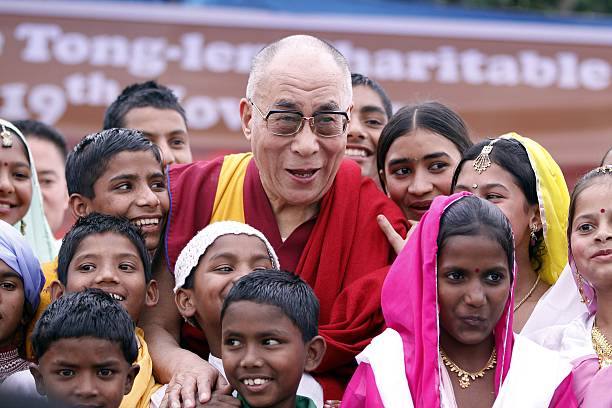

By P.K. Balachandran/Daily News
Colombo, July 15 – The ongoing dispute between China and the Tibetan refugees in India over selecting the next Dalai Lama threatens to further exacerbate tension between India and China.
With China rejecting the Tibetans’ contentions on the succession issue, India is dragged into the conflict in a throwback to 1959 when the Dalai Lama sought refuge in India after China took over Tibet, an event which triggered a Sino-Indian standoff that continues to this day.
Ever since the current, 14 th.,Dalai Lama, Tenzin Gyatso, turned 90 in early July, his followers, many of whom are Tibetan refugees in India, are discussing the issue of succession amid China’s assertion that only the Chinese government can determine the succession procedure and give official sanction to the successor. The Dalai Lama and the Tibetan Diaspora categorically reject China’s claims as they do not accept Beijing’s authority, least of all spiritual authority, over Tibet.
India is not directly involved, but faces entanglement nonetheless. Since 1959, India has hosted the Dalai Lama and his followers but under the condition that they refrain from anti-China activities. But despite the Indian injunction, the Dalai Lama, Tenzin Gyatso, became a global political figure, as a symbol of resistance to the Chinese. And to one’s surprise, he received the Nobel Peace Prize in 1989 with US backing.
As the Dalai Lama is alive and has the backing of the powerful West, Beijing has not been able to fully control the mind set of Tibetans, for many of whom, the Dalai Lama has both spiritual and temporal legitimacy. But his death would give Beijing an opportunity to secure full control of Tibet, if the next Dalai Lama is their man, someone who they had chosen and given official sanction. Hence the criticality of the succession issue for China.
Succession Process
The current Dalai Lama insists that his successor or his “reincarnation” must come from outside China. According to him, the “Gaden Phodrang Trust” which he had set up in India, has sole authority in this matter.
In the Tibetan tradition, as interpreted by the Dalai Lama, the search for a successor begins after the incumbent’s death, guided by signs like the direction of the funeral pyre smoke, oracles’ visions, and holy sites such as Tibet’s Lhamo Latso lake. A committee of high-ranking Lamas identifies young boys born near the time of the previous Dalai Lama’s passing and subjects them to tests to confirm their identity. Thereafter, the chosen child undergoes rigorous training in Buddhist philosophy and leadership.
But China, which controls Tibet, demands that the successor be China-born and be chosen through the “golden urn” method, used during the Qing dynasty (1644-1912). Senior Lamas pick a name from a bunch of names kept in an urn. The Chinese Foreign Ministry spokesperson Ms.Mao Ning emphasized that this process, along with Beijing’s approval, is mandatory. China deems any exile-appointed Dalai Lama “illegitimate.”
But the present Dalai Lama considers the “golden urn” as lacking in “spiritual legitimacy”. He also points out that this method was not used for the 9th, 13th, or his own selection.
India’s Minister for Minorities, Kiren Rijiju, a Buddhist, reinforced the Tibetan stance, stating that the Dalai Lama alone can decide his successor. More recently, the Chief Minister of the Indian State of Arunachal Pradesh, Pema Khandu, added to the controversy by asserting that his State’s borders were with “Tibet and not China”. This contradicted India’s official policy of accepting Tibet as part of China. However, the Indian Ministry of External Affairs promptly stepped in and distanced itself from Khandu’s assertion. Be that as it may, the succession issue will add to existing Sino-Indian tensions over the border.
Historical Tensions
Sino-Tibetan and Sino-Indian tensions are not new. According to historian Kallie Szczepanski of Boston University, tension has marked Sino-Tibetan relations periodically over 1,500 years. And Sino-Indian relations have been troubled since 1959.
In 692 CE, China reclaimed its western territories from Tibetan control. But in 763 CE, Tibet seized the Tang capital, Chang’an. In the 13th century, Tibet paid tribute to the Mongol Yuan Empire until the latter’s fall in 1368. It refused to pay tribute to the successor Ming dynasty (1368 to 1644).
The Qing dynasty (1644–1912) saw Sino-Tibetan relations varying from time to time. In 1653, the Dalai Lama visited Emperor Shunzhi but not as a vassal. It was a respectful “priest-patron” relationship with the Dalai Lama being the “priest” and the Qing Emperor being the “patron”. But when a Qing Commissioner was killed in Tibet in 1750, China sent troops to quell the rebellion.
In 1893 the Dalai Lama rejected a border treaty which the British in India had suggested. The British invaded Tibet in 1903 and acquired partial control over its affairs. However, in 1904, the 13th Dalai Lama, Thubten Gyatso, sought refuge in India when China claimed sovereignty over Tibet and threatened to invade. He returned to Lhasa in 1909 but only to flee again in 1910, when confronted by Chinese troops.
The 1911 the anti-monarchical revolution in China enabled Tibet to expel the Chinese forces. Dalai Lama Thubten Gyatso then openly declared that Tibet is an “independent nation.”
At the 1914 Simla Convention involving Tibet, British India and China, China’s control over “Inner Tibet” (now the Qinghai province of China) was recognized and “Outer Tibet” was recognised as Tibet’s. But China refused to sign the agreement. It objected to the British claim over “South Tibet,” which is now India’s Arunachal Pradesh State.
China still claims Arunachal Pradesh. The McMahon Line which the British said was the border between India and Tibet was also not acceptable to China. Later, in 1962, it went to war with India on this issue.
In 1972, India declared the disputed North Eastern Frontier Agency (NEFA) as a Union Territory and in 1987, NEFA was made a full-fledged Indian State and named Arunachal Pradesh. Later, China responded by giving Chinese names to 92 places in Arunachal Pradesh or “South Tibet” as it says.
In order to make peace with China and settle the border dispute, the Narasimha Rao-led Indian government began to refer to the McMahon Line as the Line of Actual Control which is a military term for an unsettled border. The A.B.Vajpayee government recognized the “Tibet Autonomous Region” as part of China. Meanwhile China tightened its control over Tibet and also constituted a separate military command for Xinjiang and Tibet calling it Western Theatre Command.
For China, the concept of “One China” does not allude only to Taiwan. It includes Tibet too. Therefore, Beijing could be expected to view any development that challenges its sovereignty over Tibet, including any challenge to its control over the institution of the Dalai Lama, as a violation of the “One China” principle. India is thus called upon to perform a delicate balancing act. Recognizing a China-appointed Dalai Lama risks alienating Tibetan refugees and Indian political sentiment, while supporting a successor chosen by Tibetan exiles could escalate tensions with China.
Asked by Karan Thapar of The Wire if China would make an issue of India’s stance on the Dalai Lama’s successor, a former Indian Ambassador to China, Shivshankar Menon, said that China would be guided by its interests. To illustrate it, he related an incident which occurred in the late 1960s. When an Indian Communist party delegation met Chairman Mao and asked him if the Sino-Indian border dispute had anything to do with India’s giving refuge to the Dalai Lama, Mao said: “It is better that he is in India rather than in imperialist US!” At that time, it was in China’s interest that the Dalai Lama was in India and not in the West.
But the view today may be different given the fact that the time has come for choosing the next Dalai Lama and asserting China’s hold on Tibet.
END
