

By Veeragathy Thanabalasingham
Colombo, December 8 – The worst natural disaster Sri Lanka faced in recent history was the December 2004 Tsunami. The next major disaster that struck the country was the Ditwah cyclone and the severe floods and landslides that it triggered.
It may take weeks before we know the full details of the death and destruction of property. It is reported that more than 600 people have died so far. The exact number of missing may never be known, as some villages in the central hill country were completely buried under the mud.
The 2004 tsunami killed more than 40,000 Sri Lankans, but it only affected coastal areas. However, the Ditwah cyclone has wreaked havoc across the country. The plight of families perched on the rooftops of their flooded houses to save their lives was a stark reminder of the gravity of the situation.
The assessment, based on data and inputs from many local and international NGOs said as of December 1, at least 80 roads and 15 bridges were damaged, nearly 3 lakh buildings were inundated and over 65,000 power outages and telecom failures were reported. Health services in all 25 districts were affected.
The destruction of crops in the main agricultural regions is going to create unprecedented food insecurity. The prices of vegetables have risen sharply. Prices of essential commodities will continue to rise. People who depend on agriculture for their livelihood are at risk of being thrown into severe debt and poverty.
According to the data released by the Disaster Management Centre (DMC) on Sunday, 20,82,195 people from 5,86,000 families have been affected. A total of 4,164 houses were completely damaged and 67,505 houses partially damaged. More details will be revealed in the coming days as the rescue operations continue.
The newly appointed Commissioner General of Essential Services Prabath Chandrakirti said the economic loss from Cyclone Ditwah is estimated to be around US$ 600- US$ 7 billion, three times more than the economic loss from the Tsunami. The complete economic loss will be assessed soon to formulate a post-disaster economic recovery plan, he added.
Sri Lanka is bracing for a period of severe crisis. The relative economic stability resulting from the IMF-assisted restructuring measures following the 2022 economic downturn has been shaken.
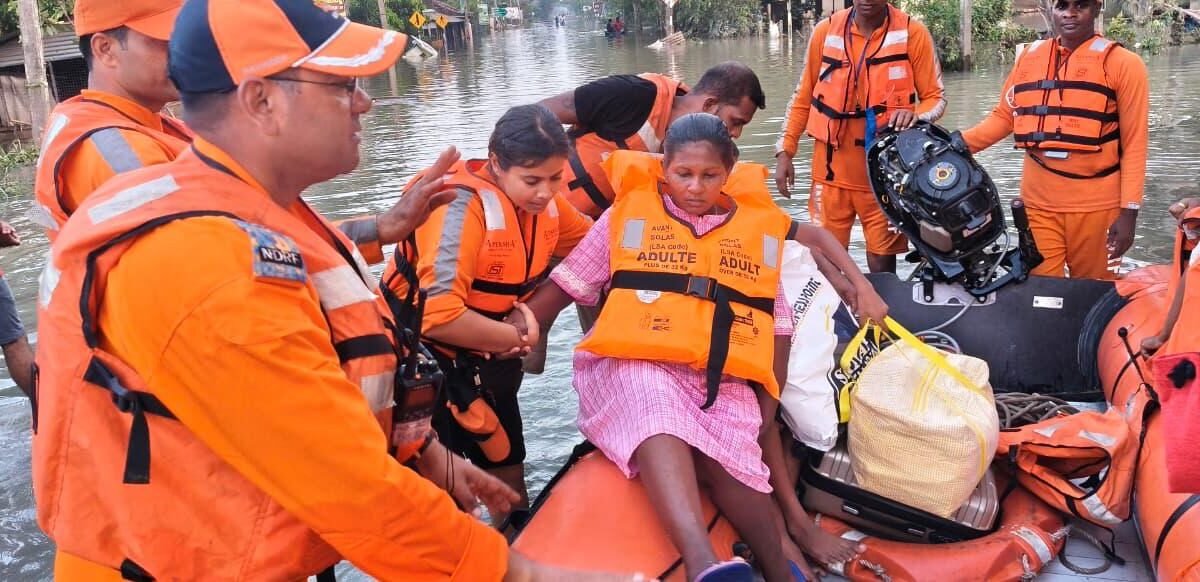
The international community continues to offer emergency assistance. The United States, European Union, Arab States and Asian countries are providing emergency assistance. In line with Prime Minister Narendra Modi’s policy of ‘ Neighbourhood First’ and the tradition of being the First Responder whenever there is a disaster in Sri Lanka, India has now launched a massive rescue and relief operation called ‘ Friend Across the Ocean ‘ (Sagar Bandhu).
President Anura Kumara Dissanayake has announced a substantial amount of compensation as an emergency relief to the affected people. But the government has come under severe criticism for not taking the necessary precaution to mitigate the effects of the cyclone despite warnings about the coming cyclone.
In a private TV program on November 12, the Director General of the Department of Meteorology Athula Karunanayake warned of the natural disaster that Sri Lanka was about to face. The program which focused exclusively on climate, was also attended by retired Major General Sampath Kottuwegoda, Director General of the DMC and Imaya Aryaratne, an expert from the National Building Research Institute.
The Department of Meteorology which comes under the Ministry of Defence works closely with the DMC and the President is the Minister of Defence. The question arises as to why the Department of Meteorology and the DMC did not bring the natural disaster risk to the attention of the President officially well in advance.
The American Weather Agency and the BBC both warned on November 12 that a cyclone could affect Sri Lanka, while Al-Jazeera issued a similar prediction on November 14. However, the Department of Meteorology and the Geological Research and Mines Bureau issued red alerts only on November 26.
After the cyclone struck and all the damage had occured, a disaster committee was appointed. It was only when deaths were reported that a circular was issued on November 28 instructing divisional secretaries to work. A disaster management director was appointed in the evening of 29th.
A natural disaster cannot be prevented, but the dangers that arise from it can be controlled. For that a basic preparedness plan is essential. There was more than ample time, yet the government did not take action. The President declared an emergency only after the leader of the opposition insisted on it in parliament.
Another important question is why, despite the warnings, the government was not alerted to the impending danger by the opposition parties, who blame the government for failure to take pre-emptive measures.
When the country was flooded, opposition leader Sajith Premadasa asked the government to hand over power to him if the government could not handle the situation. He urged the government to withdraw the 2026 budget, which had been debated and passed in parliament over the past month, and present a new one. The IMF’s current program could no longer be implemented, he argued.
Meanwhile, Sri Lanka Podujana Peramuna (SLPP) national organiser and parliamentarian Namal Rajapaksa asked the Speaker to appoint a special parliamentary select committee to investigate allegations that the government failed to take precautionary measures against the cyclone.
Addressing parliament on the final day of the budget debate, Sri Lanka Muslim Congress (SLMC ) leader Rauff Hakeem called on the government to seek the advice of former Presidents on how to get assistance from the international community and formulate plans to rescue the country from the effects of the natural disaster.
One is at a loss to understand on what basis Hakeem is advising the government to consult them when there is no precedent of any of our former Presidents taking concrete steps to mitigate the consequences of previous natural disasters.
A former President faced a court case alleging that he deposited funds received from abroad to provide relief to Tsunami victims in his bank account. It would be pertinent to recall at this juncture that a former Chief Justice, who had discharged him from the case, had publicly apologised at a later stage for the judgement he had delivered.
Another former President is still being blamed for not taking adequate security measures to prevent the Easter Sunday bombings which killed more than 250 people, despite receiving advance intelligence warnings from foreign countries. His successor was forced to flee the country following a popular uprising against misrule and economic collapse. So much for the capability of our former Presidents
United National Party (UNP ) leader and former President Ranil Wickremasinghe, has said legal action could be taken against executive action, or inaction that violates the fundamental rights of citizens, arguing that the failure to act by the President, the Prime Minister and the cabinet to avert the recent floods is a violation of the constitution which guarantees the right to life of the people.
According to his argument, legal action can be taken against all former Presidents and Prime Ministers of Sri Lanka.
It is noteworthy that the announcement from the leaders of the opposition parties to cooperate in rescuing the country from the crisis is based on the belief that the leaders of the NPP Government have no experience in governance.
The opposition parties should cooperate fully to rescue the people of the country from the crisis rather than float in the illusion that the people will throw out the government any time soon.
Mean while, the government is receiving far more support and assistance from the international community than opposition leaders expected. The International Monetary Fund (IMF) has announced that it will explore providing additional support beyond the existing agreement. Several international organizations have also pledged to help.
Recovering from the effects of the natural disaster and rebuilding the economy is not going to be easy. On the economic front, nature’s fury has compounded the existing challenges for the government.
Cyclone Ditwah has once again demonstrated the enormous threat that climate change poses to Sri Lanka’s socio-economic development. Floods and mudslides this time around have reminded us that Sri Lanka continues to be vulnerable to unexpected climatic events.
Successive droughts and floods that have hit us regularly in recent years are a stark reminder of the fact that Sri Lanka is one of the countries most vulnerable to climate change. There is no point in giving advice after a disaster has occured. It is easy to be wise after events. Today’s situation warrants commitment and cooperation from all stakeholders to rescue the country from the abyss it has fallen.
END
